Bitcoin was the first cryptocurrency, and for several years it was effectively the only one that mattered. Today there are tens of thousands of others. Every cryptocurrency that is not Bitcoin is loosely grouped under one label: altcoins, short for alternative coins. If you have ever wondered what are altcoins beyond a blur of tickers and logos, this guide gives you a clear map. Some altcoins are serious infrastructure projects with thousands of developers. Some are community experiments. A great many are, frankly, worthless tokens created in an afternoon. Understanding the main categories, why they exist, and how their risk profile differs from Bitcoin and Ethereum is essential before any of them tempts you. The honest summary is this: altcoins are where crypto’s experimentation happens, and also where most of its losses happen.
What Counts as an Altcoin?
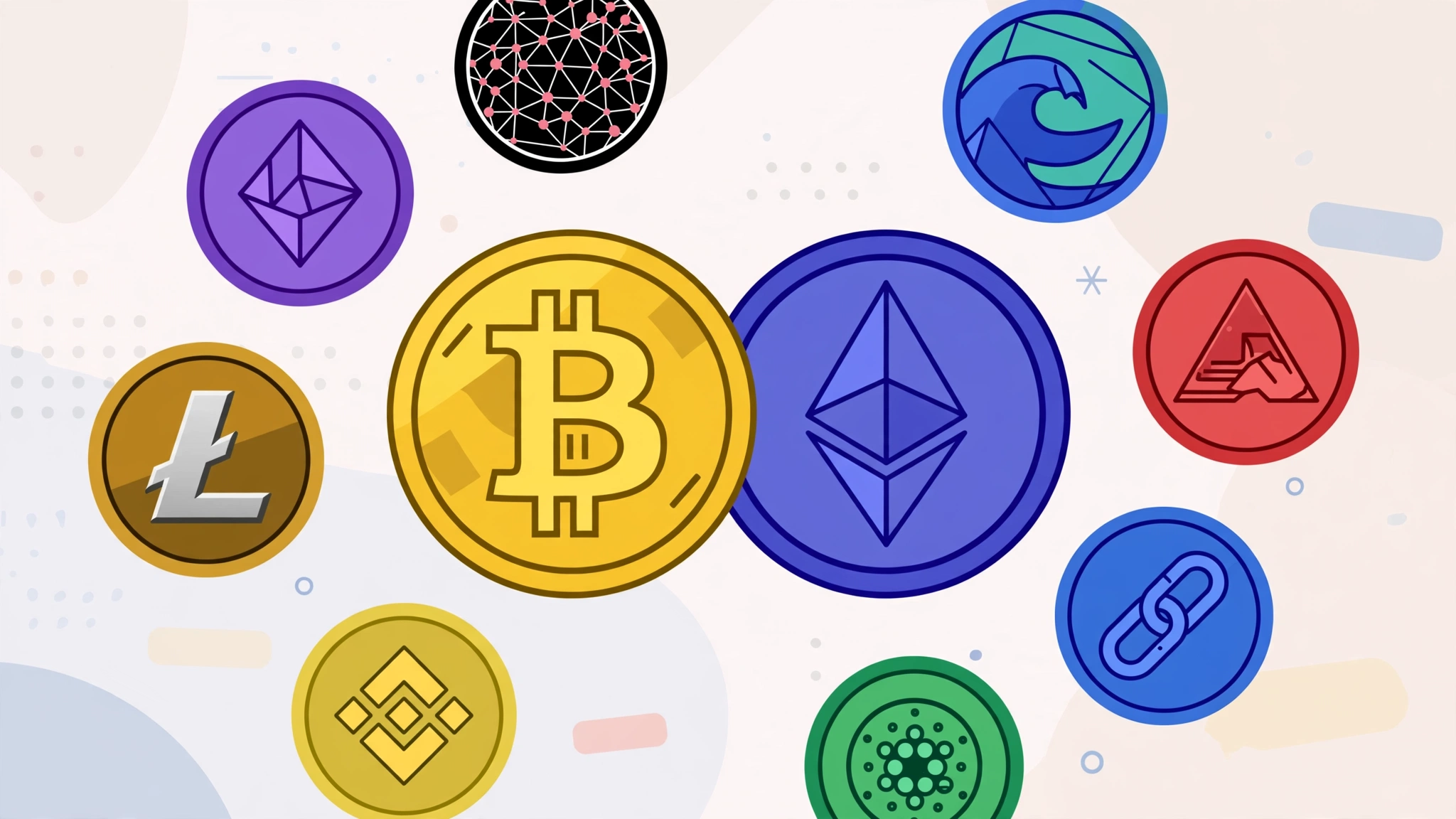
The definition is simple: any cryptocurrency other than Bitcoin. Under the strictest original usage, even Ethereum is an altcoin, although today people usually discuss Bitcoin and Ethereum as the market’s two anchors and reserve “altcoin” for everything else. Altcoins live either on their own blockchains, like Solana, Cardano or XRP, or as tokens issued on top of another chain, most commonly Ethereum. That second group is enormous: anyone can create a token in minutes using standard templates, which explains both the creativity and the flood of junk in this market.
Market share tells the story of concentration. Bitcoin alone has often represented more than half of the entire crypto market’s value, and Bitcoin plus Ethereum together typically account for around two thirds or more. The remaining thousands of altcoins fight over the rest. This matters practically: liquidity, media attention and developer talent cluster at the top, while the long tail of small coins can be nearly impossible to sell at a fair price.
The Main Types of Altcoins
Platform and Smart Contract Coins
These are the native assets of blockchains that compete with or complement Ethereum: networks designed to run applications, usually promising faster transactions or lower fees. Examples include Solana, Cardano, Avalanche and Polkadot. Their value proposition is infrastructure: if developers and users adopt the network, demand for its coin grows, because the coin pays for transactions and often secures the network through staking. The risk is equally clear: infrastructure is a brutal contest, and yesterday’s celebrated platform can fade quickly when a faster rival appears or a serious outage or exploit damages trust.
Stablecoins
Stablecoins are tokens designed to hold a steady value, usually one US dollar, backed by reserves of cash and government bonds or, in riskier designs, by algorithms and crypto collateral. They are technically altcoins but behave nothing like the rest: people use them to park money inside crypto markets, move value between exchanges cheaply, and make payments without volatility. Their risks are different too, centred on the issuer’s reserves and regulation rather than price swings, although history includes a major algorithmic stablecoin that collapsed entirely in 2022, wiping out billions.
Utility and Application Tokens
Thousands of tokens exist to power a specific application: a game’s currency, a decentralised exchange’s governance token, a data network’s payment unit. Some grant voting rights over the project’s future; others are required to use the service; many, honestly, grant very little at all and exist mainly because launching a token is a fundraising method. Evaluating these means asking an unfashionable question: does holding this token actually entitle me to anything, cash flows, fees, access, or is my only hope that someone else pays more later?
Memecoins
Memecoins are tokens built around jokes, mascots and internet culture, with no underlying product or revenue. Dogecoin, created in 2013 as a parody, is the famous survivor; thousands of imitators launch weekly. Prices are driven purely by attention and momentum, which produces spectacular rises and equally spectacular collapses. Treat memecoins as entertainment gambling at best. Anyone presenting them as investments is misleading you.
Privacy Coins and Niche Networks
A smaller category focuses on specific functions: privacy coins that hide transaction details, coins designed for particular industries, and older payment networks. These often have loyal communities and genuine technical ideas, but they face regulatory pressure, delistings from exchanges, and thin markets that magnify every risk discussed in this article.
Why Do Altcoins Exist at All?
Partly, innovation. Bitcoin deliberately changes slowly, so experimentation with faster consensus, new programming models and novel applications naturally happens elsewhere. Ethereum itself began as an altcoin with an idea Bitcoin would not adopt. Partly, economics: creating a token is a way for projects to raise funds and reward early contributors without traditional venture capital. And partly, speculation: a new coin with a tiny market value can multiply dramatically on modest buying, which attracts gamblers and promoters. All three motives coexist in every market cycle, and the proportions matter. In euphoric periods, the third motive dominates, thousands of low-quality tokens launch, and most later go to zero.
How Altcoin Risk Differs From Bitcoin and Ethereum
- Liquidity risk: small coins may show a price on screen that you cannot actually sell meaningful amounts at, because there are too few buyers.
- Concentration risk: teams and early insiders often hold large shares of supply, and their selling, or the unlocking of vested tokens on a schedule, can crush the price.
- Survival risk: most altcoins from previous cycles never regained their peaks; many became completely inactive projects with abandoned code.
- Scam risk: fake tokens impersonating real ones, rigged contracts that prevent selling, and paid promotions are concentrated in the small-cap end of the market.
- Volatility: moves of 30 percent in a day are unremarkable for small altcoins, in both directions.
None of this means every altcoin is a scam; the sector contains real engineering and a few durable networks. It means the burden of proof flips. With the largest assets, the question is whether crypto itself endures. With a small altcoin, you must also be right about that specific team, technology, token design and market timing. Beginners building foundations should read our guide to investing for beginners for the general principles of position sizing and diversification before venturing down the risk curve in any market.
Sensible Questions Before Buying Any Altcoin
If, after understanding the risks, you still want to research an altcoin, work through a checklist. What problem does it solve, and who actually uses it today, measured by real activity rather than follower counts? Who holds the supply, and when do locked tokens unlock? Is the code active and audited, and has the network suffered outages or exploits? Where does the token’s value come from, concretely? How large is its market, and could you sell your full position without moving the price? Finally, the most revealing test: could you explain, in two honest sentences to a sceptical friend, why this asset should be worth more in five years? If the answer relies on hype, celebrity tweets or a greater fool, you have your answer.
Altseasons and Market Cycles
You may hear traders talk about “altseason,” a phase in some past cycles when money rotated from Bitcoin into altcoins and smaller assets rose faster. These periods were real, but they were also brief, unpredictable, and followed by collapses in which altcoins typically fell far harder than Bitcoin, often 90 percent or more from their highs. Building a plan around catching such a rotation is market timing in its purest, most failure-prone form. The calmer reading of history is that each cycle’s survivors are fewer than its casualties, and picking them in advance has proven extremely difficult even for professionals.
Coins vs Tokens: A Distinction Worth Knowing
Within the altcoin universe, one technical distinction helps cut through confusion. A coin is the native asset of its own blockchain: ether belongs to Ethereum, solana’s SOL belongs to Solana, and each pays for that network’s transactions and security. A token, by contrast, is created on top of an existing blockchain using a standard template, most famously Ethereum’s ERC-20 standard. Tokens inherit the security of the host chain but depend on it completely, and their creators control important details such as total supply, whether more can be minted, and whether trading can be restricted by the contract.
This is why token due diligence includes checking the contract itself, or relying on reputable tools that do. Some token contracts contain functions letting the creator freeze wallets, mint unlimited new supply, or block selling, features that have been used in outright frauds where buyers discovered they could purchase but never sell. Coins on established independent chains carry different risks, centred on the network’s own security and adoption rather than one team’s contract settings. When a project migrates from a token to its own chain, or vice versa, that is usually a significant event worth understanding before holding through it.
Where to Research Without Drowning in Hype
Start with primary sources: the project’s own documentation and whitepaper, read sceptically, and its public code repositories, where genuine development activity is visible. Market data sites show supply, trading volume across exchanges and holder concentration clues, though all such figures can be gamed. Read critical coverage, not just promotional coverage; searching for a project’s name alongside words like “exploit,” “lawsuit” or “criticism” is a fast way to find what its fans omit. Be especially wary of information that arrives as urgency: countdowns, guaranteed allocations and influencer endorsements are marketing, and in this market, marketing is frequently the product.
Frequently Asked Questions
Is Ethereum an altcoin?
Technically, yes: the term originally meant everything that is not Bitcoin, and Ethereum launched as an alternative project in 2015. In everyday usage today, most people treat Bitcoin and Ethereum as the two established anchors and use “altcoins” for the rest of the market. Either way, the label matters less than understanding what each asset actually does.
How many altcoins are there?
Tens of thousands of tokens exist, and new ones are created daily, because issuing a token on an existing blockchain is cheap and easy. The overwhelming majority have negligible trading activity, no meaningful user base and no realistic future. Only a few hundred have substantial markets, and only a few dozen have large, active ecosystems.
Are altcoins a good investment for beginners?
They are among the riskiest corners of an already high-risk market. Most beginners are better served by learning the fundamentals with the largest, most liquid assets in small amounts, or by not investing at all until they understand the technology and the risks. If you do explore altcoins, tiny position sizes, heavy research and a written reason for buying are the minimum standard.
A Simple Way to Keep Perspective
When the sheer number of altcoins feels overwhelming, remember that you are allowed to ignore almost all of them. Following five assets carefully beats skimming five hundred, and missing a fleeting winner costs you nothing real, while chasing one with serious money can cost a great deal. The market will always offer another exciting ticker tomorrow; your capital, once lost to a careless purchase, does not come back nearly so easily.
The Bottom Line
Altcoins are everything in crypto beyond Bitcoin, from serious rival platforms and dollar-backed stablecoins to application tokens and pure joke coins. They exist because experimentation, fundraising and speculation all thrive in open systems. That openness is genuinely innovative and genuinely dangerous in equal measure: the same low barrier that produced Ethereum also produces thousands of tokens destined for zero. Learn the categories, respect the extra risks of small and illiquid assets, demand concrete answers about supply, utility and users, and never let a soaring chart substitute for that homework.
This article is educational content only and is not financial advice. Cryptocurrency is volatile and high-risk; altcoins are typically riskier still, and you could lose some or all of your money. Always do your own research and consider speaking to a qualified professional before investing.