Crypto prices swing violently. A coin can rise 20 percent in a week and give it all back the next, which makes the question “when should I buy?” feel impossible to answer. One popular response is to stop trying to answer it at all. Dollar cost averaging crypto investors buy a fixed amount at regular intervals, weekly or monthly, regardless of the price, and let time and repetition do the work. Instead of one anxious decision, you make a quiet system. This strategy does not remove risk, and it does not guarantee profits, but for many beginners it replaces emotional guesswork with discipline. This guide explains exactly how dollar-cost averaging works, what the maths looks like in rising and falling markets, where the strategy genuinely helps, where it honestly does not, and how to set up a plan you can actually stick to.
How Dollar-Cost Averaging Works
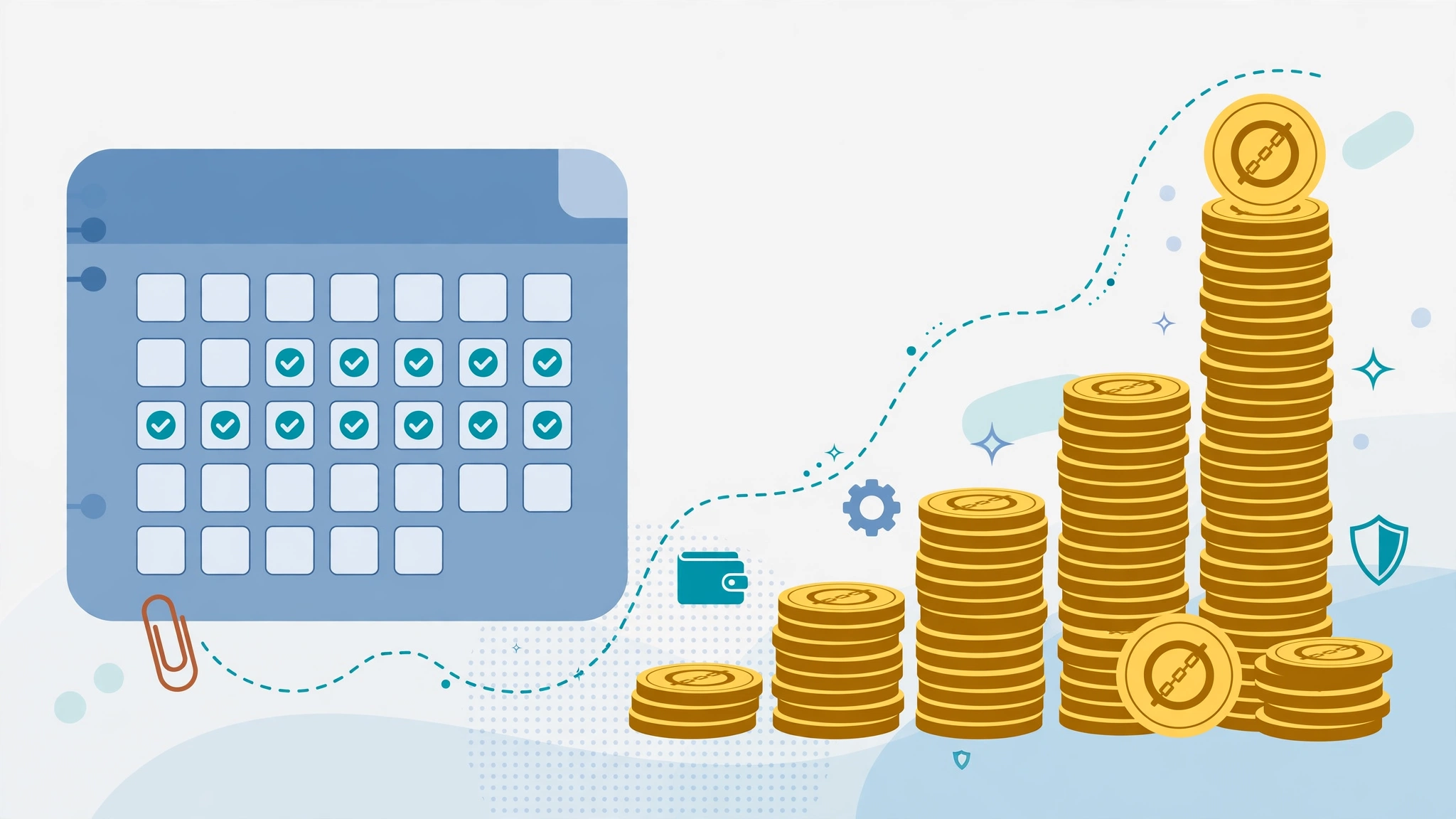
The mechanics are deliberately boring. Choose an amount you can afford, say 50 units of your currency. Choose a schedule, say every Monday, or the day after payday. Buy that fixed amount of your chosen asset on that schedule, at whatever the current price happens to be. That is the entire system. Because the amount of money is fixed, you automatically buy more coins when prices are low and fewer when prices are high. Over time, your average purchase price settles somewhere in the middle of the range the market visited, rather than being hostage to the single day you happened to act.
Most major exchanges offer recurring buy features that automate this completely, debiting your bank or balance on schedule. Automation is a genuine advantage: it removes the weekly temptation to skip a purchase because the news feels scary, or to double it because the news feels euphoric. Both impulses feel rational in the moment, and both quietly sabotage long-term plans.
A Worked Example
Imagine you invest 100 per month for four months into a coin whose price moves like this: 100, then 50, then 25, then back to 100. Your purchases buy 1 coin, then 2, then 4, then 1, for a total of 8 coins costing 400. Your average cost is 50 per coin, even though the average price over the period was about 69. When the price returns to 100, your holding is worth 800. Compare that with investing the whole 400 on day one at 100: you would own 4 coins, worth exactly what you paid. In a market that falls and recovers, spreading purchases helped enormously. Keep reading, though, because the opposite scenario is just as instructive.
Where DCA Helps Most
It Tames Timing Anxiety
The biggest benefit is psychological. New investors often freeze, waiting for a perfect entry that never announces itself, or they pile in at a euphoric peak and panic at the first drop. A schedule removes the decision. You are no longer asking “is today the day?” every time you open an app, and that calm is worth a great deal in a market engineered to provoke emotion.
It Protects Against the Worst Single Mistake
Putting your entire budget in at a local top is the classic beginner disaster. DCA makes that outcome structurally impossible for the averaged portion, because most of your money enters at other prices. You trade away the fantasy of the perfect entry in exchange for never suffering the worst one with your full stake.
It Matches How People Actually Earn
Most people receive money monthly, not in one lump sum. Investing a slice of each payday is simply realistic cash-flow management. It also enforces affordability: a sensible recurring amount is one your budget barely notices, which makes the plan survivable through job changes, expenses and the inevitable months when crypto headlines turn bleak.
The Honest Limitations
In a Rising Market, Lump Sum Usually Wins
Run the worked example in reverse. If the price climbs steadily from 25 to 100 over four months, your monthly purchases buy fewer and fewer coins, and your average cost ends up far above the starting price. Investing everything at the start would have produced more coins and more profit. Studies of traditional markets consistently find that lump-sum investing beats phased entry roughly two thirds of the time, for the simple reason that markets rise more often than they fall. Crypto’s extreme cycles complicate the picture, but the basic truth stands: DCA is insurance against bad timing, and like all insurance, it has a cost when nothing goes wrong.
It Cannot Rescue a Bad Asset
Averaging into something that falls to zero produces a perfectly averaged total loss. Thousands of coins from previous cycles have never recovered. DCA improves your entry prices; it does nothing to improve what you are entering. The strategy works best, if it works at all, applied to assets you have researched and genuinely believe have long-term staying power, not whatever is trending this week.
Fees and Taxes Multiply
Frequent small purchases can mean frequent small fees, and on some platforms the percentage cost of tiny trades is punishing. Check whether your exchange offers low-fee recurring buys, and consider a monthly rather than weekly rhythm if fees bite. Each purchase also creates a separate tax record in many countries, so keep your exchange statements organised from the start.
Setting Up a Sensible DCA Plan
- Pick one or two researched assets: most people who use this strategy apply it to the largest, most established cryptocurrencies rather than spreading thinly across dozens of speculative coins.
- Choose an amount you could sustain for a year: the plan only works if it survives bad months in both the market and your own budget.
- Fix the schedule and automate it: same day, same amount, no discretionary tweaks based on headlines.
- Decide your review rhythm: check the plan quarterly, not daily. Ask whether the asset still merits buying, not whether the price feels exciting.
- Write down your exit thinking in advance: are you accumulating for years, or toward a target? Deciding while calm beats deciding mid-panic.
These habits overlap strongly with general long-term discipline. If you are new to all of this, our broader guide to investing for beginners covers budgeting, emergency funds and risk sizing, which matter far more than any single buying technique.
DCA vs Lump Sum vs Trying to Time Dips
The third option deserves a mention because it is so tempting: waiting with cash to “buy the dip.” In practice, dips are only obvious afterwards. Prices that fall 20 percent can fall another 40, and prices that look expensive can double. Most people who wait for the perfect dip either buy higher later, in frustration, or never buy at all. A scheduled plan accepts an unglamorous truth: nobody reliably knows short-term prices, so the plan removes prediction from the process. That humility, more than any cleverness, is what the strategy really sells.
Emotional Traps That Break DCA Plans
The most common failure is pausing purchases during crashes, which is precisely when the strategy earns its keep, because those cheap purchases drag your average cost down. The second failure is the mirror image: doubling the amount during euphoric rallies, which quietly converts a disciplined plan into momentum chasing. The third is switching assets constantly, restarting the clock each time a new coin trends. A plan you abandon at the first uncomfortable month was never really a plan. Choose something boring enough to survive your own emotions.
Variations People Use, and What to Be Careful About
Once the basic idea makes sense, you will encounter variations. Value averaging adjusts each purchase to push your holding toward a target growth path, buying more after falls and less, or even selling, after rises. It can improve returns on paper, but it demands unpredictable amounts of cash and far more discipline, and its occasional sell signals create extra tax events. A simpler hybrid suits many beginners: run a modest automatic recurring buy as the core, and keep a small, pre-committed reserve for exceptional dislocations, with written rules for what counts as exceptional. The reserve satisfies the urge to act without letting improvisation swallow the plan.
Another common question is whether to average into several coins at once. Splitting a small monthly amount across many assets multiplies fees, records and mediocre convictions. Most people who succeed with this approach keep it narrow, one or two positions they have genuinely researched, and revisit that choice rarely and deliberately. Also be careful with platform-specific twists, such as bonuses for recurring buys or gamified streaks. Incentives designed by an exchange exist to increase trading activity, which serves the exchange. Your plan should be designed around your budget and temperament, not around an app’s engagement targets.
Finally, think about the end of the plan as carefully as the beginning. Dollar-cost averaging describes how you enter, but life eventually asks how you exit: a house deposit, a rebalancing into other assets, or simply taking some profit after a euphoric run. Some people mirror the entry strategy and sell in fixed tranches on a schedule, which applies the same anti-emotional logic in reverse. Whatever you choose, deciding in advance, in writing, while prices are calm, protects you from the two worst exit strategies of all: panic selling everything at the bottom, or refusing to sell anything at the top because the excitement feels endless.
Frequently Asked Questions
How often should I buy with dollar-cost averaging?
Monthly, aligned with payday, suits most people and keeps fees and admin low. Weekly buys smooth prices slightly more but multiply fees and records. The best frequency is the one you will maintain consistently for a long period without it straining your budget or attention.
Does dollar-cost averaging guarantee a profit in crypto?
No. It guarantees a disciplined average entry price, nothing more. If the asset trends down over your whole buying period and never recovers, you will lose money, just more gradually and predictably than a lump-sum buyer. It manages timing risk, not asset risk.
When should I stop or change my DCA plan?
Review it if your income or goals change, if fees become unreasonable, or if your research conclusion about the asset itself changes, for example after a serious security failure or a fundamental change to the project. Price movement alone, up or down, is not a reason to abandon a plan you designed while calm.
A Note on Expectations
Set the plan’s job description correctly from the start. Dollar-cost averaging is there to make your behaviour consistent and your entry prices reasonable, not to outperform skilled traders or to turn a modest monthly amount into a fortune on any schedule. Judge it after a full market cycle, not after a exciting month, and judge it by whether you actually kept going calmly, because that persistence, applied to sound assets, is the entire point of the exercise.
The Bottom Line
Dollar-cost averaging in crypto is a behaviour tool disguised as a maths trick. It will not beat the market, rescue a bad coin, or turn a falling asset into a winning one. What it does is replace stressful, emotional timing decisions with a steady system that buys more when prices are low, fits naturally around a salary, and keeps beginners invested through the volatility that shakes most people out. For the right person, holding the largest and most researched assets, that calm consistency is worth more than the theoretical gains of perfect timing they were never going to achieve anyway.
This article is educational content only and is not financial advice. Cryptocurrency is volatile and high-risk; values can fall sharply and you could lose some or all of your money. Always do your own research and consider speaking to a qualified professional before investing.