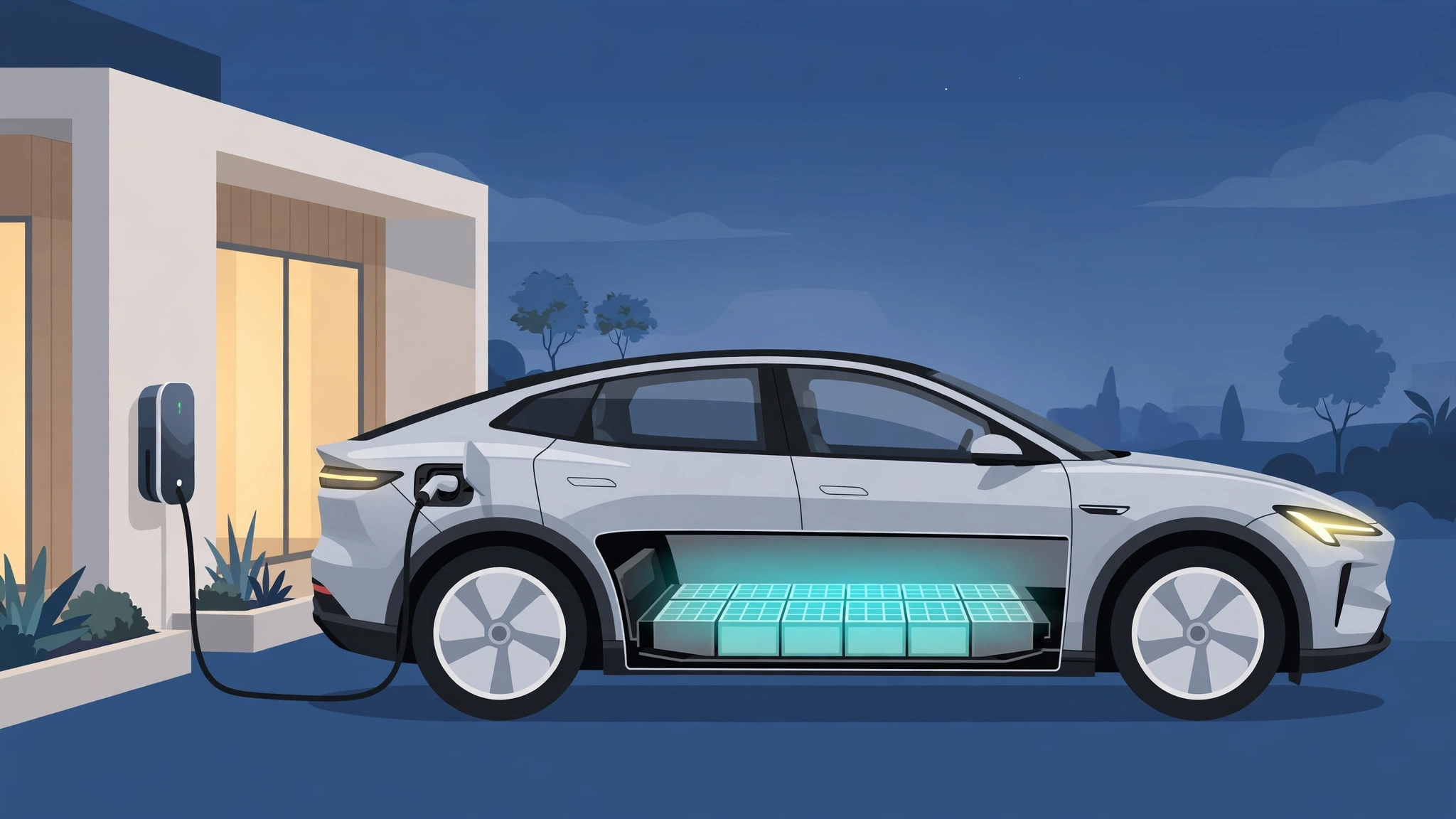
Electric cars look familiar on the outside, but under the floor they are completely different machines from the petrol and diesel vehicles most of us grew up with. If you are curious about how electric vehicles work, the good news is that the core idea is surprisingly simple: store electrical energy in a battery, use it to spin an electric motor, and let that motor turn the wheels. There is no engine block full of explosions, no gearbox with dozens of moving parts, and no exhaust pipe. This guide explains each part of an electric vehicle (EV) in plain language, how charging and range really work, what EVs cost to run and maintain, and what to check before you buy your first one.
The Main Parts of an Electric Vehicle
Every EV, from a small city hatchback to a heavy pickup truck, is built around the same handful of components. Understanding these parts makes everything else about electric cars much easier to follow.
The Battery Pack
The battery pack is the EV equivalent of a fuel tank, except it is far larger, heavier, and smarter. It is usually a flat slab of lithium-ion cells mounted low in the floor of the car, which keeps the centre of gravity down and improves handling. Battery size is measured in kilowatt-hours (kWh). A small city EV might carry 40 kWh, a typical family model 60 to 80 kWh, and large luxury models more than 100 kWh. As a rough guide, most modern EVs travel about 3 to 4 miles per kWh, so a 60 kWh pack delivers roughly 180 to 240 miles of real-world range. The pack is not one big battery but thousands of individual cells grouped into modules, all monitored by a battery management system that watches temperature, voltage, and health, and protects the pack from damage.
The Electric Motor
The motor converts electrical energy into movement. When electricity flows through the motor’s coils, it creates rotating magnetic fields that spin a rotor connected to the wheels. Electric motors deliver their full twisting force, called torque, almost instantly, which is why EVs feel so quick and smooth pulling away from traffic lights. Many EVs use a single motor driving one axle. Dual-motor models add a second motor on the other axle for all-wheel drive and extra performance. Unlike a petrol engine, an electric motor has very few wearing parts and works efficiently across a wide range of speeds, so most EVs need only a single-speed gear reduction instead of a complex multi-gear transmission.
The Inverter and Onboard Charger
Two pieces of power electronics do the quiet translation work. The inverter converts the battery’s direct current (DC) into alternating current (AC) for the motor, and controls exactly how much power the motor receives when you press the accelerator. The onboard charger does the opposite job when you plug into AC power at home or at a public post: it converts that AC into DC the battery can store. The size of the onboard charger, commonly 7 kW or 11 kW, sets how fast the car can charge on AC. A small control unit also manages the 12-volt system that runs lights, screens, and locks, just like in a conventional car.
How an EV Actually Drives
Press the accelerator in an EV and the inverter instantly feeds power from the battery to the motor. There is no waiting for an engine to rev, no gear changes, and almost no vibration or noise beyond a soft whine and the sound of the tyres. This direct response is one of the first things new drivers notice, and it makes city driving noticeably calmer.
Regenerative Braking
EVs can also run the process in reverse. When you lift off the accelerator or press the brake, the motor becomes a generator, slowing the car while converting movement back into electricity that tops up the battery. This is called regenerative braking, or regen. It is why EVs are especially efficient in stop-start traffic, and why many offer one-pedal driving, where lifting off slows the car strongly enough that you rarely touch the brake pedal in town. Regen also reduces wear on the conventional brake pads and discs, which is one reason EV brakes often last far longer than those on petrol cars. The friction brakes are still there for hard stops and emergencies, and the car blends both systems automatically.
Software Is Half the Car
Modern EVs are rolling computers. Software decides how power is shared between motors, how aggressively regen works, how the battery is heated or cooled before a fast charge, and how range is estimated. Manufacturers regularly improve these systems with over-the-air updates, so an EV can genuinely get better during ownership. The same software trend appears across the business world, where tools built around AI automation now manage everything from delivery fleets to charging schedules, predicting when vehicles should charge to take advantage of cheap overnight electricity.
Charging an EV: Home, Public, and Rapid
Charging is the habit that changes most for new owners. Instead of weekly trips to a fuel station, most EV drivers charge little and often, usually overnight at home, and wake up to a full battery every morning.
Home Charging
A standard household socket can charge an EV slowly, adding roughly 6 to 8 miles of range per hour. That is fine for emergencies or very low mileage, but most owners install a dedicated home wallbox. A typical 7 kW wallbox adds about 25 to 30 miles of range per hour, refilling an average EV overnight in 8 to 10 hours. Installation usually requires a qualified electrician and, in many countries, a grant or tax incentive may help with the cost. If you have off-street parking and a wallbox, home charging is almost always the cheapest and most convenient way to run an EV, especially on an off-peak electricity tariff.
Public and Rapid Charging
Public AC chargers, found at supermarkets, car parks, and workplaces, work at similar speeds to a home wallbox and suit places where you park for hours. Rapid and ultra-rapid DC chargers are different: they bypass the car’s onboard charger and feed DC straight to the battery at 50 kW to 350 kW. On a compatible car, that can mean a 10 to 80 percent charge in 20 to 40 minutes, designed for motorway stops on long trips. Charging slows as the battery fills, especially past 80 percent, to protect the cells, so experienced drivers charge little and often on long journeys rather than waiting for 100 percent. Payment has become simpler too, with most new rapid chargers accepting ordinary contactless bank cards.
Range: What the Numbers Really Mean
Range anxiety is the most common worry about EVs, and it is usually based on official figures that need some interpretation. In Europe, cars are rated on the WLTP cycle; in the United States, the EPA cycle is generally closer to real life. Expect to achieve roughly 10 to 25 percent less than the official figure in mixed driving, and less again in cold weather at motorway speeds.
What Affects Range
Speed is the biggest factor: air resistance rises sharply, so cruising at 70 mph uses far more energy than driving at 50 mph. Cold weather thickens the challenge because batteries work less efficiently when cold and cabin heating draws power, although heat pumps, now common on newer models, cut that penalty significantly. Roof boxes, heavy loads, under-inflated tyres, and aggressive acceleration all trim range too. On the positive side, most drivers travel far less each day than they imagine. Average daily driving in many countries is under 30 miles, which even the smallest EV covers easily with overnight charging to spare.
Battery Health Over Time
EV batteries do lose capacity slowly with age and use, typically around 1 to 2 percent per year in modern models with good thermal management. That means a car rated at 250 miles when new might manage around 210 to 225 miles after eight years, still perfectly usable. Manufacturers back this with long warranties, commonly eight years or 100,000 miles guaranteeing at least 70 percent capacity. You can protect the battery by avoiding leaving the car at 100 percent charge for long periods, limiting frequent rapid charging if you do not need it, and following the maker’s guidance, often charging to 80 or 90 percent for daily use.
Running Costs and Maintenance
EVs usually cost more to buy than an equivalent petrol car, although the gap narrows every year and used prices have fallen sharply. The running costs are where EVs win back ground. Electricity per mile at home rates is typically a fraction of the cost of petrol, even public rapid charging often works out cheaper than fuel, and an EV has far fewer consumable parts. There is no engine oil, no spark plugs, no clutch, no exhaust system, and no timing belt to replace. Routine servicing mainly covers the cabin filter, brake fluid, tyres, and inspections of the battery and software.
Tyres deserve a mention: EVs are heavier than similar petrol cars and deliver instant torque, so they can wear tyres faster if driven hard, and many use EV-specific tyres designed for low rolling resistance and extra load. Insurance varies by model and region and is worth quoting before you buy, as repair costs for some models can be higher. Overall, most independent cost comparisons find that an EV charged mainly at home is significantly cheaper to run over three to five years than a comparable petrol car, which offsets much or all of the higher purchase price.
What to Check Before You Buy
Start with your real life, not the brochure. Add up your typical weekly mileage and your longest regular journey, then choose a battery that covers the long trip with one comfortable charging stop. Check whether you can charge at home or at work, because that single factor shapes the whole ownership experience. If you rely on public charging, look at the networks near your home and usual routes, and confirm the car’s rapid-charging speed, not just its range, since that decides how long motorway stops take.
On a test drive, try one-pedal driving, check the rear seat and boot space lost or gained by the battery layout, and test the infotainment and driver-assistance systems you will use daily. For a used EV, ask for a battery health report if available, check the charging cables are included, and confirm how much battery warranty remains. Finally, look into local incentives, company car tax rules, and home charger grants, which can change the maths considerably in your favour.
Frequently Asked Questions
How long does it take to charge an electric vehicle?
It depends on the charger. A home wallbox typically refills an average EV overnight in 8 to 10 hours. A public rapid charger can take the battery from 10 to 80 percent in about 20 to 40 minutes on a compatible car. A normal household socket is slowest, adding only a few miles of range per hour, so it suits top-ups rather than full charges.
Do EV batteries need replacing after a few years?
No. Modern EV batteries are designed to last the life of the car. They lose capacity gradually, often around 1 to 2 percent a year, and most manufacturers guarantee at least 70 percent capacity for eight years or 100,000 miles. Complete battery failure is rare, and individual modules can often be repaired or replaced rather than the whole pack.
Are electric vehicles really cheaper to run?
For most drivers, yes, especially if you charge at home on a standard or off-peak tariff. Electricity per mile usually costs far less than petrol, and servicing is simpler and cheaper because there are fewer moving parts and no oil, exhaust, or clutch to maintain. Higher purchase prices and public rapid-charging costs can narrow the gap, so it is worth comparing total costs for your own mileage.
The Bottom Line
An electric vehicle replaces the engine and fuel tank with a battery, an inverter, and an electric motor, then lets software manage the rest. The result is a car that is simple to drive, quiet, quick, and cheap to fuel if you can charge at home. Understand your range needs, sort out charging before you buy, and an EV stops being a leap of faith and becomes the easiest car you have ever owned.