Passive Income Ideas: 20 Ways to Build Income Streams
Introduction: Passive Income Is Built, Not Found
Passive income is money that continues to arrive after the initial setup is complete. Every stream on the list that follows requires either capital, labor, or a combination of both before any cash flow begins, and none of them comes with a guarantee of returns. Anyone who claims you can earn money without effort is usually selling a course, not a realistic strategy.
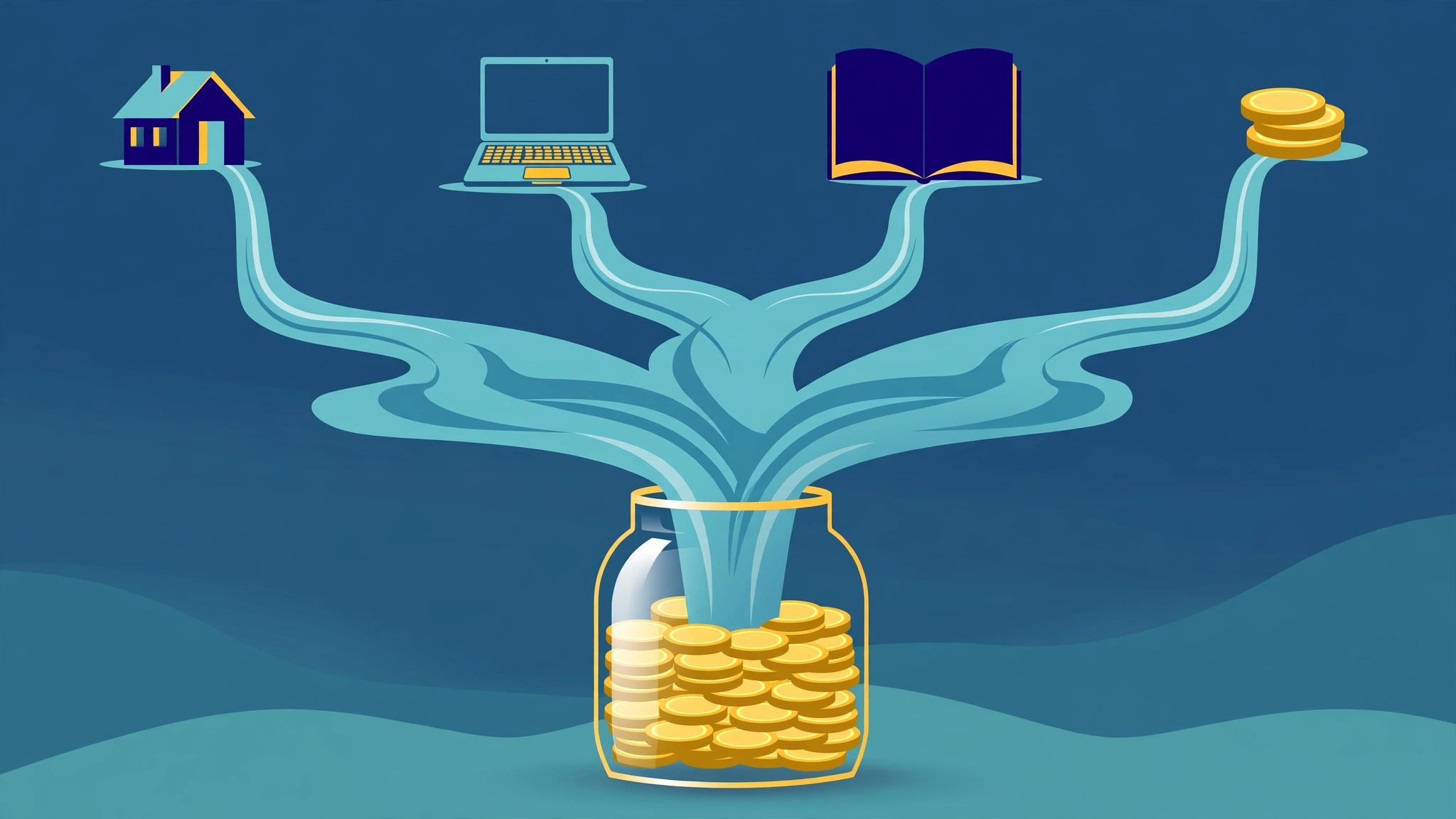
The three families of passive streams
Before diving into specific ideas, it helps to group the options into three broad families. Each family shares a common structure: an upfront commitment, a period of building or acquiring, and a later phase where the asset produces cash with limited daily involvement.
- Capital at work – you put money into assets such as dividend‑paying stocks, bonds, or real‑estate funds. The assets generate income while you hold them, but the upfront capital is at risk and the payouts can vary.
- Build‑once‑sell‑repeatedly – you create a product once (an e‑book, a software template, a printable design) and sell copies over time. The creation phase demands time and skill; ongoing sales depend on demand and marketing.
- Renting out what you own – you lease physical space, equipment, or digital assets (a spare room, a parking spot, a domain name). The owner supplies the asset and handles maintenance, while tenants provide recurring payments.
Choosing a family depends on how much money you can allocate, how much time you can invest up front, and how comfortable you are with ongoing maintenance or market fluctuations.
Each family carries its own mix of upfront cost, ongoing management, and risk. For example, a hypothetical $10,000 investment in a diversified dividend portfolio might yield a few hundred dollars a year, but the principal can rise or fall. A hypothetical $500 effort to write a short guide could generate sales for years, yet sales may stop if the topic loses relevance. Renting a garage for a hypothetical $150 per month produces steady cash, but vacancies and repairs reduce net income.
Keep in mind that every stream requires periodic review; tax rules, platform policies, and market conditions can change the economics of a once‑profitable idea.
Understanding these trade‑offs helps you choose streams that match your resources, risk tolerance, and willingness to maintain the asset. The following sections explore twenty concrete ideas across the three families, each with a brief look at the typical startup requirements and ongoing considerations.
The first family is capital doing the work, and its steadiest members are monthly dividend ETFs: funds that genuinely pay every month rather than quarterly payers in disguise.
The capital family’s most argued-over fork is inside dividend investing itself, and dividend yield vs dividend growth: two income strategies, honestly compared separates the high payout today from the payout that grows.
Family One: Let Capital Do the Work (Ideas 1-7)
These first seven ideas share one trait: they put money you already have to work instead of trading your hours for pay. Each one pays you some form of interest, rent, or corporate profit share. None of them removes risk, and the market-based ones can lose value. Think of this family as the foundation, not a shortcut.
1. Dividend ETFs
A dividend ETF holds a basket of stocks that pay dividends, and it passes those payments along to you, typically each quarter. The income is real but variable — payouts can be trimmed or suspended when companies struggle, and the fund’s price moves with the market. A hypothetical illustration: if a fund distributed 3% of a $10,000 investment in a year, that would be $300 before taxes, not a promise of what any fund will do.
2. Individual Dividend Stocks
Here you own shares in single companies and receive dividends directly. You control which businesses you hold, but you also carry single-company risk: one bad year at one firm can hit your income and your principal at the same time. If you want the mechanics, our dividend investing for beginners guide walks through payout ratios, ex-dates, and screening basics.
3. REITs
Real estate investment trusts own or finance property and are generally required to distribute most of their taxable income to shareholders, which is where the income comes from. The catch is that real estate is cyclical, interest rates affect valuations, and distributions are often taxed differently than qualified dividends. Our REITs explained: real estate income without buying property piece covers the main categories and the tax treatment in more depth.
4. Treasury Bills and Notes
These are debt issued by the U.S. government, so they carry backing that corporate investments don’t, and you receive interest at maturity or in semiannual payments. The tradeoff is that yields are modest, and if you sell before maturity you may get less than you paid. The Treasury sets the auction terms, and rates change with every auction.
5. Bond Index Funds
Instead of one bond, you own thousands, which spreads out default risk. Income arrives as monthly distributions, but bond prices fall when interest rates rise, so the fund’s value can drop even while it keeps paying you.
6. High-Yield Savings Account Interest
Banks pay interest on deposits, and the appeal is access to your cash plus federal deposit insurance up to the standard limit set in federal law. The honest catch: the rate is modest, it’s variable, and inflation can outpace it. A hypothetical illustration — $5,000 at 4% would be $200 a year, before taxes.
7. Series I Savings Bonds
These government savings bonds combine a fixed rate with an inflation adjustment, and the Treasury sets both rates on its own schedule. The catch is the annual purchase limit per person, which the Treasury sets and revises, a one-year lockup, and a small penalty for cashing out before five years. Interest is deferred until redemption.
Many passive-income ideas are really online businesses in disguise, so it helps to compare them with legit online income routes that actually work, filtered for what a beginner can start this month.
Family Two: Build Once, Sell Repeatedly (Ideas 8-15)
These eight streams share a pattern: you create something once, then sell, license, or monetize it repeatedly. The work is front-loaded and real. Writing, filming, designing, editing, and launching can take weeks or months before a single sale. Many creators earn little or nothing for months, and some never reach meaningful income. Treat the result as business income: keep records of sales and expenses, set money aside for taxes, and get advice from a qualified tax professional. Rules and thresholds are set by authorities and platforms and change over time.
8) An Ebook
Write a focused guide, edit it, format it, design a cover, and publish it where readers can buy it. Sales depend on topic, audience, and promotion. You may need to update the file, answer reader questions, and market it again after launch.
9) An Online Course
Build lessons, slides, videos, worksheets, and a simple way to deliver them. Courses take more upfront work than ebooks, and you may need to revise content based on learner feedback. Refunds, platform fees, and support requests are part of running it like a business.
10) Templates and Printables
Create planners, spreadsheets, checklists, trackers, or design files that solve a specific task. You can sell them individually or in bundles. Expect to maintain files, respond to questions, and refresh designs as needs change.
11) Stock Photos or Design Assets
Produce photos, icons, fonts, presets, mockups, or graphics and license them for reuse. This can be competitive and slow. Quality, search visibility, and licensing terms matter, and you need to track where your work appears.
12) A Blog Earning from Ads and Affiliates
Publish useful articles, build search visibility, and add ad or affiliate arrangements. Ad income usually depends on traffic; affiliate income depends on trust and relevant recommendations. Disclose relationships clearly, and expect a long ramp-up period.
13) A YouTube Channel
Plan videos, film, edit, write descriptions, and build an audience. Monetization rules and thresholds are set by the platform and can change. Sponsorships and affiliate arrangements may add other paths, but audience growth takes time and consistent effort.
14) A Paid Newsletter
Choose a narrow topic, publish on a schedule, and offer paid subscriptions. You must keep readers interested, manage churn, and handle payment fees. A small, engaged audience may be more realistic than a large, passive one.
15) Print-on-Demand Designs
Upload original designs to products such as shirts, mugs, or posters, and let a provider handle printing and shipping. Margins vary, and you need to check product quality, follow trends, and respect intellectual property. Marketing and customer service still take work.
A hypothetical illustration: if a template sells for $10 and you sell 20 copies in a month, that is $200 in gross sales before fees and taxes—hypothetical only. The common thread is front-loaded work, ongoing marketing, and business recordkeeping. No stream comes with a promise of profit.
Family Three: Rent Out What You Own (Ideas 16-20) – and Picking Your First Stream
The third family of passive income ideas looks less like investing and more like being a careful steward of things you already own. Instead of buying a new asset, you put an idle one to work. None of these remove effort entirely, but each can turn unused space, equipment, or creations into something that may pay you over time.
- 16) Rent a spare room or property. An empty bedroom, a garage, or a second home can be offered as short- or long-term lodging. You handle cleaning, screening guests, and local rules, and the amount you collect depends on demand where you live.
- 17) Rent out a car. If your vehicle sits most of the week, peer-to-peer car sharing lets others pay to use it for a fee. You weigh insurance, wear, and mileage against what renters in your area are willing to pay.
- 18) Rent tools or equipment. Power tools, cameras, party gear, and yard machines are often bought, used once, and stored away. Lending them out for a fee can recover part of what they cost.
- 19) Rent a parking or storage space. A driveway near a busy area or extra square footage in a basement or closet can be listed for storage. Demand shifts with location and season.
- 20) License something you created. Music, photography, software, or a design can be licensed so others pay for the right to use it. This front-loads the work, but it can pay again and again if people keep licensing it.
Before you chase any of these, match the idea to the resource you actually have. If you have spare capital, you might buy something to rent out. If you have spare time and skills, you might build or maintain what you offer. If you already own an idle asset, renting it may ask the least of you. Trying to force a stream that fits none of your resources usually stalls before it starts. Whichever you choose, keep a simple record of what you spend and what comes in, so you can judge whether the effort is worthwhile for you.
Pick one and start small. A single room or one tool teaches you the real work faster than a plan that spreads you across all five at once. As with any investment approach, the official grounding is worth reading first: Investor.gov, the SEC’s introduction to investing lays out the basics before you commit time or money.
A warning worth repeating
Finally, watch for anyone selling a “guaranteed passive income system.” A product promising effortless, risk-free money is almost always the seller’s income stream, not yours. Genuine streams take setup, ongoing upkeep, and carry some risk. Treat the word “guarantee” as a signal to slow down and look closer, not as a reason to buy.
A Hypothetical Example: Two Streams, Invented Numbers
Before getting into specifics, it helps to see the arithmetic laid out plainly. Everything below is hypothetical. The prices and amounts are invented for illustration, and they are not typical earnings, averages, or targets. Use them to understand the mechanics, not to set expectations.
Stream one: selling a digital template
Imagine a digital template — say, a printable planner — priced at an invented $15. In this made-up month, it sells four copies. The math is simple: 15 times 4 equals $60 in gross revenue.
- That $60 is before platform or marketplace fees, payment processing costs, and any taxes that may apply.
- Refunds, discounts, and chargebacks could reduce it further.
- Nothing here suggests a template will sell four copies, or any copies, in a given month.
The engine worth noticing is sales: a digital file is created once and can, in principle, be sold more than once. Whether that engine produces anything at all is not promised.
Stream two: regular contributions to an investment-based account
Now a different example. Suppose someone puts $100 a month into an investment-based stream. Over twelve months, that is $1,200 of contributions — money the person added, not money the account produced.
- Any income, growth, or dividends on top of those contributions is variable. It can be positive, negative, or zero, and it is not promised.
- Fees, expenses, and taxes can all affect the outcome.
- Some account types have contribution limits and tax rules set by a government authority. That authority sets the figures, and they change over time, so check the current rules instead of relying on any number printed in an article.
The engine here is contributions: consistent additions over time, paired with an investment that carries risk.
Two different engines — one driven by sales, one driven by contributions. The invented numbers are only scaffolding for understanding how each one is built.
The Bottom Line
Every genuine passive income stream is a trade: capital, work, or an asset you own, exchanged for money that arrives later with less daily effort. The investing family asks for capital and patience; the digital family asks for months of building before the first sale; the rental family asks for something worth renting and the willingness to maintain it.
Start with the resource you actually have, build one stream until it works, and keep honest records from the first dollar – business and investment income both come with tax paperwork. Treat any offer of guaranteed, effortless income as the warning sign it is. Real streams are boring to build and satisfying to own, which is exactly why they work.
Disclaimer: This article is for educational purposes only and is not financial, tax, or legal advice. Investing involves risk, including the possible loss of principal. Examples are hypothetical and do not represent actual or future returns. Consider speaking with a qualified financial or tax professional about your own situation.