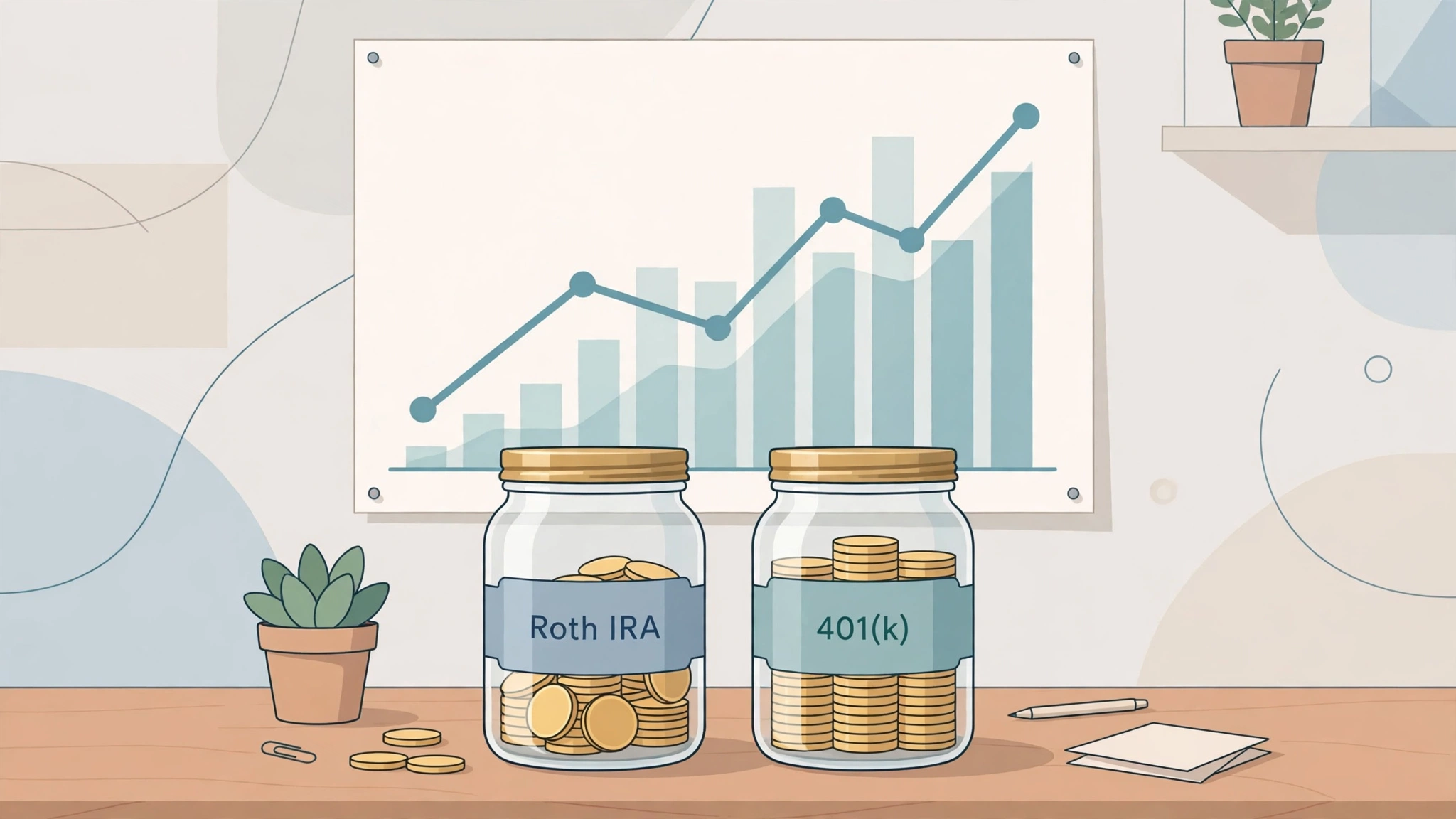
If you are saving for retirement in the United States, two accounts dominate the conversation: the workplace 401(k) and the individual Roth IRA. Both shelter your investments from annual taxes and both can build serious wealth over a career. But they treat taxes in opposite ways, come with different rules, and shine in different situations. Understanding the roth ira vs 401k trade-offs helps you put each dollar where it does the most good — and for many savers, the honest answer is not one or the other, but a deliberate order of both.
A quick note before the comparison: rules, limits, and tax brackets change, and the figures mentioned here are general and approximate. Always check the current year’s official limits and your own plan documents before acting.
The Core Difference: When You Pay the Tax
Everything else flows from one distinction. A traditional 401(k) gives you the tax break now: contributions come out of your paycheck before income tax, reducing this year’s taxable income, and the money grows tax-deferred. You pay ordinary income tax later, when you withdraw in retirement. A Roth IRA gives you the tax break later: you contribute money you have already paid tax on, it grows tax-free, and qualified withdrawals in retirement — including all the growth — come out completely tax-free.
So the real question is a bet on tax rates: is your tax rate higher today, or will it be higher in retirement? If today is higher, paying tax later at a lower rate (the 401(k) route) wins. If retirement will be higher — common for young savers early in their careers, whose incomes and brackets will rise — paying tax now at a low rate (the Roth route) wins. When the rates are equal, the two are mathematically equivalent, which is why the details below often decide the matter.
A Note on Roth 401(k)s
Many employers now offer a Roth option inside the 401(k) itself, combining Roth tax treatment with the 401(k)’s higher limits and employer match. It is a legitimate middle path. This article compares the classic pairing — traditional 401(k) versus Roth IRA — because that is the choice most savers actually face first.
Head-to-Head Comparison
Employer Match: The 401(k)’s Superpower
Many employers match part of your 401(k) contribution — for example, matching half of the first 6 percent you contribute. That match is an immediate 50 to 100 percent return on those dollars, something no account feature can beat. A Roth IRA, being individual, has no match. This single fact drives the most common advice in all of retirement saving: contribute at least enough to the 401(k) to capture the full employer match before sending extra dollars anywhere else. Declining a match is declining part of your pay.
Contribution Limits
The 401(k) allows far larger annual contributions — roughly three times the IRA limit for workers under 50, with additional catch-up contributions allowed from age 50. Exact figures are set yearly, so verify the current numbers. If you are a high saver, the 401(k)’s room is essential; the Roth IRA alone cannot shelter a large income’s worth of saving. Note that employer matching contributions do not count against your personal elective limit in the same way, which adds even more capacity.
Income Limits and Eligibility
Anyone with a participating employer plan can contribute to a 401(k), regardless of income. The Roth IRA, by contrast, phases out eligibility at higher incomes — direct contributions are restricted once earnings pass certain thresholds, though workarounds exist for some savers. If your income is high, the 401(k) may be your only straightforward option of the two.
Investment Choices and Fees
A Roth IRA is yours: at most brokers you can choose from thousands of funds, ETFs, and individual stocks, including the lowest-cost index funds available. A 401(k) offers a limited menu chosen by your employer — sometimes excellent and cheap, sometimes mediocre and pricey. If your 401(k) menu is expensive, that strengthens the case for prioritizing the Roth IRA after capturing the match. If your plan offers institutional-priced index funds, the 401(k) can be just as cheap.
Withdrawals, Loans, and Flexibility
The Roth IRA is strikingly flexible: because you already paid tax on contributions, you can withdraw your contributions (not earnings) at any time without tax or penalty. That makes it a partial safety valve — though raiding retirement savings is still a last resort. Earnings withdrawn before age 59½ and before the account is five years old generally face taxes and penalties, with some exceptions.
The 401(k) is stricter. Money is generally locked until 59½ (or separation from service at 55 or later in some cases), with a 10 percent early-withdrawal penalty on top of taxes, apart from specific exceptions. Many plans allow loans against your balance — borrowing from yourself — which sounds friendly but risks repayment demands if you leave the job, and the borrowed money misses market growth. Flexibility clearly favors the Roth IRA.
How the Money Goes In
The mechanics differ in a way that quietly helps discipline. The 401(k) is funded straight from your paycheck before you ever see the money, which makes saving automatic — many people find this “invisible” contribution the easiest habit they ever build. The Roth IRA usually requires you to move money yourself from your bank account, though most brokers let you automate a monthly transfer on payday to mimic the same effect. Whichever account you choose, set the contribution to happen automatically; a retirement plan that depends on remembering and deciding every month is a plan that quietly stops.
Required Distributions and Estate Notes
Traditional 401(k)s require you to start taking minimum distributions in your seventies, whether you need the money or not, and every dollar is taxable. Roth IRAs have no required distributions during the owner’s lifetime, so the account can keep growing tax-free for as long as you live and pass to heirs with favorable treatment. For people who expect to have more than enough, that freedom is valuable.
So Which One Wins?
It depends on your stage of life. Early career, lower bracket: the Roth IRA is powerful — you pay tax at today’s low rate and buy decades of tax-free growth. Peak earning years, high bracket: the traditional 401(k)’s upfront deduction is worth more, especially if you expect a lower retirement bracket. High savers: you will likely use both, because the Roth IRA’s limit cannot hold everything. If you are still building the basics, our guide to investing for beginners shows how retirement accounts fit into a complete first plan.
The Popular Order of Operations
- Contribute to the 401(k) up to the full employer match — never leave free money behind.
- Pay off high-interest debt and build a starter emergency fund.
- Fund a Roth IRA up to its annual limit, choosing low-cost diversified investments.
- Return to the 401(k) and raise contributions toward the maximum as income allows.
- Invest any remainder in a regular taxable brokerage account.
This sequence captures the match, buys tax-free Roth growth while you are likely in a lower bracket, and then uses the 401(k)’s big capacity. It is a framework, not a command — adjust it to your plan’s fees, your bracket, and your goals.
Two Savers, Two Answers: A Simple Comparison
Consider Maya, 26, earning a modest starting salary in a low tax bracket. Every dollar she puts into a Roth IRA is taxed at today’s low rate — and then never taxed again, through forty years of growth. For her, the Roth is close to unbeatable, once she captures any employer match on offer. Now consider Daniel, 48, at the peak of his earnings in a high bracket, expecting a quieter, lower-income retirement. Each traditional 401(k) contribution shelters income at his high current rate, and withdrawals later will likely be taxed at a lower one. For him, the 401(k) deduction is the prize. Same two accounts, opposite answers — decided entirely by when each saver pays the taxman. Your own answer sits on the same spectrum: estimate today’s bracket, make an honest guess about retirement, and let that guide the split.
Special Situations Worth Knowing
Self-employed savers have no employer plan unless they create one: options such as a Solo 401(k) or SEP IRA can provide 401(k)-style capacity, and they can usually be combined with a Roth IRA as well. Very high earners who exceed the Roth IRA income limits sometimes use a “backdoor” Roth conversion — contributing to a traditional IRA and converting it — a legitimate but detail-sensitive maneuver where professional guidance is wise, because other IRA balances can trigger unexpected tax. Early retirees often value the Roth IRA’s flexible access to contributions and the ability to manage taxable income year by year. And anyone changing jobs frequently should track old 401(k)s carefully; consolidating them into an IRA or a new plan prevents forgotten accounts and simplifies rebalancing. The right structure depends on your employment, income, and plans — which is precisely why a short conversation with a tax professional can pay for itself.
Mistakes That Cost Savers Real Money
A few avoidable errors show up again and again. The costliest is skipping the employer match — saving in an IRA while leaving matched 401(k) dollars unclaimed is turning down part of your salary. Second is cashing out a 401(k) when changing jobs: taxes plus penalties can consume a third of the balance, and the lost decades of compounding cost far more. Third is leaving contributions in cash: money inside a retirement account still needs to be invested in funds or other assets, or inflation quietly erodes it — an astonishing number of accounts sit in default cash-like options for years. Fourth is ignoring fees in the 401(k) menu, where an expensive fund lineup can change the Roth-versus-401(k) answer by itself. Finally, waiting for the perfect account decision while contributing nothing: a good account funded now beats the perfect account funded five years from now, every single time.
Frequently Asked Questions
Can I have both a Roth IRA and a 401(k)?
Yes. There is no rule against using both, and many savers do. The limits apply separately to each account type, and the combination gives you a mix of taxable-later and tax-free money in retirement — useful flexibility.
What happens to my 401(k) if I change jobs?
You can usually leave it with the old employer, roll it into your new employer’s plan, or roll it into an IRA. Rolling to an IRA is a common choice for wider investment options, but compare fees and protections first, and avoid cashing out, which triggers taxes and penalties.
Is the employer match ever a reason to skip the Roth IRA entirely?
The match is a reason to fund the 401(k) first, up to the match — not necessarily to skip the Roth. After the match, compare your current tax bracket and your plan’s fees to decide where the next dollar works hardest.
The Bottom Line
In the roth ira vs 401k contest, there is no universal winner — there is a right order. Capture the full employer match, favor the Roth IRA while your tax bracket is low, use the 401(k)’s higher limits as your income and savings grow, and let the two accounts complement each other. Paying attention to when you are taxed, keeping fees low, and starting early will matter far more than picking a single “best” account. This article is educational and is not personalized financial or tax advice; rules change and individual situations differ, so consult a qualified professional for decisions specific to you.