If you have spent any time reading about artificial intelligence, you have probably seen the terms used almost interchangeably. Understanding machine learning vs deep learning is the fastest way to cut through that confusion. The short version is simple: deep learning is a specialized kind of machine learning, and machine learning is one part of the wider field of artificial intelligence. But the differences in how they learn, how much data they need, and what they are good at matter a great deal when you are choosing tools, hiring people, or just trying to understand the technology shaping your world.
This guide explains both approaches in plain language, with everyday examples, honest trade-offs, and a practical framework for deciding which one fits a given problem.
First, the Big Picture: AI, Machine Learning, Deep Learning
Think of three nested boxes. The biggest box is artificial intelligence: any technique that lets a computer perform a task that normally seems to require human intelligence, from playing chess to understanding speech. Inside that box sits machine learning: systems that improve at a task by learning patterns from data instead of following only hand-written rules. And inside machine learning sits deep learning: a family of methods built on large, layered neural networks that learn features from raw data on their own.
Not all AI is machine learning. An old-fashioned chess program that follows rules written by programmers is AI, but it does not learn from data. And not all machine learning is deep learning. A model that predicts house prices from a spreadsheet of features is machine learning, but it involves no deep network. Keeping these layers straight prevents a lot of muddled thinking — and muddled purchasing decisions.
What Is Machine Learning?
Machine learning (ML) is the practice of training a mathematical model on examples so it can make predictions or decisions on new data. Instead of telling the computer exactly what to do in every situation, you show it many examples of inputs and correct outputs, and an algorithm adjusts itself until its predictions match the examples closely.
How machine learning learns
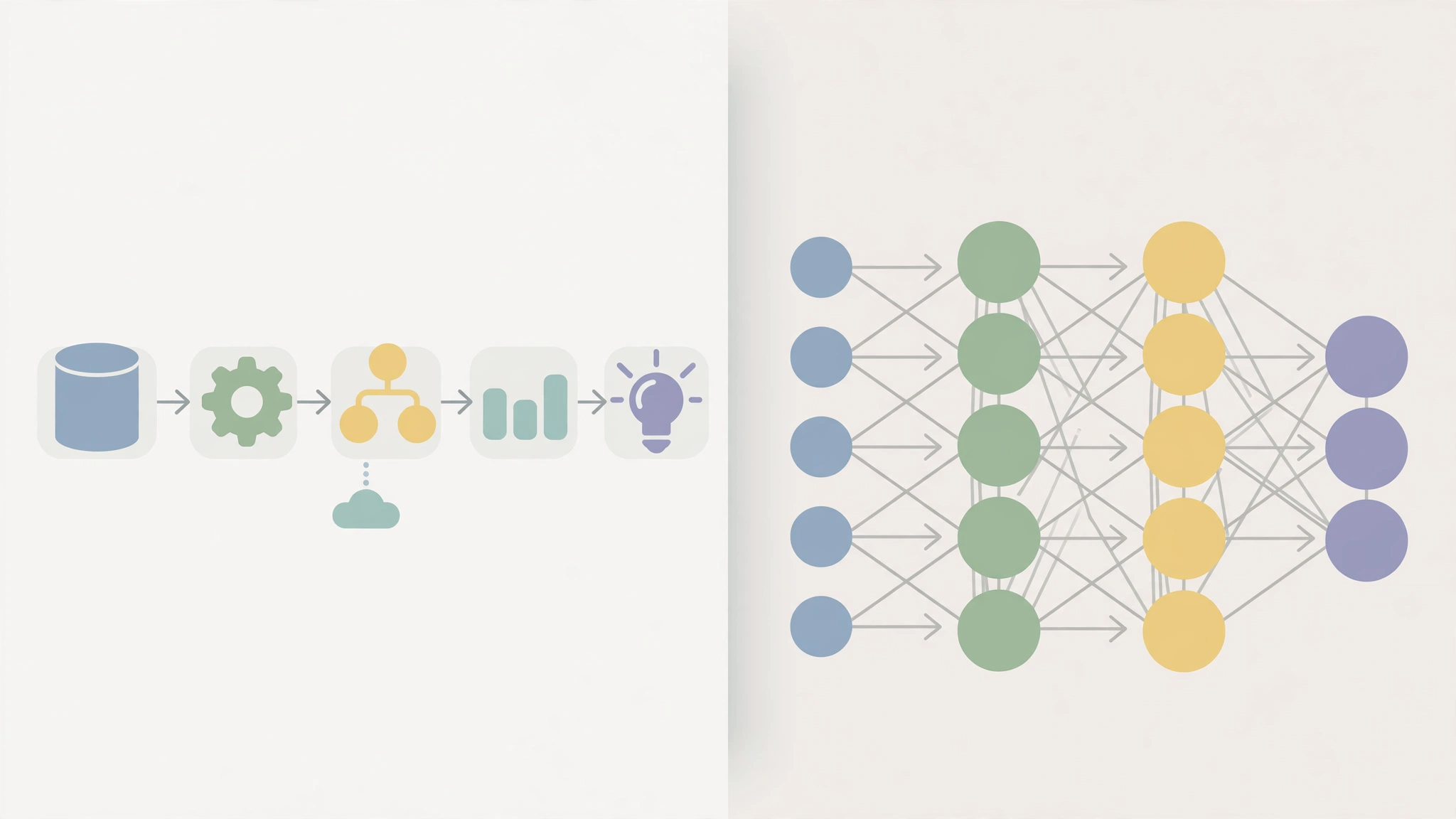
A typical ML workflow looks like this: you gather data, clean it, and decide which measurements — called features — describe each example. For a spam filter, features might include how many exclamation marks an email contains, whether it has certain suspicious phrases, and whether the sender is in your contacts. A human expert chooses and engineers those features. Then an algorithm such as a decision tree, a random forest, or logistic regression learns how to weigh them.
The important detail is that the human does a lot of the intellectual heavy lifting up front: picking the data, defining the features, and choosing the algorithm. The machine learns the fine-grained patterns within that framework.
Common machine learning algorithms
- Linear and logistic regression — simple, fast models for trends and yes/no predictions.
- Decision trees and random forests — flowchart-like models that are easy to interpret.
- Support vector machines — good at drawing boundaries between categories.
- Gradient boosting — ensembles that often win tabular-data competitions.
- K-means clustering — groups similar items together without labels.
What Is Deep Learning?
Deep learning (DL) uses neural networks with many layers — hence “deep” — to learn directly from raw data. Rather than a human hand-crafting features, the network discovers useful features by itself. Feed a deep network millions of labeled photos, and its early layers learn to detect edges and textures, middle layers learn shapes like eyes and wheels, and later layers learn whole objects. Nobody programmed “eye detector” into it; that structure emerged from training.
How deep learning learns
A neural network is made of connected units arranged in layers. Each connection has a weight. During training, the network makes a prediction, measures how wrong it was, and nudges millions of weights slightly in the right direction — a process called backpropagation. Repeat this millions of times and the network becomes remarkably good at tasks like recognizing faces, transcribing speech, and translating languages.
The catch: this power demands enormous amounts of labeled data and serious computing power, usually specialized chips called GPUs. Deep learning is also harder to interpret — when a deep network makes a mistake, it can be genuinely difficult to explain why.
The Key Differences at a Glance
Data requirements
Traditional machine learning can perform well with hundreds or thousands of examples. Deep learning typically needs tens of thousands to millions. If your dataset is a modest spreadsheet, ML is usually the right tool. If you have a mountain of images, audio, or text, DL becomes viable.
Feature engineering
In classic ML, humans design the features, and model quality depends heavily on that skill. In deep learning, the network learns its own features from raw inputs. This is why DL revolutionized fields like computer vision and speech, where hand-designing features was always a bottleneck.
Hardware and training time
Many ML models train in seconds or minutes on an ordinary laptop. Deep learning models can take hours, days, or longer on expensive GPU hardware. Inference — actually using the trained model — can also be heavier for deep networks.
Interpretability
A decision tree can be printed out and read. A deep network with a hundred million weights cannot. In regulated fields like lending or medicine, the ability to explain a decision is not a luxury; it is often a legal requirement, and it pushes teams toward simpler ML.
Performance ceiling
On large, messy, unstructured data — images, video, audio, free text — deep learning usually wins by a wide margin. On clean, structured, tabular data, well-tuned classic ML frequently matches or beats deep learning at a fraction of the cost.
Real-World Examples of Each
Classic machine learning at work: a bank scoring loan applications from income, history, and debt features; a retailer forecasting next month’s sales from past records; an email provider filtering spam; a factory predicting machine failures from sensor readings.
Deep learning at work: your phone unlocking with your face; voice assistants transcribing what you say; photo apps finding every picture of your dog; translation tools converting a paragraph between languages; large language models drafting text and answering questions.
Notice the pattern: when the input is a tidy table, think ML. When the input is raw perception — sights, sounds, language — think DL. Many real products blend both. A recommendation system might use deep learning to understand video content and classic ML to rank what you see next. Businesses exploring AI automation for small businesses meet the same blend: simple ML quietly handles forecasting and sorting, while deep learning powers the chat and vision features customers actually notice.
Which One Do You Actually Need?
Start with the problem, not the technology. Ask four questions. First, what does my data look like — a table, or raw media and text? Second, how much of it do I have? Third, do I need to explain each decision to a customer, auditor, or regulator? Fourth, what can I afford to train and run?
If your answers point to a modest, structured dataset with explainability needs, classic machine learning is almost certainly your answer — and it will be cheaper, faster, and easier to maintain. If you are working with images, audio, or language at scale and accuracy matters more than explanation, deep learning earns its cost. And if you are unsure, begin with a simple ML baseline. You may discover it solves 90 percent of the problem for 10 percent of the budget.
Three Ways Machines Learn
Both approaches share a few basic learning styles worth knowing, because they show up in every product you use. In supervised learning, the model trains on labeled examples — photos tagged “cat” or “not cat,” emails marked spam or not — and learns to predict the label for new items. Most business applications, from both camps, are supervised.
In unsupervised learning, there are no labels. The algorithm looks for structure on its own: grouping customers into segments, or flagging transactions that look nothing like the rest. In reinforcement learning, the system learns by trial and error, receiving rewards for good moves — the technique behind game-playing AI and some robotics. Deep learning can be combined with all three styles, which is one reason the boundary between the fields keeps blurring in practice.
A Worked Example: Two Ways to Build a Spam Filter
Imagine you are building a spam filter in 2005 and again today. The classic machine learning version: an engineer lists suspicious features — words like “free” and “winner,” excessive capital letters, strange sender addresses — and a model learns how much each feature matters. It works well, and when it misfires, the engineer can see exactly which feature caused the mistake and adjust it.
The deep learning version skips the feature list entirely. A neural network reads millions of raw emails and learns its own internal signals — combinations of phrasing, structure, and sender behavior too subtle for a human to enumerate. It may catch novel scams the feature list would miss, but when it flags your boss’s email, there is no single dial to turn; you retrain with better examples and hope the pattern corrects itself. Neither approach is “smarter” in the abstract — they trade control for adaptability, and good engineers choose based on which trade their problem rewards.
Why Deep Learning Took Off When It Did
Neural networks are not new — the core ideas date back decades. Deep learning exploded in the 2010s because three ingredients finally arrived together: enormous datasets from the internet, cheap powerful GPUs originally built for video games, and refined training techniques that made very deep networks practical. This history carries a lesson: the “best” method is partly a question of what resources exist. As data and compute keep growing cheaper, deep learning keeps expanding into new territory — but classic machine learning remains the sensible default wherever data is scarce, budgets are small, or explanations are required.
Common Myths Worth Dropping
Three misconceptions cause endless confusion. First, “deep learning is always more accurate.” On small or tabular datasets it often is not — and a model that is 1 percent more accurate but a hundred times more expensive is not better in any business sense. Second, “machine learning and AI are the same thing.” As the nested boxes showed, ML is one route to AI, not the whole map. Third, “more data automatically means better results.” Dirty, biased, or mislabeled data produces confidently wrong models in both camps. Data quality beats data quantity more often than headlines suggest, and cleaning a dataset is rarely glamorous — but it is where experienced practitioners spend most of their time, and where projects quietly succeed or fail.
Frequently Asked Questions
Is deep learning better than machine learning?
Not universally. Deep learning is better for large amounts of unstructured data like images, audio, and text. For smaller, structured datasets, classic machine learning is often just as accurate while being cheaper, faster, and easier to explain.
Do I need a GPU to use deep learning?
For training serious models, effectively yes — GPUs (or cloud equivalents) make training dramatically faster. For small experiments or using pre-trained models, a normal computer can be enough to learn and prototype.
Can a beginner learn both?
Yes, and the sensible order is machine learning first. Its core ideas — training data, features, overfitting, evaluation — are the foundation deep learning builds on. Master the basics, then go deep.
The Bottom Line
Machine learning and deep learning are not rivals; they are tools in the same toolbox, at different scales. Machine learning learns patterns from data a human has carefully prepared, and it shines on structured problems with modest data. Deep learning learns its own features from raw data using large neural networks, and it shines on perception and language at scale. Understand what each one asks of you — data, hardware, and explainability — and the choice usually makes itself.