A persistent myth keeps millions of people on the sidelines: the belief that investing is only for people who already have a lot of money. A generation ago, that was almost true — high minimums and per-trade commissions punished small accounts. Today it is simply false. You can invest with 100 dollars, and in many cases with far less. What matters is not the size of your first deposit but the habit you build around it. This guide shows exactly how to turn a modest amount into a real, diversified investment, and how to grow it steadily from there.
Why Starting Small Beats Waiting
The most valuable ingredient in investing is time. Money invested early has more years for compound growth to work — earnings generating their own earnings, year after year. A person who invests 100 a month starting at 25 gives that money four decades of growth. Someone who waits until 35 to start with larger amounts often never catches up, despite contributing more overall. Waiting for a “proper” amount to start is one of the most expensive decisions a beginner can make.
Starting small also teaches you the emotional side of investing while the stakes are tiny. Watching a 100 portfolio dip to 92 feels very different from watching 50,000 dip to 46,000. Learning to stay calm, keep contributing, and ignore daily noise is a skill — and it is far cheaper to learn it with small numbers. By the time your account is large, your temperament will already be trained.
The Real Goal of Your First $100
Your first 100 will not change your life financially. Its job is to change your behavior: to open the account, make the first purchase, set up the automatic contribution, and prove to yourself that you are now an investor. Every large portfolio in history began with a first deposit. Treat the first 100 as tuition and momentum, not as a lottery ticket.
Before You Invest: Two Quick Foundations
Investing works best on a stable base. Before your first purchase, check two things. First, keep a small starter emergency buffer — even 500 set aside in savings — so an unexpected bill never forces you to sell investments at a bad moment. Second, if you carry credit card debt at high interest, paying it down usually beats investing, because the interest you avoid is a guaranteed return higher than markets typically deliver. Our guide to investing for beginners walks through these foundations in more detail if you want the full picture before you begin.
Also set expectations honestly. Investing involves risk, values go down as well as up, and no legitimate investment guarantees profits. Money you will need within the next year or two — for rent, a deposit, or a planned purchase — does not belong in the stock market. Invest money you can leave alone for at least five years.
What Can $100 Actually Buy?
Fractional Shares
Many modern brokers let you buy a slice of a share instead of a whole one. If a company’s stock trades at 300 per share, you can still invest 25 and own a proportional piece. Fractional shares remove the price tag barrier entirely: your 100 can buy pieces of several companies or funds at once, in exactly the proportions you choose. Dividends, gains, and losses all scale to your slice.
Index Funds and ETFs
For most beginners, the smartest first purchase is a broad index fund or exchange-traded fund (ETF). One purchase can hold hundreds or thousands of companies, giving you instant diversification that would be impossible to build stock by stock with 100. Low-cost index ETFs tracking a broad market index are popular first investments because they are simple, diversified, and cheap to own. With fractional shares, even an ETF priced at several hundred dollars per share is within reach of a 100 budget.
Micro-Investing Apps
Some apps round up your everyday purchases and invest the spare change, or let you schedule tiny recurring deposits of 5 or 10. These can be a friendly on-ramp if discipline is your challenge. Watch the fees, though: a flat monthly fee of a few dollars is a heavy percentage drag on a 100 balance. As your balance grows, a straightforward low-cost brokerage account usually becomes the better deal.
A Simple Plan for Your First $100
Step 1: Choose a Reputable, Low-Cost Platform
Pick a regulated broker or investment app available in your country. Look for: no or very low trading commissions, fractional shares, no account minimums, low fund fees, and strong security such as two-factor authentication. Read the fee schedule before depositing — small accounts are hurt most by fixed fees.
Step 2: Keep It Simple — One Diversified Fund
Resist the urge to split 100 across ten exciting individual stocks. With a small account, one broad index fund or ETF gives you diversification, low costs, and a clear view of how markets move. You can add complexity later, when your balance and knowledge have grown. Simple is not a compromise at this stage; it is the strategy.
Step 3: Automate the Next Contribution
The first 100 is a spark; regular contributions are the fuel. Set an automatic transfer — even 25 or 50 a month — into the same investment. This habit, called dollar-cost averaging when applied to regular purchases, means you automatically buy more when prices are low and less when they are high, without trying to time the market. Over years, consistency beats intensity.
Step 4: Reinvest and Leave It Alone
If your investment pays dividends, reinvest them so compounding can work on them too. Then, mostly, do nothing. Check your account monthly at most. Every extra glance is a chance for emotion to talk you into a mistake. Your plan should be boring — that is how you know it is working.
Mistakes Small Investors Should Avoid
- Chasing hot tips and meme stocks. With 100, the temptation to gamble for a quick double is strong. Speculation is entertainment, not a strategy, and most day traders lose money.
- Paying high fees. A 1 percent annual fee sounds small, but on small balances fixed subscription fees can quietly eat 10 percent or more per year. Always know what you pay.
- Buying too many tiny positions. Ten positions of 10 each is not diversification — it is clutter, and it makes learning harder.
- Panic selling the first dip. A 10 percent fall on 100 is 10. Treat it as a lesson in market weather, not a reason to abandon the plan.
- Investing money you need soon. Short-term money and stock market swings do not mix. Keep near-term savings in a savings account.
What Growth Could Look Like Over Time
To see why consistency matters, imagine contributing 100 a month — your first 100, then the same again every month. After one year you have put in 1,200. After ten years, 12,000 of contributions, plus whatever growth markets provide. After twenty years, 24,000 contributed, with compounding doing increasingly heavy lifting in the later years. Actual returns vary and are never guaranteed, and some years will be negative. The pattern, though, is consistent across history: regular contributions, low costs, and patience turn modest amounts into meaningful sums. The biggest variable is not which week you started — it is whether you kept going.
As your income grows, raise the contribution a little each year. An extra 25 a month feels small in the present and looks large in hindsight. Many investors automate an annual increase so the habit grows with their earnings without fresh willpower each time.
A Worked Example: Your First $100 at Work
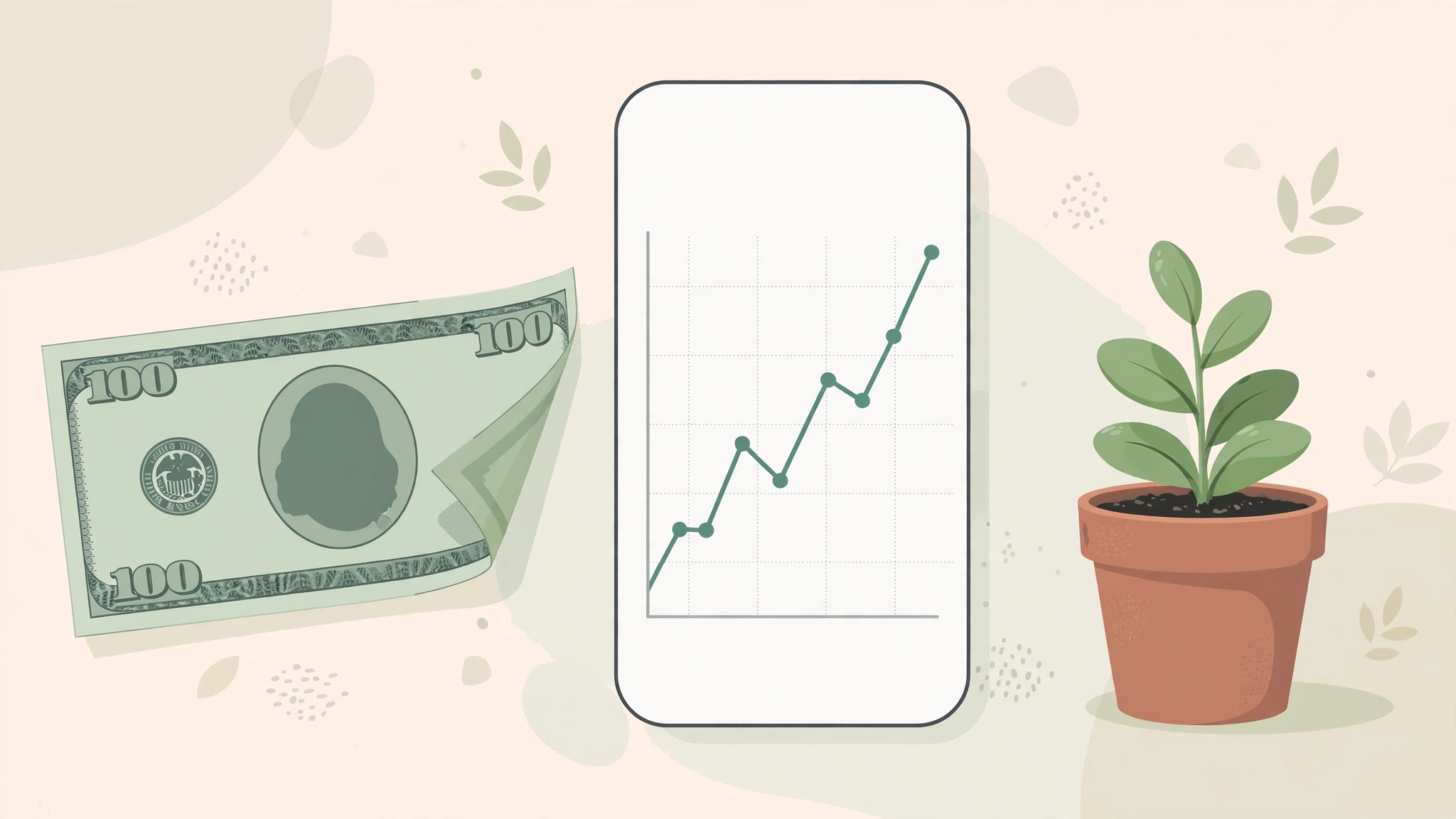
Imagine you open a brokerage account on Monday and deposit 100. You buy a fractional position in a broad market index ETF — one purchase that instantly spreads your money across hundreds of companies, from technology giants to banks, healthcare firms, and manufacturers. By Friday, the market has wobbled and your balance reads 98.40. Nothing has gone wrong; that is simply what markets do on ordinary weeks. A month later it reads 104. Three months later, after a nervous headline or two, 101. The line will zigzag for as long as you own it. What turns that zigzag into wealth is not the first 100 — it is the 50 you add next month, and the month after, each buying its own slice of hundreds of companies at whatever price the day offers.
Now fast-forward. Suppose you keep adding 75 a month — roughly the cost of a couple of takeaway meals — and markets deliver moderate long-term growth. After five years you have contributed about 4,600, and growth may have added a few hundred more. After ten years, contributions pass 9,000, and compounding is visibly helping: your balance can exceed what you put in by a widening margin. None of this is guaranteed, and real markets will hand you frightening months along the way. But notice the engine: a small start, a boring fund, and an automatic habit. That is the entire formula, and it is available to anyone with 100 today.
From $100 to Your First $1,000
The journey from 100 to 1,000 is mostly psychological. Set the milestone, automate the contributions, and watch the balance cross three digits, then four. Many investors find that reaching 1,000 changes how they see themselves — saving and investing stops being an experiment and becomes part of their identity. At that point, consider small upgrades: confirm your fund’s fees are among the lowest available, make sure dividends are set to reinvest, and review whether your contribution can rise by even 10 a month. Each tiny increase compounds for decades. Momentum, once built, is the most valuable asset a small investor owns.
What About Crypto and Other Trendy Options?
New investors often ask whether their first 100 should go into cryptocurrency or a single fashionable stock instead. These assets are far more volatile than a diversified fund — swings of 20 percent in a week are ordinary — and their prices rest heavily on sentiment. If curiosity wins, treat such a purchase as a small experiment with money you can afford to lose entirely, and keep your core plan in the diversified fund. Your financial future should rest on the boring engine, not on the exciting side bet. Learning how markets behave with a stable core portfolio first will also make you a calmer judge of speculative assets later.
Frequently Asked Questions
Is $100 really enough to start investing?
Yes. With fractional shares and low-cost index ETFs, 100 buys a genuinely diversified investment. The amount matters less than starting early and contributing regularly.
What is the best first investment for a small amount?
For most beginners, a single broad, low-cost index fund or ETF is the sensible default: instant diversification, minimal fees, and no need to research individual companies.
How often should I add money?
A fixed amount every payday or every month works well. Regular automatic contributions build the habit and smooth out market ups and downs over time.
The Bottom Line
You do not need to be rich to invest — you need to start. Open a low-cost account, put your first 100 into a diversified index fund or ETF using fractional shares, automate a monthly contribution you can sustain, and let time and compounding do the heavy lifting. Keep fees low, ignore hot tips, and remember that the goal of the first 100 is momentum, not miracles. This article is educational and is not personalized financial advice; consider your own situation and consult a qualified professional for guidance specific to you.