Every few years, mobile networks take a generational leap, and the latest one arrived with enormous promises. To make sense of the marketing, it helps to have 5g explained in plain terms: 5G is the fifth generation of mobile network technology, designed to be faster, more responsive, and able to connect far more devices than 4G. This guide explains how it works, what genuinely improves, and — just as importantly — what 5G does not change.
What 5G Actually Is
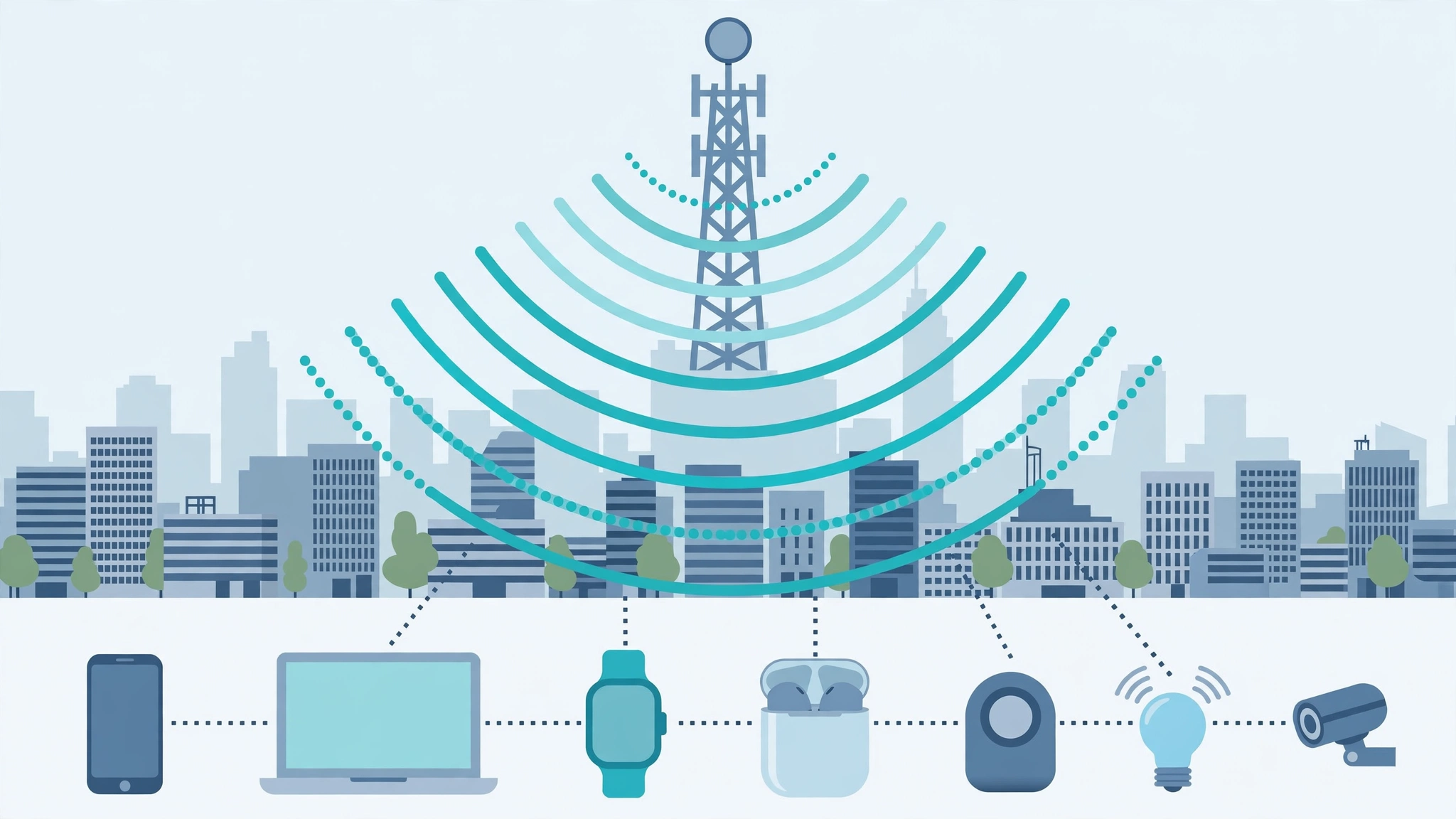
5G is a set of global standards for wireless communication between your phone and the mobile network. Like 4G before it, it carries data over radio waves, but it uses those waves more efficiently and can operate across a wider range of frequencies. The result is a network built not only for smartphones, but also for cars, factories, sensors, and the billions of connected devices expected in the coming years.
A Quick Look Back
Each generation changed what phones could do. 1G brought analogue voice calls, 2G added digital calls and text messages, 3G introduced mobile internet, and 4G made streaming video and app-based life normal. 5G continues that pattern, but its biggest upgrades are about capacity and responsiveness rather than a single headline feature.
How 5G Works: The Three Bands
5G operates across three broad frequency ranges, and understanding them explains most of the confusion around coverage and speed.
Low-Band 5G
Low-band uses frequencies similar to 4G. Signals travel far and pass through walls well, so coverage is broad. Speeds, however, are only modestly better than good 4G. This is the 5G most people in wide areas actually receive.
Mid-Band 5G
Mid-band is the sweet spot: a strong balance of coverage and speed, often delivering several times the performance of 4G. Most experts consider mid-band the true workhorse of 5G, and networks worldwide are racing to expand it.
High-Band (mmWave) 5G
Millimetre-wave 5G offers spectacular speeds — sometimes faster than home fibre — but signals travel only a few hundred metres and are easily blocked by walls, windows, and even rain. It shines in stadiums, airports, and dense city centres, not in suburbs or countryside.
Two More Key Technologies
5G also uses massive MIMO — antennas with many elements that aim focused signals at individual devices — and network slicing, which lets operators carve one physical network into virtual networks tuned for different needs, such as ultra-reliable connections for hospitals or cheap, simple links for sensors.
What 5G Genuinely Changes
- Higher speeds: real-world 5G commonly delivers 100–400 Mbps in mid-band areas, compared with typical 4G speeds a fraction of that.
- Lower latency: responses can arrive in around 10–30 milliseconds, making cloud gaming, video calls, and interactive apps feel snappier.
- Far more capacity: crowded places — concerts, stations, stadiums — stay usable because the network can handle many more simultaneous connections.
- New applications: connected vehicles, remote machinery, smart factories, and large sensor networks become practical at scale.
- A fixed-line alternative: 5G home internet routers now compete with cable and fibre in some areas, especially where wired options are poor.
For businesses, these improvements combine with cloud platforms and AI automation to support real-time monitoring, connected equipment, and staff who can work productively from almost anywhere with a signal.
What 5G Does Not Change
Balanced expectations matter. 5G does not make a slow website fast — if a server or app is sluggish, a faster radio link will not fix it. It does not guarantee coverage: rural areas may wait years for meaningful 5G, and indoor reception still depends on building materials and distance from a mast. It does not replace Wi-Fi, which remains cheaper and better indoors for most homes and offices. And despite dramatic headlines, everyday tasks like messaging, email, and social media feel much the same as on good 4G, because those apps never needed extreme speed in the first place.
About Health and Safety Claims
5G uses radio waves, a form of non-ionising radiation that cannot damage DNA the way X-rays can. Decades of research, reviewed by bodies such as the World Health Organization, have found no established health effects from mobile networks operating within international safety limits. The frequencies and power levels used by 5G fall well within those long-standing guidelines.
5G vs 4G: The Honest Comparison
Think of 4G as a reliable motorway and 5G as a wider motorway with faster entry ramps and room for far more vehicles. Peak speeds rise from roughly 100 Mbps on the best 4G to potentially several gigabits on 5G, latency drops noticeably, and the number of devices per square kilometre the network can support grows by orders of magnitude. In daily use, the most visible differences are quicker downloads, smoother performance in crowds, and more consistent speeds at busy times — improvements, certainly, but evolutionary rather than magical.
Do You Need a 5G Phone?
It is also worth checking whether your current phone already supports 5G without you realising it: many models sold in the last few years include a 5G modem, and the feature may simply be switched off in settings or missing from an older SIM card. Swapping to a 5G-ready SIM and enabling the option costs nothing and takes minutes.
If you are buying a new phone today, 5G support is standard on most mid-range and premium models, so you will likely get it by default. There is rarely a reason to upgrade a working 4G phone purely for 5G unless you live in a strong mid-band coverage area, use your phone as a hotspot, or regularly struggle with congested 4G. Also check your plan: some cheaper tariffs cap speeds or exclude 5G access even if your phone supports it.
The Road Ahead: Standalone 5G and Beyond
Many current networks are “non-standalone,” meaning 5G radios still lean on a 4G core. Fully standalone 5G unlocks the lowest latency and advanced features like network slicing, and it is rolling out progressively. Looking further ahead, researchers are already sketching 6G for the 2030s, but for this decade the story is simple: 5G coverage and quality will keep improving year by year as mid-band networks expand.
5G Around the World: Why Your Experience Varies
If friends in different cities report wildly different 5G speeds, geography and spectrum policy are the reasons. Each country auctions different frequency bands to its operators, and each operator builds at its own pace. Countries that released generous mid-band spectrum early — much of East Asia, parts of Europe, and the United States — tend to offer the strongest everyday 5G. Elsewhere, networks lean on low-band, which covers maps impressively but delivers modest speeds. Terrain matters too: hills, dense buildings, and even the energy-efficient glass in modern offices can weaken signals. When judging 5G, the honest question is never “how fast is 5G?” but “how fast is 5G here, on this network, in this building?”
Why the 5G Icon Can Mislead
The “5G” symbol on your phone simply means a 5G network is available or in use; it says nothing about which band you are on or how fast the connection will be. Some networks also display 5G icons when the actual data still travels partly over 4G in non-standalone mode. A speed test tells the real story, and results at different times of day can vary dramatically as networks get busier.
What 5G Means for Work and Industry
Consumer downloads grab the headlines, but many of 5G’s most valuable uses are industrial. Warehouses use it to coordinate fleets of robots that cannot afford Wi-Fi dead spots. Ports and mines run remotely operated vehicles from safe control rooms, relying on 5G’s low latency. Hospitals experiment with connected ambulances that stream patient data ahead to emergency teams. Farms link sensors and machinery across wide areas where laying cables is impossible. These applications share a pattern: they need connections that are wireless, responsive, and able to handle many devices at once — exactly the combination 5G was designed to provide, and one reason governments treat 5G infrastructure as strategically important.
How to Get the Best From 5G
- Check coverage maps honestly: look at your operator’s mid-band coverage for the places you actually live and work, not national averages.
- Position matters: speeds are best with line-of-sight to a mast; indoors, a spot near a window can transform a 5G home router’s performance.
- Mind your plan: some tariffs throttle speeds after a data allowance or restrict 5G to premium tiers.
- Keep software updated: modem firmware updates regularly improve how phones handle 5G networks.
- Use Wi-Fi where it is better: switching between the two is normal; the best connection is the one that works, not the one with the newest label.
5G and Your Data Allowance
One practical surprise catches many new 5G users: faster connections burn through data allowances much more quickly. A film that took ten minutes to download on 4G — and perhaps made you give up — finishes in under a minute on mid-band 5G, and streaming apps automatically raise video quality when bandwidth allows, using several gigabytes per hour at the highest settings. Speed tests themselves can consume a gigabyte or more on the fastest networks. If your plan has a modest data cap, set download limits in streaming apps, prefer Wi-Fi for large downloads at home, and check whether your operator offers a genuinely unlimited tier before 5G enthusiasm meets an unexpectedly large bill.
What About 5G on Planes, Trains, and at Sea?
Coverage follows people and infrastructure, so 5G is strongest in cities and along major transport routes. Trains increasingly carry onboard systems that blend 5G with Wi-Fi for passengers, and ports use private 5G networks to run cranes and vehicles. In the air and at sea, satellite connections still do the heavy lifting — a reminder that 5G is one tool among several, not a universal replacement for every kind of connectivity.
Frequently Asked Questions
Is 5G faster than Wi-Fi?
It can be, especially compared with older routers, but a modern home fibre connection with good Wi-Fi is usually faster and more consistent indoors. 5G’s advantage is mobility — it works wherever you go, not just near your router.
One last note: your experience will also depend on how many people nearby are using the same mast at the same moment.
Will 5G replace home broadband?
For some households, yes: 5G home internet is a genuine option where fibre is unavailable or overpriced. For heavy users, gamers, and large families, wired fibre generally still offers better consistency and unlimited data.
Does 5G drain phone batteries faster?
Early 5G phones did use more power, particularly on mmWave networks. Newer chipsets are far more efficient, and most phones intelligently switch between 4G and 5G to balance speed and battery life.
The Bottom Line
5G is a real and worthwhile upgrade: faster speeds, quicker responses, and far greater capacity than 4G, delivered across low, mid, and high bands that trade coverage against performance. What it does not do is transform every experience overnight or reach everyone at once. If you understand where your local coverage sits on that spectrum, you can judge the marketing calmly, choose the right phone and plan, and enjoy the improvements 5G genuinely delivers. It also helps to remember that networks are still young: the 5G you use this year will very likely be noticeably better next year, as operators light up more mid-band spectrum, switch on standalone cores, and fill in the gaps. You do not need to chase every development — just check your coverage and plan once in a while, and let the network’s steady progress work in your favour.