How to Build a Three-Fund Portfolio
Introduction: Three Funds, Almost Everything Investable
For a beginner investor, managing a diversified portfolio can be a daunting task. With so many investment options and a vast array of assets to choose from, it’s easy to feel overwhelmed. However, there is a simpler way to approach investing: the three-fund portfolio.
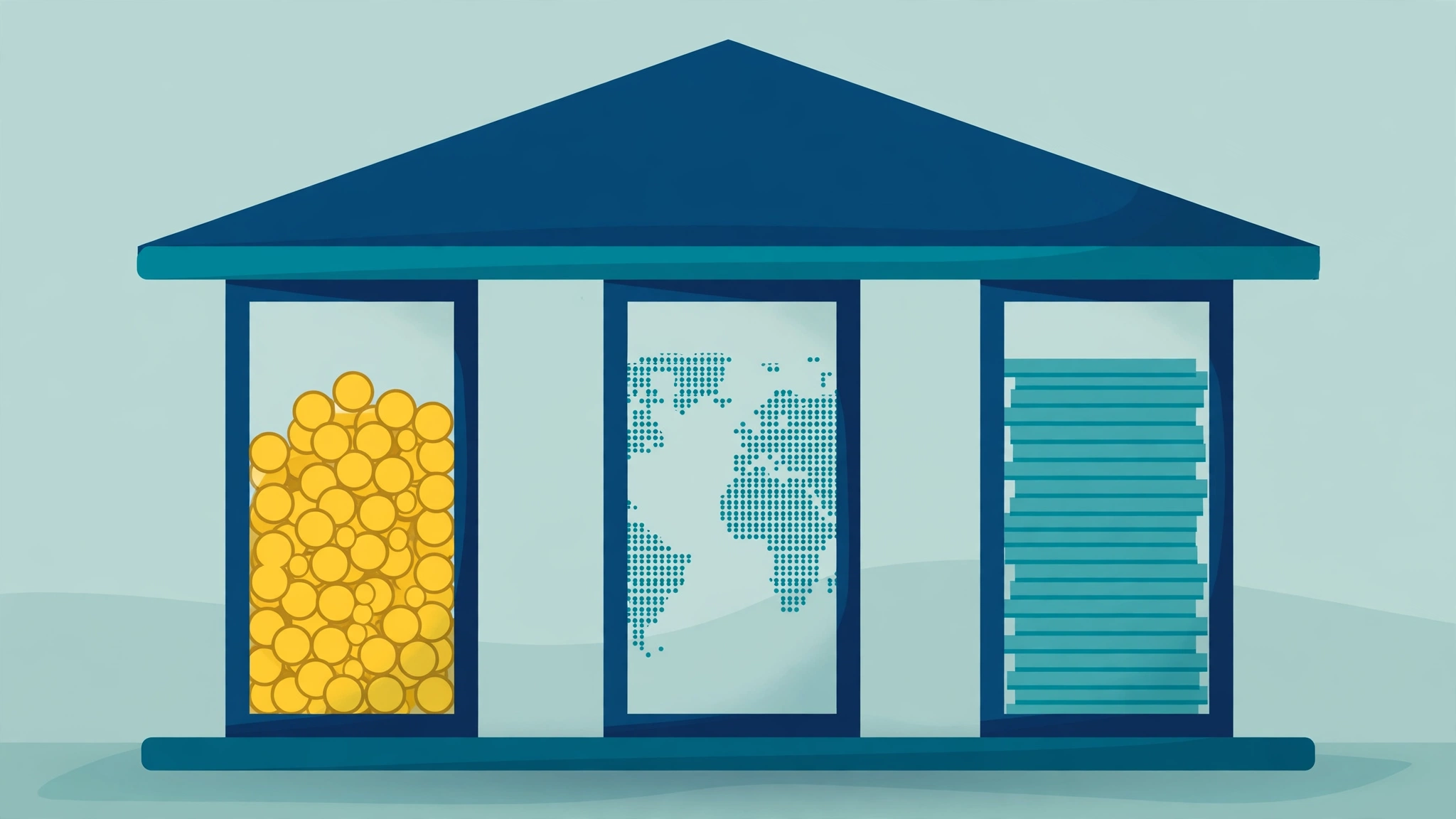
This approach involves combining three specific types of funds to cover most of the world’s investable markets. The three funds are a total US stock index fund, a total international stock index fund, and a total bond index fund. By including these three funds in a portfolio, you’re able to capture the performance of nearly every asset class and geographic region.
This strategy is not a magic bullet, and it’s not a get-rich-quick scheme. It does require some fundamental decisions and ongoing maintenance. But, for a beginner investor, it’s a more approachable and sustainable way to manage risk and grow your portfolio over the long term.
So, what are the key ingredients of this strategy? First, you’ll need to select three funds that track their respective markets. The first fund will be a US stock index fund, which will provide exposure to the US equity market. The second fund will be an international stock index fund, which will capture the performance of non-US developed markets. The third fund will be a total bond index fund, which will include a broad range of fixed-income securities.
Now, the real decision: how to split your portfolio between these three funds. There is no one-size-fits-all answer, as this will depend on your individual financial goals, risk tolerance, and time horizon. However, a common approach is to allocate a fixed percentage to each fund. For example, a 60/20/20 split – 60% US stocks, 20% international developed markets, and 20% bonds.
Ultimately, the upkeep of this portfolio will be a regular process, involving periodic rebalancing and monitoring of your investments. It’s essential to stay informed, but not to try to time the market or make emotional decisions. By following this strategy and being patient, you’ll be well on your way to creating a solid foundation for your investment journey.
If three funds still feel like three too many, target-date funds: the one-fund alternative collapses the same ingredients into a single ticker that rebalances itself.
Each of those ingredients usually arrives inside a fund wrapper, and what a mutual fund is, and how an ETF wraps the same idea differently explains the two wrappers you will meet first.
Each ingredient can arrive in either of the two wrappers, and ETFs vs mutual funds compared: fees, taxes and minimums side by side scores the wrappers before you pick one for the job.
The Three Ingredients and What Each One Does
When building a diversified portfolio, it’s easy to get caught up in trying to time the market or pick individual winners. However, a more effective approach is to focus on broad, long-term investments that are less volatile and can provide a steady foundation for your portfolio. At the heart of this strategy is a three-fund portfolio, which combines three different types of investments: stocks, international companies, and bonds.
The US Fund
The US Fund is the foundation of your portfolio, and it’s made up of thousands of American companies, large and small. This portfolio is an index fund: a vehicle that tracks a specific market index, such as a total US market index, and essentially mirrors the performance of that index, providing broad diversification and reducing the risk of individual stock picks. If the term is new to you, start with what an index fund is and how it works. By investing in the US Fund, you’re essentially buying a tiny piece of the entire US economy, which can be a powerful way to build wealth over the long term.
The International Fund
The International Fund takes the diversification of the US Fund to the next level by adding companies based outside the US. Again, this portfolio is an index fund, and it tracks a global market index, such as the MSCI EAFE Index. By investing in the International Fund, you’re exposing yourself to foreign markets and companies, which can provide a unique set of risks and rewards. While this portfolio may be more volatile than the US Fund, it can also provide access to growth opportunities that may not be available in the US market.
The Bond Fund
The Bond Fund is the third and final ingredient in our three-fund portfolio, and it’s designed to provide a stable source of income and ballast in times of market volatility. This portfolio invests in bonds, which are essentially loans to governments and companies. While bonds may not be as exciting as stocks, they can provide a relatively stable source of returns, especially in times of economic uncertainty. By investing in the Bond Fund, you’re essentially lending money to companies and governments, which can provide a steady stream of income over the long term.
In the next section, we’ll explore how to combine these three ingredients into a single portfolio that meets your individual needs and goals.
The Only Real Decision: Your Split
Once you have chosen your three funds — a total stock market fund, a total international stock fund, and a total bond market fund — the recipe itself is settled. What is not settled is the proportions. That is the only real decision left, and it belongs to you alone.
Two things drive it: your timeline and your temperament.
Your Timeline
Money you expect to spend soon has very little time to recover from a rough stretch in the market. Money you will not touch for decades has many chances to work through one. So the closer the spending date, the more the balance tilts toward bonds, which historically swing less than stocks — though less swinging is not the same as no risk. A hypothetical illustration: imagine you have set aside $20,000 for a house down payment you expect to make in about two years. That money has a short job and a short deadline, so a bond-heavy mix fits it better than a stock-heavy one would. Now imagine $20,000 aimed at retirement forty years out. That money can afford a very different mix, because it has time on its side. Neither example is advice about your own numbers. And if you are also putting money into a tax-advantaged account, the IRS sets the annual contribution limit, and that figure changes over time, so confirm the current one rather than trusting a number you remember.
Your Temperament
The best split on paper is worthless if you abandon it in a bad year. So test yourself honestly. Picture your account down a third, the headlines ugly, and a friend announcing they have moved everything to cash. Would you buy more, hold steady, or sell? Your truthful answer tells you more about your split than any formula does. If you would sell, you probably need more bonds than you think — not because bonds are safe in some absolute sense, but because a smaller swing is a swing you can actually sit through. If a steep drop genuinely does not rattle you, you can lean further toward stocks.
Some people describe a starting point loosely, in terms like 90/10 or 60/40 stocks to bonds, with the stock side divided between US and international. Treat any percentages you see, including those, as illustrations of the idea rather than a recommended allocation. Your own figure may look nothing like them, and that is fine.
If you want the mechanics of spreading money across many holdings rather than just dividing it into three buckets, our walkthrough on how to build a diversified portfolio step by step covers the details.
Whatever you land on, write the split down along with the reason behind it. Future you, reading that note during a miserable month, will be grateful. Then check the mix once or twice a year, nudge it back toward your targets, and otherwise leave it alone. A plan you can hold is worth more than a cleverer plan you will not.
If rebalancing by hand sounds like the part you would skip, robo-advisors explained: fees, features and who they suit covers the services that automate exactly this portfolio for a small fee.
Building It and Keeping It: Accounts, Buying and Rebalancing
All three funds can live in a single account. You do not need a separate account for your domestic stock fund, your international stock fund, and your bond fund; one brokerage account or one retirement account can hold the entire mix. That simplicity is the point. One login, one statement, one set of proportions to remember. Where you hold the portfolio does matter for taxes, and the general idea is that different account types are taxed differently, but the details depend on your own circumstances and the rules change over time, so it helps to read the basics from Investor.gov, the SEC’s introduction to investing before you decide.
Buying In at Your Target Mix
Set your target percentages first, then buy toward them. If you settled on 60 percent domestic stocks, 30 percent international stocks, and 10 percent bonds, buy in roughly those proportions. Most brokers let you enter a dollar amount for each purchase, so you can approximate the split even when you are starting small. If your account supports automatic recurring investments, set those amounts to match your targets and the routine buying largely runs itself.
Suppose, purely as a hypothetical illustration, you invest $1,000 a month. At a 60/30/10 target that means $600 into the domestic fund, $300 into the international fund, and $100 into the bond fund. Round numbers used only to show the arithmetic, with no particular outcome implied.
Rebalancing Without Selling
Markets move, so the mix you actually hold will drift away from the mix you chose. Stocks are the more volatile piece of a three-fund portfolio and can rise or fall sharply relative to bonds, which nudges the stock share away from your target. Rebalancing pulls it back.
Check once a year, and no more often than that. Pick a date you will remember, such as your birthday or the first week of January, and look at what you actually own. Then compare it against your written targets.
- Direct new contributions first. If bonds have slipped to 7 percent while your target is 10 percent, send your next few contributions to the bond fund until the gap closes. This corrects the drift without selling a thing.
- Sell only when contributions cannot close the gap. Trimming a holding that has run far ahead is sometimes necessary, and it is simpler inside a tax-advantaged account than in a taxable one.
- Keep the target in writing. A written plan makes it harder for a strong year or a rough month to change your mind.
Some brokers offer automatic rebalancing, and target-date funds handle the shifting for you. Either approach is reasonable. What matters is that the annual check happens on a schedule rather than in reaction to headlines, and that you understand what your portfolio holds when you make it.
A Hypothetical Example: A $300-a-Month Three-Fund Split
Let’s walk through the mechanics with a purely hypothetical example. The numbers below are round figures chosen to make the arithmetic easy to follow. They are not a projection of what your account could be worth, and they are not a recommendation about how to divide your money.
Imagine you set aside $300 a month in contributions, and you split it like this:
- $180 to the US total market fund — 60% of the monthly contribution
- $60 to the international fund — 20% of the monthly contribution
- $60 to the bond fund — 20% of the monthly contribution
That adds up to $300, and the proportions add up to 100%. Over twelve months, your contributions total $3,600: $2,160 into the US fund, $720 into the international fund, and $720 into the bond fund. Again, that $3,600 is simply money you put in. It says nothing about what the account might be worth later.
Notice what this example does not include. There is no ending balance, no growth figure, and no timeline to a goal. Building one would mean inventing a rate of return, and nobody can honestly tell you what the markets will do. The value of the illustration is in the mechanics: how one monthly amount becomes three separate purchases, and how your chosen percentages set the size of each.
Why the Split Is Only an Illustration
The 60/20/20 mix here is one of many possible combinations, chosen because the math is clean. It is not a suggested allocation for your age, your timeline, or your comfort with ups and downs. A different mix, say more bonds or more international exposure, would divide the same $300 differently and still total $300.
What stays the same in every version is the process. You pick a total, you pick percentages, and you direct each fund accordingly. Then you keep contributing and, at least once a year, check whether the funds have drifted from your targets.
One practical note: which accounts you can use, how much you can put in, and any tax treatment are set by rules and authorities that change over time. Check current guidance before acting on any example, including this one.
The Bottom Line
A three-fund portfolio is the complete investing strategy reduced to its skeleton: one fund for US stocks, one for international stocks, one for bonds. There is nothing left to research each month, no manager to monitor, and almost no way to complicate it – which is precisely why so many long-term investors end up here.
Your real work is choosing a split you can hold through a frightening year, then rebalancing back to it about once a year, ideally with new contributions. Confirm each fund’s current fee and the index it tracks on the provider’s page before buying, and let the boring structure do what it is designed to do.
Disclaimer: This article is for educational purposes only and is not financial, tax, or legal advice. Investing involves risk, including the possible loss of principal. Examples are hypothetical and do not represent actual or future returns. Consider speaking with a qualified financial or tax professional about your own situation.