A diversified portfolio is the closest thing investing has to a free lunch. It cannot guarantee profits, and it will not make you rich overnight, but it can dramatically reduce the damage any single investment can do to your savings — without giving up the long-term growth you are investing for in the first place.
This step-by-step guide shows you exactly how to build one: what diversification really means, which building blocks you need, how to decide your mix, and how to keep it on track with a few minutes of attention each year.
What Diversification Actually Means
Diversification means spreading your money across different investments so that no single company, industry, or country can sink your whole portfolio. If one holding falls sharply, others may hold steady or rise, softening the overall blow.
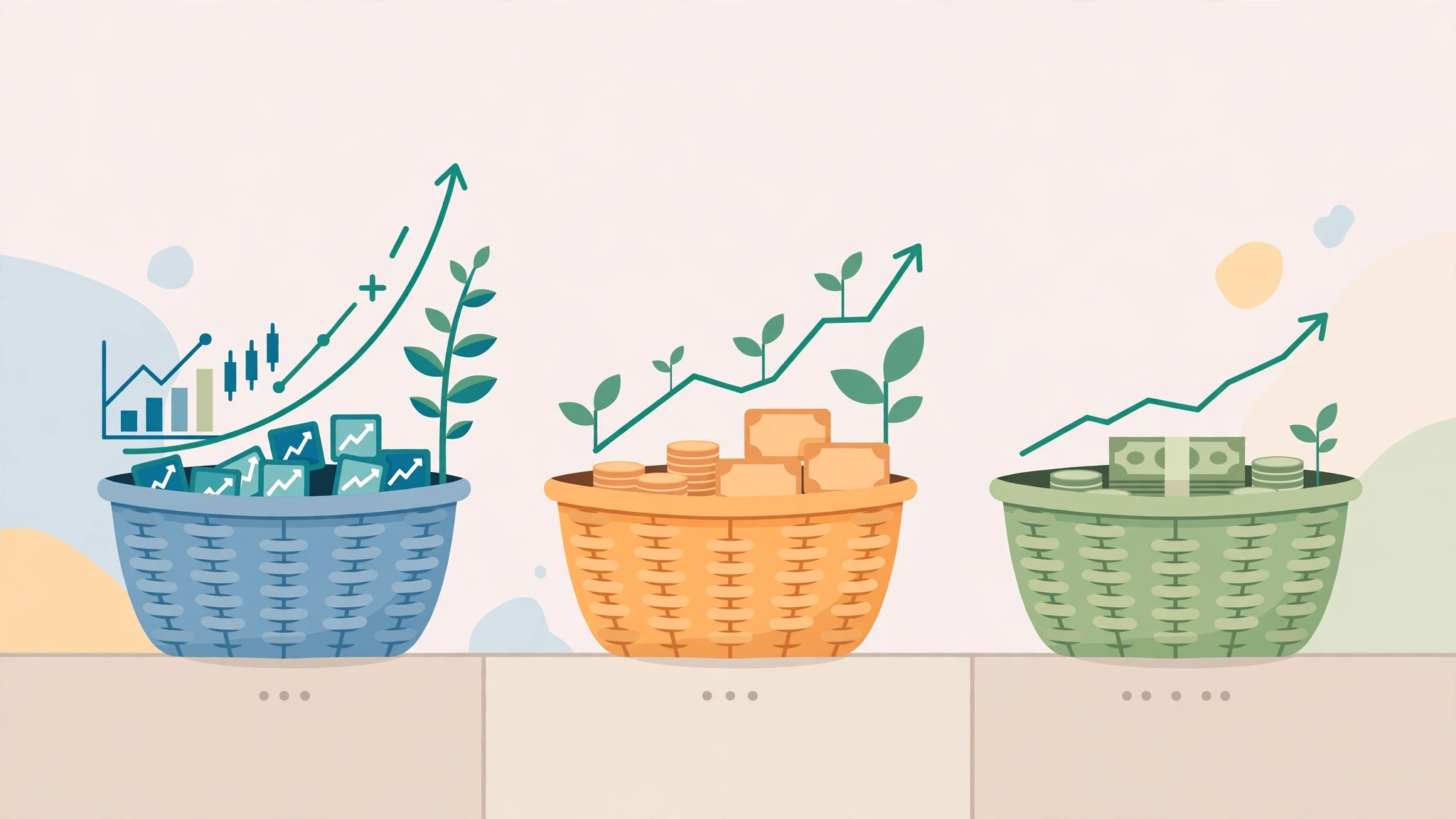
True diversification works on several levels at once. You diversify across companies (owning hundreds instead of one), across industries (technology, healthcare, energy, and more), across countries (your home market plus international markets), and across asset classes (stocks, bonds, and cash-like holdings, which behave differently in the same economy).
What diversification is not
Owning six different technology stocks is not diversification — they will mostly rise and fall together. Neither is owning three funds that all track the same index. Real diversification means your holdings respond differently to the same events, so your overall ride is smoother than any single part of it.
Step 1: Set Your Goal and Time Horizon
Every portfolio decision flows from two questions: what is this money for, and when will you need it? Money for a house deposit in two years belongs in safe, stable places. Money for retirement in thirty years can ride out market storms in growth-oriented investments, because there is time to recover from every dip.
Write your goal in one sentence, with a date attached. That sentence becomes your anchor whenever headlines tempt you to abandon the plan.
Step 2: Understand the Main Building Blocks
Stocks
Stocks are ownership slices of companies. They have historically delivered the highest long-term returns and the sharpest short-term swings. In a diversified portfolio, stocks are the growth engine.
Bonds
Bonds are loans to governments and companies that pay interest. They are generally steadier than stocks and often hold up better when stock markets fall, which makes them the portfolio’s shock absorbers.
Cash and money market funds
Cash equivalents earn little but are stable and available. They suit short-term goals and emergency reserves rather than long-term growth.
Broad funds that bundle them
Index funds and ETFs bundle hundreds of stocks or bonds into one purchase, giving you instant diversification inside each asset class. As our beginner’s guide to investing explains, these funds are the simplest tools for building a portfolio without researching individual companies.
Step 3: Choose Your Asset Allocation
Asset allocation — your percentage split between stocks and bonds — is the single most important decision in portfolio building. It determines most of your returns and nearly all of your ups and downs.
A common starting framework links stock allocation to age and temperament. Younger investors with decades ahead often hold 80 to 100 percent in stocks. Investors closer to their goal often hold more bonds, such as a 60/40 stock-to-bond split. These are starting points, not rules: the right allocation is the most growth-oriented one you can hold without panic-selling during a crash.
A simple self-test
Imagine your portfolio falls 25 percent in a bad year — because portfolios with heavy stock allocations sometimes do. If that thought makes you want to sell everything, your allocation is too aggressive. Dial back the stocks until a bad year feels uncomfortable but survivable. A slightly conservative portfolio you actually keep beats an aggressive one you abandon.
Step 4: Pick Your Funds
With your allocation decided, choose a small number of broad, low-cost funds to fill it. A classic three-fund structure covers nearly everything:
- A total stock market index fund for your home country’s stocks.
- An international stock index fund for companies outside your home market.
- A total bond market index fund for stability and income.
Some investors simplify further with a single target-date fund, which holds a pre-mixed, gradually more conservative portfolio inside one fund. That is a perfectly reasonable choice, especially inside retirement accounts.
Whatever you choose, check the expense ratio. Broad index funds commonly charge under 0.20 percent per year, and many charge far less. Fees are one of the few things you fully control, and they compound against you just as returns compound for you.
Step 5: Decide Your International Split
Investors naturally favor their home country’s stocks, but the rest of the world offers real diversification: different economies, currencies, and industries. A common approach is to hold roughly 20 to 40 percent of your stock allocation in international funds. There is no single correct number — what matters is choosing a split you can stick with through years when one region outperforms the other.
Step 6: Fund the Portfolio and Automate It
Open the appropriate account (a retirement account first if you have access to one, for its tax advantages), make your initial purchases according to your target percentages, and set up an automatic monthly contribution. Automation turns portfolio building from a project into a habit, and new contributions naturally flow toward whichever part of your plan needs them.
If you receive a windfall — a bonus, a tax refund, an inheritance — decide in advance that it will be invested according to the same allocation, rather than waiting for a “better time” that may never announce itself.
Step 7: Rebalance Once or Twice a Year
Over time, your winners grow faster than the rest, and your allocation drifts. A 70/30 portfolio can quietly become 80/20 after a strong stock market run — riskier than you intended. Rebalancing means trimming what has grown beyond its target and adding to what has lagged, restoring your original mix.
Rebalancing feels wrong — you sell a little of what is winning to buy what is not — but it enforces buy-low, sell-high discipline automatically. Many investors rebalance on a fixed date each year, or when any allocation drifts more than five percentage points from target. Inside retirement accounts, rebalancing has no tax consequences; in taxable accounts, you can often rebalance simply by directing new contributions to the lagging side.
Common Diversification Mistakes
- False diversification: many funds, all holding the same big stocks.
- Home-country tunnel vision: ignoring international markets entirely.
- Chasing last year’s winner: rotating into whatever just performed best.
- Overcomplicating: fifteen funds where three would do, making the portfolio impossible to monitor.
- Forgetting cash goals: investing money you will need soon in volatile assets.
- Never rebalancing: letting drift silently change your risk level.
Diversifying Within Each Asset Class
Allocation between stocks and bonds is the first layer of diversification, but there is a second layer inside each class. Within stocks, a total market fund spreads you across large, mid-sized, and small companies, and across growth and value styles — businesses at different stages that tend to shine in different economic conditions. Adding international funds extends that spread across currencies and political systems, so a downturn in any single country cannot dominate your results.
Within bonds, diversification means mixing maturities and issuers. Short-term bonds react less to interest-rate changes; longer-term bonds pay more but swing more. Government bonds offer safety; high-quality corporate bonds offer somewhat higher interest with somewhat higher risk. A total bond market fund blends all of these automatically, which is why it is the default choice in simple portfolios.
Watch Out for Concentration You Did Not Choose
Sometimes a portfolio becomes concentrated by accident. The most common example is employer stock: if you work for a publicly traded company and receive shares or buy them through a company plan, a large share of your wealth — on top of your salary — can depend on one firm’s fortunes. If that firm stumbles, your job and your savings are hit at the same time. Many advisors suggest keeping any single company’s stock to a small fraction of your total portfolio, whatever its source.
The same caution applies to a stock you inherited, a cryptocurrency position that ballooned, or a single property dominating your net worth. Diversification reviews should look at your whole financial picture, not just the account labeled “investments.”
A Worked Example: One Beginner’s Portfolio
Consider a 30-year-old saving for retirement with a moderate comfort for risk. She chooses an 80/20 stock-to-bond allocation. Her stocks split between a total US market fund and an international fund; her bonds sit in a total bond market fund. She contributes automatically each payday, split in the same proportions.
Three years later, strong stock markets have pushed her allocation to 86/14. At her annual review, she directs new contributions entirely to bonds for a few months and sells a small slice of stocks inside her retirement account to restore 80/20. Total time spent: under an hour a year. No predictions, no stock research, no stress — yet her portfolio holds thousands of securities across dozens of countries, and its risk level stays exactly where she chose it. That is the entire system, and it scales from a few hundred in savings to a lifetime of wealth building.
How Diversification Feels in Practice
New investors sometimes expect a diversified portfolio to rise steadily and feel disappointed the first time it falls. It will fall — in a serious market crash, a stock-heavy diversified portfolio can drop 20 to 30 percent before recovering. The benefit of diversification is not avoiding declines; it is avoiding disasters. A concentrated investor can lose 80 percent in a single company’s collapse and never recover, because recovery requires capital that no longer exists. The diversified investor’s decline, by contrast, is spread across thousands of companies, and history shows broad markets have eventually recovered from every crash so far.
Diversification also changes your emotional experience month to month. When some holdings zig while others zag, the overall line is calmer, statements are less shocking, and the temptation to make drastic changes fades. Many investors underestimate this behavioral benefit, yet it is often the difference between a plan that survives thirty years and one abandoned in year two. Your portfolio does not need to be exciting. It needs to be standing, growing, and intact when your future self comes to collect it.
Frequently Asked Questions
How many investments do I need to be diversified?
Fewer than you think. Two or three broad index funds can hold thousands of underlying securities across countries and asset classes. Diversification is about what your funds hold, not how many lines appear in your account.
Does diversification guarantee I will not lose money?
No. In broad market crashes, most investments fall together for a while, and a diversified portfolio will fall too — usually less than a concentrated one. Diversification reduces risk; it does not eliminate it.
How often should I check my portfolio?
Once or twice a year is enough for most long-term investors, mainly to rebalance and confirm your plan still matches your goals. Checking daily mostly creates stress and tempts you into changes that rarely help.
The Bottom Line
Building a diversified portfolio is a sequence of calm, ordinary decisions: set a goal, choose a stock-bond mix you can live with, fill it with a few broad low-cost funds, automate your contributions, and rebalance on schedule. No stock tips, no market timing, no drama. That quiet structure is exactly what lets ordinary investors capture the market’s long-term growth while sleeping at night.
This article is educational content, not personalized financial advice. Consider your own goals, timeline, and risk tolerance, and consult a qualified financial professional before making investment decisions.