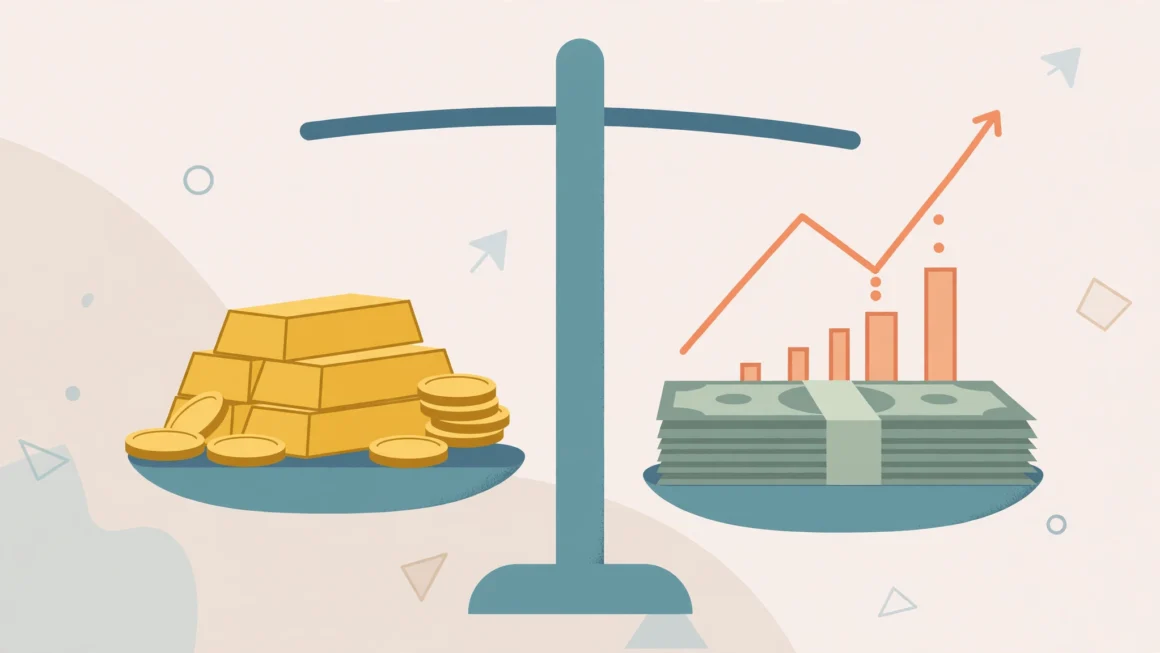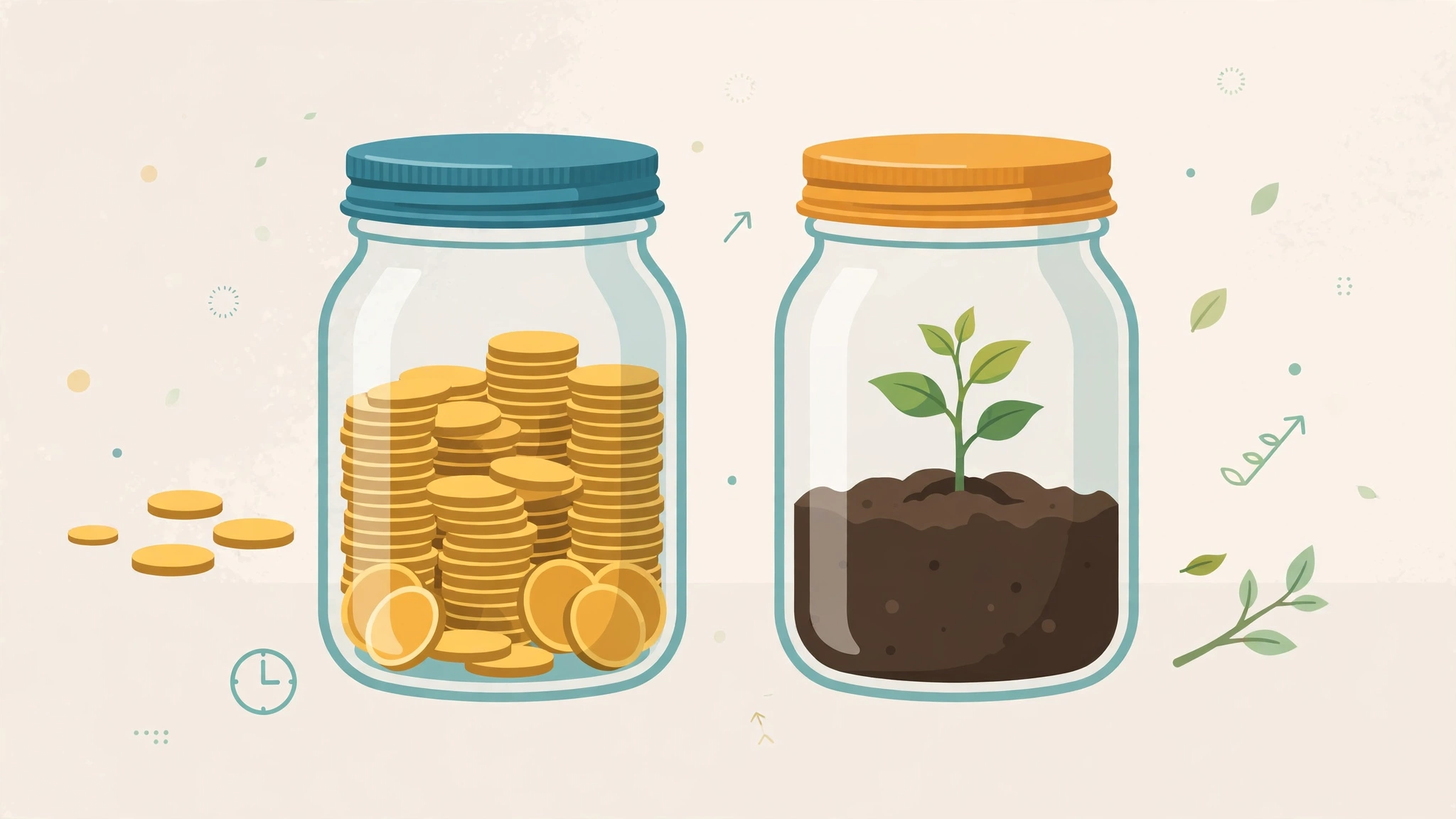
Ask a room of beginners what they should do with spare money and you will start an argument: one side swears by the safety of savings, the other by the growth of investing, and both talk as if you must pick a team. The truth is less dramatic and far more useful. In the saving vs investing question, neither tool is “better” — they are different instruments built for different jobs, and nearly every healthy financial life uses both at once. Saving protects money you cannot afford to lose and may need soon. Investing grows money you will not need for years, accepting ups and downs in exchange for returns that can outpace inflation. This guide explains how each works, the honest risks of both, and a simple framework for deciding where every spare pound or dollar belongs.
What Saving Actually Is
Saving means putting money somewhere safe and accessible — a bank or building society account — where the balance does not fall in value and you can withdraw it when needed. In most countries, deposits are protected up to a limit by a government-backed scheme, which makes saving the closest thing in finance to a certainty: the number you see is the number you can spend.
In exchange for that safety, you accept a modest interest rate. Savings accounts pay variable rates that rise and fall with the central bank’s decisions, and easy-access accounts — the most flexible kind — usually pay less than fixed-term ones that lock your money away. Saving’s superpower is not growth. It is reliability: the money is there, in full, on the exact day life demands it.
What Saving Is For
- An emergency fund covering essential expenses for three to six months
- Goals arriving within the next one to three years: a holiday, a car repair fund, next year’s tax bill
- Money already committed: deposits, fees, and purchases with a fixed date
- Peace of mind — the buffer that stops a bad week becoming a debt spiral
What Investing Actually Is
Investing means buying assets — shares in companies, bonds, property funds, and similar instruments — whose value moves up and down, with the aim of growing your money over years. When you invest, you are putting capital to work in the real economy: companies build, lend, and sell, and investors share in the results through rising prices and income payments.
The bargain is explicit. In exchange for accepting that your balance can fall — sometimes sharply, sometimes for years — you gain access to long-run returns that have historically beaten inflation by a comfortable margin. Diversified stock markets, for example, have delivered average returns well above savings rates across long periods, though never in a straight line and never with a guarantee. Investing’s superpower is growth. Its price is patience and nerve.
What Investing Is For
- Retirement, typically decades away
- Long-term goals seven or more years out: financial independence, children’s future funds
- Money you can genuinely leave untouched through a market crash
- Beating inflation over the long run, which savings alone rarely achieve
The Risk Nobody Mentions: Saving Has One Too
Saving feels risk-free because the number never drops. But there is a second way to measure your money: what it can buy. Inflation steadily shrinks the purchasing power of cash. If your savings account pays 3% while inflation runs at 5%, your balance grows and your wealth shrinks — you can buy about 2% less each year with money that looks, on the screen, like it is increasing. Over one year, that is an annoyance. Over thirty years of retirement saving, it is the difference between comfort and struggle: cash left entirely in savings across a working lifetime has historically lost a large share of its real value.
Investing carries the opposite profile: visible, sometimes frightening short-term risk, in exchange for protection against that slow, invisible long-term risk. Neither risk is imaginary. The skill is matching each risk to the money that can afford it. If you are building your foundations, our investing for beginners guide shows how the two tools combine in a first complete plan.
A Simple Framework: The Three Questions
For any spare money, ask three questions in order.
1. When Will I Need This Money?
This is the master question. Needed within about three years: save it. A market fall just before a house purchase or a wedding is not a learning experience; it is a disaster with a date. Needed in seven years or more: investing becomes the sensible default, because time gives markets room to recover from their inevitable falls. Between three and seven years, a cautious blend — mostly savings, perhaps some lower-risk investments — usually fits.
2. What Happens If It Falls 30% at the Wrong Moment?
If the honest answer is “the goal collapses” or “I would have to borrow,” the money does not belong in investments yet, whatever the timeline says. If the answer is “annoying, but the goal survives and I could wait,” investing is on the table. This question protects you from the costliest beginner error: being forced to sell at the bottom because life needed the cash.
3. Is My Safety Net Already Funded?
Investing before you have an emergency fund is building the roof before the walls. The first savings goal for almost everyone is a starter cushion — even one month of expenses changes your resilience — growing toward three to six months. Only money above that cushion, and beyond near-term goals, is truly free to be invested.
How the Balance Changes Through Life
The saving-investing mix is not set once; it breathes with your circumstances. A young worker with a secure job might hold a modest emergency fund and invest most of every surplus, because time is their greatest asset. Someone saving for a deposit in two years shifts heavily toward cash as the date approaches, whatever the market is doing. Approaching retirement, many people rebuild a larger cash buffer — a few years of spending in savings — so that a market crash early in retirement cannot force them to sell investments cheaply to pay the bills. None of these is the “right answer” in the abstract; each is the right answer for a timeline.
A Worked Example
Imagine Maya, who has 800 a month available after essentials. She has no emergency fund and two dreams: a trip in eighteen months costing 2,400, and retirement in thirty years. A sensible split: 500 a month builds her emergency fund in a high-interest savings account until it covers three months of expenses; 150 a month fills the trip fund, also in savings, finishing exactly on time; 150 a month starts a diversified investment for retirement, small but immediate, so compounding and habit begin now. Once the emergency fund is full, its 500 is redirected — part to investing, part to the next goal. Every pound has a job matched to its deadline.
Common Mistakes at Both Extremes
- Investing the emergency fund because savings rates look boring — discovered, painfully, at the first job loss that coincides with a market dip.
- Saving everything forever out of fear, then reaching retirement with a balance that inflation has quietly halved.
- Investing money with a date attached — deposits, tuition, tax bills — where a fall cannot be waited out.
- Stopping one to do the other: pausing all investing to oversave a giant cash pile, or draining savings to chase a hot investment tip. Both abandon the framework.
- Judging by last year’s returns: the correct split comes from your timelines, not from which tool recently performed better.
Getting the Best From Each Tool
Choosing the split is only half the work; each side also has a “done well” version and a lazy version. On the savings side, the interest rate matters more than most people bother to check. The gap between the best easy-access accounts and the worst can be several percentage points — on a meaningful emergency fund, that is real money every year for the ten minutes it takes to switch. Keep savings in accounts covered by your country’s deposit protection scheme, stay within the protected limit per institution, and review the rate a couple of times a year, because banks quietly cut rates on old accounts while advertising better ones to new customers.
On the investing side, doing it well mostly means keeping costs low and diversification high. A single broad, low-cost index fund or a simple multi-asset fund covers most beginners’ needs; layers of expensive funds and frequent trading almost always subtract more than they add. Use tax-advantaged accounts where your country offers them, contribute automatically so the habit survives busy months, and rebalance occasionally rather than constantly. Notice the pattern on both sides: the wins come from setup and housekeeping, not from brilliance. Savings reward the person who shops for a rate once a year. Investments reward the person who chooses a sensible fund once and then mostly leaves it alone. Neither tool asks you to be clever every week — both ask you to be organised once and consistent thereafter.
It is also worth naming what neither tool can do. Saving cannot make you wealthy by itself, and investing cannot protect next month’s rent. Expecting either to do the other’s job is the root of nearly every disappointment in this area — and the reason the answer to “which one?” is almost always “both, in the right order, for the right goals.”
Frequently Asked Questions
How much should I keep in savings before investing?
A common guideline is three to six months of essential expenses, adjusted for your job security and responsibilities. Freelancers and single-income households often aim higher; dual-income households with stable jobs may be comfortable at the lower end. Build at least a small starter cushion first, then invest alongside completing it.
Can I lose money in a savings account?
Your balance will not fall in money terms, and deposits are usually government-protected up to a limit. But if the interest rate is below inflation, you lose purchasing power every year — a real loss, just an invisible one.
Is it ever too late to start investing the long-term portion?
Rarely. Even a ten-to-fifteen-year horizon gives diversified investments a reasonable chance to outgrow savings, and the alternative — cash losing real value for decades — is itself a decision with consequences. The timeline framework matters more than your age alone.
The Order of Operations, Summarised
If you want the whole framework as a sequence, it looks like this. First, save a starter emergency cushion — even a few hundred in an accessible account changes how a crisis feels. Second, clear high-interest debt, because its guaranteed cost beats any uncertain investment return. Third, complete the emergency fund to your chosen level of three to six months of essentials. Fourth, save deliberately for any goals arriving within the next three years, each in its own labelled pot. Fifth, invest everything genuinely long-term — retirement and distant goals — in diversified, low-cost funds, automatically, every month. Then maintain: top the savings pots up as goals approach, keep investing through market weather, and revisit the split once or twice a year. Thousands of words of personal finance advice reduce, in the end, to that paragraph — because the order, more than any clever product choice, is what makes the system work.
The Bottom Line
Saving and investing are not rivals; they are the two halves of a working financial life. Save the money that protects you and funds the near future — it must be safe, liquid, and boring. Invest the money whose job is growth across many years — it must be diversified, patient, and left alone. Decide with three questions — when do I need it, what if it falls, and is my safety net funded — and the saving vs investing debate dissolves into what it always should have been: a plan.
This article is educational content only and is not personalized financial advice. Consider your own circumstances, or speak with a qualified adviser, before making financial decisions.