Stocks get the headlines, but bonds quietly do much of the heavy lifting in the world’s portfolios. If you have ever wondered how bonds work, the short answer is simple: a bond is a loan you make to a government or a company, and in return they pay you interest and promise to give your money back on a set date. That simplicity is exactly why bonds are worth understanding. They can provide steady income, soften the ups and downs of a stock portfolio, and help you plan for goals where you cannot afford nasty surprises. This guide explains bonds in plain language — what they are, how they pay you, the main types you will meet, the real risks involved, and how to decide when bonds deserve a place in your own plan.
What Is a Bond, Really?
When a government needs to build roads or a company wants to open a new factory, it can borrow money from thousands of ordinary investors instead of going to a single bank. It does this by issuing bonds. Each bond is a standardized loan with written terms: how much is borrowed, how long for, and how much interest will be paid along the way.
When you buy a bond, you become the lender. The issuer — the borrower — owes you two things: regular interest payments, called coupons, and the return of the original amount, called the principal or face value, when the bond reaches its maturity date. A typical bond might have a face value of 1,000, pay 4% interest per year in two instalments, and mature in ten years. Buy it, hold it, and you know in advance exactly what cash you are scheduled to receive and when.
The Key Terms in Plain English
- Face value (par value): the amount repaid at maturity, often 1,000 per bond.
- Coupon rate: the interest rate printed on the bond, used to calculate your payments.
- Coupon payment: the actual interest cash you receive, usually every six months.
- Maturity date: the day the loan ends and the principal is repaid.
- Yield: your effective return, which depends on the price you actually paid.
- Issuer: the government or company that borrowed the money.
That last term, yield, matters more than beginners expect. Bonds can be bought and sold before maturity, and their prices move. If you pay less than face value for a bond, your yield is higher than its coupon rate; pay more, and your yield is lower. Price and yield always move in opposite directions, like the two ends of a seesaw.
How Bonds Pay You
Bonds can reward you in two ways. The first and most obvious is interest income. Those regular coupon payments arrive on a predictable schedule, which is why retirees and cautious investors value bonds: the cash flow is known ahead of time, unlike stock dividends, which a company can cut whenever it likes.
The second way is through price changes. If you buy a bond and interest rates in the wider market later fall, your bond — with its higher, older coupon — becomes more attractive, and its market price rises. You could sell it for a profit before maturity. The reverse also happens: if rates rise, your bond’s price falls, and selling early could mean a loss. Investors who hold to maturity sidestep this drama entirely, because temporary price swings do not change the payments they receive or the principal repaid at the end.
A Simple Worked Example
Imagine you buy a ten-year bond with a face value of 1,000 and a 5% coupon, paid annually for simplicity. Every year you receive 50 in interest. After ten years you have collected 500 in coupons, and at maturity you get your 1,000 back. Your total cash received is 1,500 on a 1,000 investment — assuming the issuer never misses a payment. That predictability is the entire point of the product.
The Main Types of Bonds
Not all bonds carry the same risk, because not all borrowers are equally reliable. The type of issuer is the single biggest factor in how safe a bond is and how much interest it must offer to attract lenders.
Government Bonds
National governments issue bonds to fund public spending. Bonds from stable governments with strong finances are considered among the safest investments in the world, because a government can raise taxes or, in its own currency, create money to meet its obligations. In the United States these are Treasury bonds, notes, and bills, differing mainly by maturity. Safety comes at a price: these bonds usually pay lower interest than riskier alternatives.
Municipal Bonds
States, cities, and local authorities issue municipal bonds to fund schools, water systems, and transport projects. In some countries their interest enjoys tax advantages for residents, which can make their after-tax return better than the headline rate suggests. Their safety varies with the finances of the issuing authority.
Corporate Bonds
Companies borrow through bonds too. A large, profitable company with modest debts can borrow cheaply; a struggling company must offer high interest to persuade anyone to lend. Corporate bonds are graded by rating agencies: investment-grade bonds come from solid issuers, while high-yield bonds — historically nicknamed junk bonds — come from weaker ones and pay much more interest to compensate for the extra risk of default.
Other Varieties Worth Knowing
- Inflation-linked bonds adjust their principal with inflation, protecting your purchasing power.
- Zero-coupon bonds pay no regular interest; instead you buy them at a deep discount and receive full face value at maturity.
- Convertible bonds can be exchanged for shares of the issuing company under set conditions.
- International bonds let you lend to foreign governments or companies, adding currency risk alongside the usual risks.
The Real Risks of Bonds
Bonds are generally steadier than stocks, but “steadier” does not mean risk-free. Understanding the four main risks helps you choose bonds with your eyes open.
Credit Risk
The issuer might fail to pay. Governments of stable countries rarely default; companies do it more often, especially in recessions. Credit ratings exist to summarize this risk, but they are opinions, not guarantees, and they can change.
Interest Rate Risk
If market rates rise after you buy, your bond’s price falls. The longer the bond’s maturity, the more sensitive its price. A thirty-year bond can swing in price almost like a stock when rates move sharply. Short-term bonds barely flinch.
Inflation Risk
Your coupons are fixed in money terms. If inflation runs at 6% while your bond pays 4%, your wealth is quietly shrinking in real terms even though every payment arrives on time. This is the slow, invisible risk of playing it too safe for too long.
Liquidity and Call Risk
Some bonds are hard to sell quickly at a fair price. Others are “callable,” meaning the issuer can repay you early when rates fall — precisely when you would rather keep your high coupon. Both features should be checked before buying individual bonds.
Bonds vs Stocks: Different Jobs, Same Portfolio
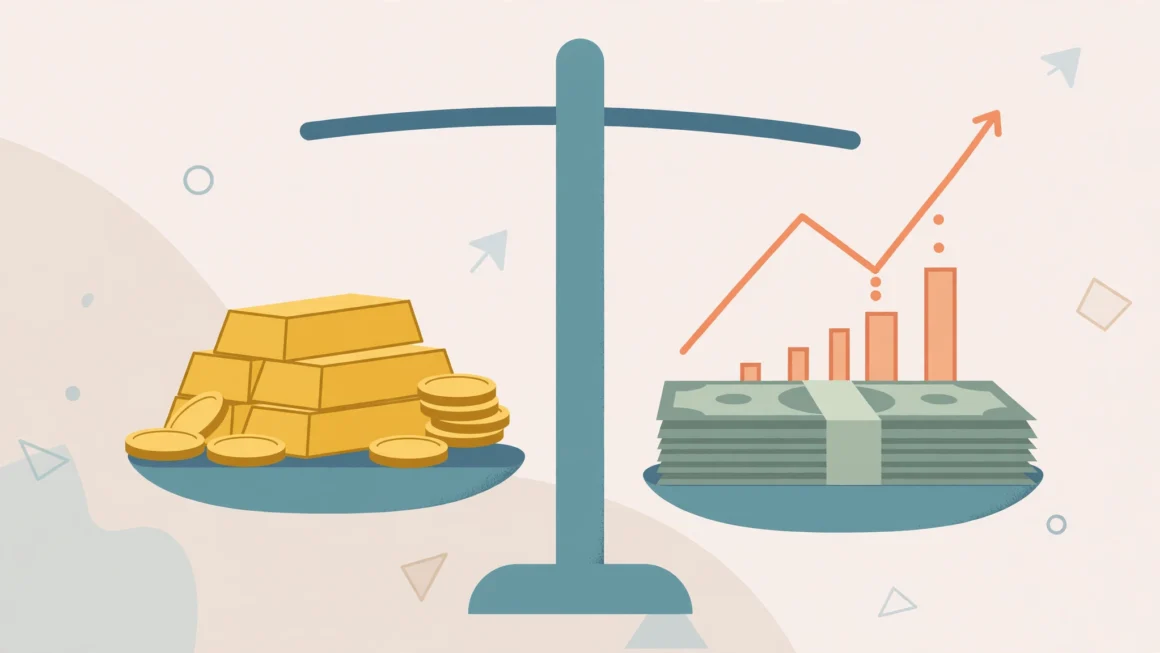
It helps to stop thinking of bonds and stocks as competitors. They do different jobs. Stocks are ownership: higher expected growth, bumpier ride. Bonds are lending: modest, contract-based returns, smoother ride. When stock markets panic, high-quality bonds often hold their value or even rise, which is why a blend of the two has historically been less stressful to own than stocks alone. If you are still building your overall picture of the market, our guide to investing for beginners shows how these pieces fit together in a first portfolio.
The trade-off is long-term growth. Over very long periods, stocks have historically outpaced bonds by a wide margin, because owners share in business profits while lenders only ever receive their agreed interest. A portfolio of only bonds feels calm but may not grow fast enough to reach distant goals like retirement. A portfolio of only stocks grows faster on average but demands strong nerves. Most sensible plans sit between the two extremes.
When Should You Own Bonds?
There is no universal answer, but there are reliable guidelines based on your goal and your timeline.
- Money needed within one to three years: capital preservation matters most. Short-term, high-quality bonds or bond funds fit better than stocks, whose value could be down exactly when you need the cash.
- Goals five to ten years away: a meaningful bond allocation can cushion stock swings while still allowing growth.
- Retirement income: bonds’ predictable payments can be matched to expected spending, turning a portfolio into something closer to a pay cheque.
- Emotional insurance: if watching your portfolio fall 30% would make you sell everything, holding more bonds may keep you invested — and staying invested is worth more than a theoretically perfect allocation you cannot stick with.
A common rule of thumb suggests holding roughly your age in bonds — 30% at age thirty, 50% at fifty — but treat it as a starting conversation, not a law. Your job security, other income, and temperament all matter.
How to Buy Bonds in Practice
Few beginners buy individual bonds directly. Choosing issuers, maturities, and credit quality one bond at a time takes work, and minimum purchase sizes can be large. Most investors use bond funds or bond ETFs instead: a single purchase gives you hundreds or thousands of bonds, instant diversification, and professional handling of maturities and defaults. The cost is a small annual fee, and one behavioural difference — a bond fund never “matures,” so its price keeps moving with rates rather than settling at face value on a known date.
Whichever route you choose, check three things: the average credit quality of what you own, the average maturity or “duration” (your sensitivity to rate changes), and the total annual cost. Those three numbers describe most of what a bond holding will do to your portfolio.
Two Ideas That Make Bond Behaviour Click: Duration and Ladders
Once the basics make sense, two concepts explain almost everything else bonds do. The first is duration, a measure of how much a bond’s price moves when interest rates change. As a rough guide, a bond or fund with a duration of five will lose about 5% of its value if rates rise by one percentage point, and gain about 5% if rates fall by the same amount. Short-term bonds have low duration and barely move; long-term bonds have high duration and swing hard. When you hear that long bonds “got crushed” in a year of rising rates, duration is the entire explanation — and it is also why long bonds reward holders handsomely when rates fall.
The second idea is the bond ladder. Instead of putting all your money into bonds maturing in a single year, you spread it across bonds maturing in one, two, three, four, and five years, and so on. Each year one rung matures and returns your principal, which you can spend or reinvest at whatever rates then prevail. A ladder smooths out interest-rate risk in both directions: you are never fully locked into yesterday’s low rates, and never fully exposed to tomorrow’s. Bond funds achieve something similar automatically by holding bonds across many maturities, which is one more reason beginners usually start there rather than building ladders by hand.
Frequently Asked Questions
Are bonds completely safe?
No. High-quality government bonds are among the safest assets available, but all bonds carry some combination of credit, interest-rate, and inflation risk. Safety depends on who issued the bond and how long it runs.
Can you lose money in a bond fund?
Yes. When interest rates rise, bond fund prices fall, and there is no maturity date at which you are guaranteed face value. Losses are usually milder than stock market falls, but they are real.
How much of my portfolio should be in bonds?
It depends on your timeline and temperament. Short-term goals argue for more bonds; distant goals argue for fewer. Many investors start from an age-based guideline and adjust it to what lets them sleep at night.
The Bottom Line
Understanding how bonds work removes much of their mystery: you are lending money, on written terms, for interest and repayment. Bonds will rarely make you rich quickly, but that was never their job. Their job is income you can schedule, stability when stocks wobble, and a safe home for money with a near-term purpose. Choose quality issuers, respect the risks of long maturities and inflation, and let bonds do their quiet work alongside the growth engines of your portfolio.
This article is educational content only and is not personalized financial advice. Consider your own circumstances, or speak with a qualified adviser, before making investment decisions.