Dividend Stocks vs Dividend ETFs: Which Fits Your Portfolio?
Introduction: The Honest Answer to “Which Pays Better?”
If you came here hoping for a straight answer to which route pays better over the next ten years, here it is: nobody can tell you that in advance. Not me, not any article, and not any expert with a confident chart. The honest truth is that the outcome depends on too many moving parts to predict. It depends on which individual stocks you happen to own, the prices you pay to get in, and a full decade of company fortunes that no one can see coming. A single runaway winner or a single painful stumble can swing your results dramatically. Anyone who claims certainty about the next ten years is guessing, no matter how convincing they sound.
So instead of promising a winner, this article does something more useful. It compares what can actually be compared: the structure of each approach. That means looking closely at control, diversification, effort, cost, and risk. These are the levers you can understand, weigh, and match to your own situation before you commit a single dollar. Structure is something you can reason about today, even when the future stays hidden. That is the part of this decision you can actually control.
Here is a quick preview of both routes.
- Dividend stocks mean buying shares in individual companies that pay a portion of their profits back to shareholders. You pick each business, you decide how many shares to hold, and you live with the results of every single choice you make.
- Dividend ETFs bundle many dividend-paying companies into one fund that trades like a stock. Instead of hand-picking names, you own a small slice of the whole basket in a single purchase.
One route hands you more control and more responsibility. The other trades some of that control for instant diversification and less day-to-day effort. Neither is automatically the “right” choice, and the better fit depends on your goals, your schedule, and how much involvement you actually want. Some investors enjoy researching businesses; others would rather not spend weekends reading annual reports.
By the end, you will understand the tradeoffs clearly enough to decide which structure suits you, rather than chasing a number that no one can honestly promise. The goal here is clarity, not a crystal ball.
The Single-Stock Route: Your Picks, Your Risk
Choosing individual dividend stocks puts you in the driver’s seat. Instead of owning a broad basket, you hand-pick each company, which means you decide how much you want in current yield versus dividend growth. Some investors lean toward higher payouts today; others prefer companies that raise their dividends steadily over time. Neither approach is right for everyone, and you can mix them however you like.
That control comes with real homework. You are responsible for reading financial reports, following earnings announcements, and keeping an eye on several companies at once. A dividend that looks attractive on paper may rest on a business you don’t fully understand, so the more companies you hold, the more time you spend staying informed. If you enjoy research and want to know exactly what you own, this hands-on approach can suit you. If you would rather set something up and check in occasionally, the workload may feel heavy. Our dividend investing for beginners: income from your portfolio guide walks through the basics of evaluating a company before you buy.
The Concentration Problem
The biggest trade-off in single-stock investing is concentration. When you own only a handful of companies, each one carries more weight in your overall income. If a single holding supplies a large share of your dividends and then cuts its payout, your income drops right along with it. That risk is smaller in a fund that spreads money across many businesses, but it is front and center when you pick stocks yourself.
Here is a hypothetical illustration. Imagine you own three stocks, and each pays you a round $100 in dividends over a year, for $300 total. If one company cuts its dividend in half, your income falls to $250. Now imagine that company had been your only holding. A cut to $50 would be the whole of your income, not just a slice of it. The fewer names you own, the more a single decision swings your results.
You can soften this risk by spreading your money across more companies and across different industries, so that no single payout dominates. Still, you cannot eliminate the possibility that a company reduces or suspends its dividend. Companies set their own payout policies, and those decisions can change with business conditions over time.
The single-stock route rewards curiosity and discipline, but it asks for both your attention and your tolerance for risk. Weigh the workload and the concentration honestly against the control you gain, and you will be better prepared to decide whether hand-picking dividend stocks fits the way you want to invest.
Within the ETF route, payment timing is its own filter, and dividend ETFs that pay monthly: what actually pays and when separates true monthly payers from quarterly ones in disguise.
The ETF Route: Many Payers, One Purchase
Where a dividend stock means buying a single company, a dividend ETF hands you a whole basket in one trade. With a single purchase, your income can be spread across dozens or even hundreds of companies that pay dividends, so no single name dominates what you collect. That spread is the core appeal of the fund route for beginners who do not want to research individual businesses.
The diversification does more than widen your base. When one company in the basket announces a dividend cut, the effect on your overall income is diluted across all the other payers, so the sting of a single bad headline is muted. You are not depending on any one firm to keep sending money your way. Just as important, most dividend ETFs follow a published set of rules that periodically review their holdings. A company that stops paying, or falls below the fund’s criteria, can be dropped and swapped out automatically. You do not have to monitor the news or decide when to sell; the fund’s methodology handles that turnover for you.
That convenience is not free, and it helps to be clear about what you are trading away. First, the fund charges an expense ratio, an ongoing fee that is taken out of the fund’s assets to cover management and administration. Even a small annual fee compounds over a ten-year holding period, so it is worth understanding before you buy. Second, you give up control over what you own. The fund decides which companies go in and out, and your money may sit in businesses you would not have picked yourself. Third, your yield is set by the basket as a whole rather than by you. You cannot tilt toward a favorite payer or avoid a sector you dislike; you accept the blended income the fund produces. If you want to understand the mechanics behind these pooled products, our index funds vs ETFs compared guide walks through how they are built and traded.
- Broad income: one purchase can hold many dividend payers at once.
- Automatic upkeep: fund rules replace weak or dropped payers for you.
- Expense ratio: a recurring fee, described here in general terms only.
- No control: you do not choose the individual holdings.
- Basket yield: your income reflects the fund, not your preferences.
None of this makes the ETF route better or worse than owning stocks directly; it simply shifts the work and the tradeoffs. To see how a hypothetical illustration might look, imagine a fund holding hundreds of payers each contributing a small slice. If one company cuts its dividend, the change to your total is a rounding error rather than a crisis. Over a decade, that steady, hands-off structure is what many beginners find appealing, provided you go in understanding the fees and the limits on your control.
Ten years of results hinge less on the wrapper than on the strategy inside it, and dividend yield vs dividend growth: income now or a rising income compares the two strategies that wrapper can hold.
What Ten Years Actually Depends On
A decade of dividend investing is not settled by the word “stock” or “ETF” in the name. It is settled by a few variables that apply to both routes, and the same variable can help or hurt either one.
- The price you pay on the day you buy
- Whether earnings and cash flow cover the payouts
- How consistently distributions get reinvested
- What the product costs and how it is taxed
- What you do when the market falls
The Prices You Pay at the Start
Your entry point matters more than almost anything else you control. Buying when valuations are stretched means a lower starting yield and more room for disappointment; buying after a long slide means the opposite. Two investors can hold identical portfolios for ten years and finish far apart simply because they started at different prices. That is why the starting yield on a fund is worth noting on day one.
Whether Earnings Actually Cover the Payout
A dividend is paid out of something real, and that something is earnings and cash flow. When a payout is comfortably covered, it has room to grow through ordinary business cycles. When it is not, it becomes vulnerable to being frozen or cut, and a cut hurts a stock holder and a fund holder alike. With a fund, the question is how many holdings fall into that second category.
Reinvestment Discipline
Compounding only happens if the cash goes back to work. Reinvesting every distribution automatically, without watching the share price, is the habit that turns a payout into growth. As a hypothetical illustration with round numbers: put in $10,000 and reinvest everything, and all $10,000 stays exposed; spend the distributions, and only the original $10,000 does. The arithmetic is simple. The behavior is where people slip.
Fees and Taxes
Fees are the one variable you know in advance. Fund costs appear in the prospectus, and the regulator requires that disclosure; expense ratios vary by product and change over time, so check the current figure for anything you are considering. Taxes depend on the account. In a taxable account, dividends are generally taxed in the year you receive them, reinvested or not, while tax-advantaged accounts postpone that. The rates and rules are set by the government and change over time. For how these products are built and priced, the SEC Investor.gov guide to mutual funds and ETFs is a plain-language starting point.
Your Own Behavior in Bad Years
The last variable is you. A plan that keeps reinvesting through a bad year behaves nothing like the same plan abandoned halfway through. Deciding in advance what you will do when prices fall is worth more than fine-tuning the holdings.
Why the Last Ten Years Prove Little
Any back-test covering the most recent decade ran through one particular sequence of prices, growth, and sentiment. The next decade gets its own sequence. A strong record from the past ten years reflects the conditions of that period as much as the quality of the approach, and neither carries forward. Treat historical comparisons as a description of what happened, not a forecast.
A Hypothetical Example: The Same $150 a Month, Two Structures
To illustrate the difference in structure, we’ll put the same $150 a month into two different arrangements: a dividend-paying stock portfolio and a dividend-focused exchange-traded fund (ETF) portfolio. Please note that this is a hypothetical example and not a real-world investment scenario.
This example is based on $150 a month being invested for a period of ten years, consisting of 120 payments totaling $18,000. Neither the balance nor the total income from these investments is modeled, as it would require speculating on future dividend payments and market prices. Our goal is to compare the initial structure and composition of the two portfolios, not to predict long-term outcomes.
Dividend-Paying Stock Portfolio
- A hypothetical portfolio composed of a mix of established dividend-paying stocks
- No specific holdings or weights are provided
- The portfolio’s structure and composition are not modeled, but rather used for illustrative purposes only
Dividend-Focused ETF Portfolio
- A hypothetical ETF portfolio focused on tracking a dividend index
- No specific holdings or weights are provided
- The portfolio’s structure and composition are not modeled, but rather used for illustrative purposes only
By examining the initial structure and composition of these two hypothetical portfolios, investors can begin to understand how the two structures differ in what they hold and who makes the decisions. This example serves as a starting point for further exploration and education on the topic at hand.
The Bottom Line
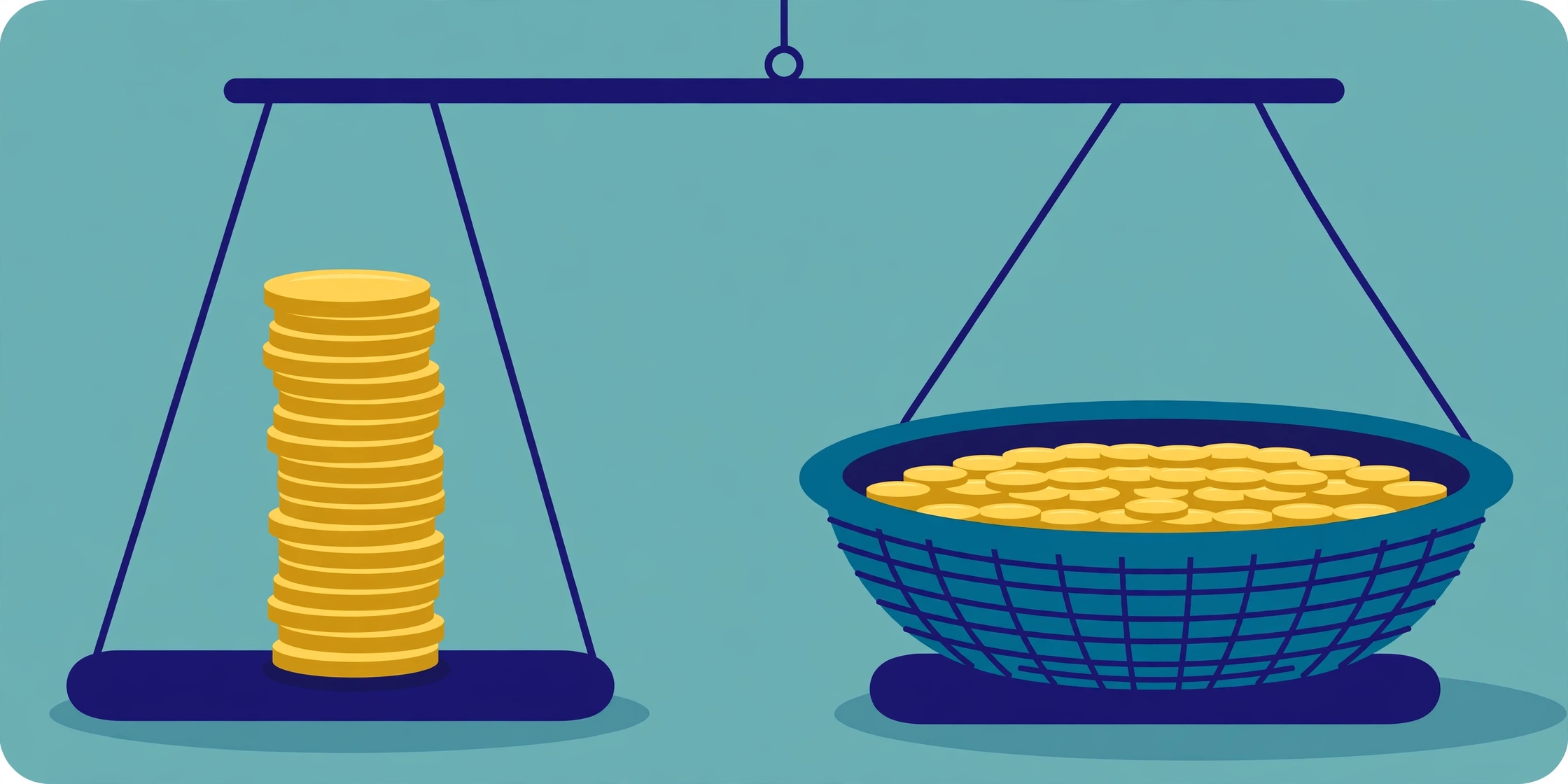
Nobody can tell you whether hand-picked dividend stocks or a dividend ETF will pay better over the next ten years – the answer depends on companies and prices that have not happened yet. What you can choose today is the structure: the control and concentration of picking stocks yourself, or the diversification and hands-off maintenance of a fund.
For most beginners, the fund’s structure is the safer default: one company’s dividend cut becomes a rounding error instead of a pay cut, and there is nothing to monitor but the habit of contributing. If you do pick stocks, size each position so that no single cut can break your income plan, and judge yourself on total return, not on the yield of the day you bought.
Disclaimer: This article is for educational purposes only and is not financial, tax, or legal advice. Investing involves risk, including the possible loss of principal. Examples are hypothetical and do not represent actual or future returns. Consider speaking with a qualified financial or tax professional about your own situation.