Every few months a new headline announces that artificial intelligence is about to take all the jobs — or create millions of them. The truth about the ai future of work is less dramatic and more interesting: AI is changing tasks inside jobs far faster than it is eliminating whole occupations, and it is creating new categories of work at the same time. Understanding that distinction is the difference between panic and a practical career plan.
This article looks honestly at which kinds of work are most exposed, which are surprisingly durable, the new roles emerging around AI, and the skills that will hold their value.
The Key Insight: AI Changes Tasks, Not Just Jobs
A job is a bundle of tasks. A marketing manager writes briefs, analyzes campaign data, sits in meetings, manages people, and makes judgment calls about brand and budget. AI might draft the first version of a brief and crunch the campaign numbers, but the meetings, management, and judgment remain human work. When researchers analyze occupations task by task, they find that most jobs contain a mix: some tasks AI handles well, many it does not.
This is why predictions of total job replacement keep missing. The spreadsheet did not eliminate accountants; it eliminated manual calculation and made accountants more analytical. ATMs did not eliminate bank tellers overnight; they changed what tellers spend their day doing. AI is a bigger and faster wave than those, but the pattern — automation of tasks, transformation of roles — is the one to plan around.
Work That Is Changing Fastest
Routine writing and content production
First drafts of emails, reports, product descriptions, and marketing copy are now routinely machine-generated. Writers and marketers are shifting toward editing, strategy, original reporting, and voice — the parts readers actually pay for. The entry-level rung of “produce a competent first draft” is genuinely weaker than it was, which makes developing a distinctive specialty more important.
Customer support and administration
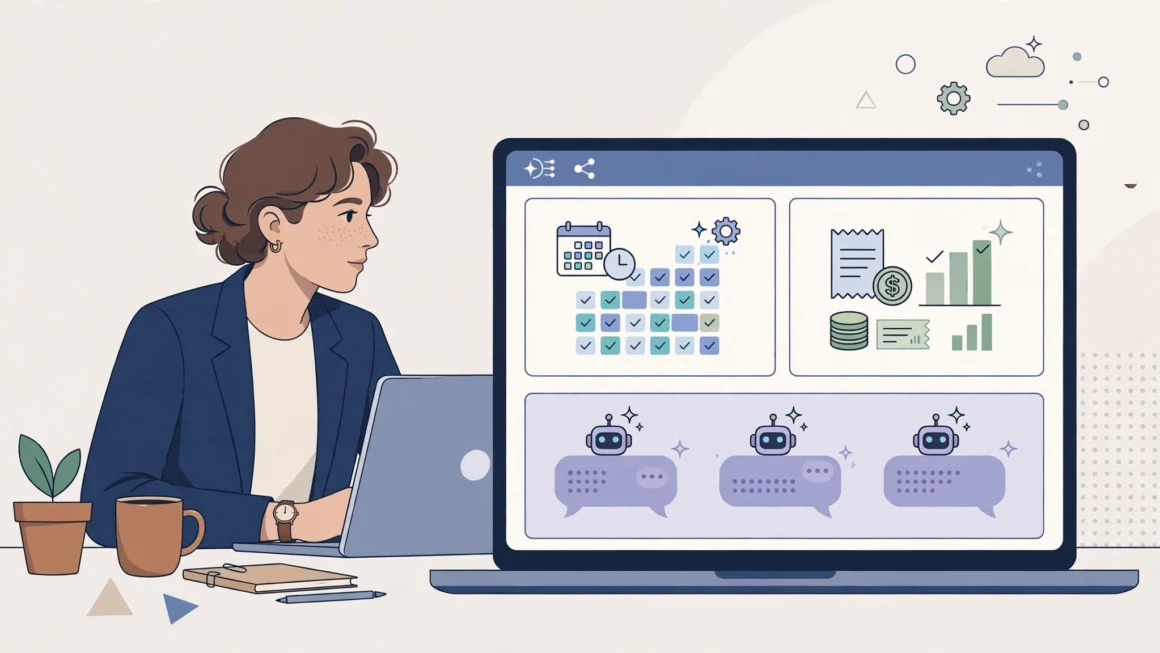
Chatbots resolve common questions instantly, and AI tools schedule meetings, summarize calls, process forms, and route documents. Support agents increasingly handle the escalations — angry customers, weird edge cases, judgment calls — while software absorbs the repetitive volume. The same shift powers AI automation for small businesses, where small teams use these tools to operate like much larger ones.
Data entry, bookkeeping, and basic analysis
Any job that is mostly moving information from one format to another is highly exposed. In finance and operations, AI reconciles accounts, flags anomalies, and builds first-pass forecasts. The human role moves up a level: checking the machine’s work, investigating exceptions, and deciding what the numbers mean.
Software development
AI coding assistants write boilerplate, suggest fixes, and generate tests. Developers report real productivity gains, especially on routine code. But someone must still design systems, understand requirements, review output for security flaws, and debug the strange failures. The job is becoming more about architecture and verification, less about typing.
Work That Is Surprisingly Durable
Jobs grounded in the physical world and human trust are changing more slowly. Skilled trades — electricians, plumbers, mechanics — work in unpredictable environments that robots handle poorly. Healthcare roles combine physical care, emotional presence, and accountability that patients and regulators demand from humans. Teachers, therapists, and caregivers sell attention and trust, not just information.
Leadership, negotiation, and sales also lean on reading people and building relationships. AI can prepare the briefing; it cannot yet sit in the room and earn confidence. Creative direction — deciding what is worth making and why — remains human even as execution tools multiply.
New Jobs AI Is Creating
- Prompt engineers and AI workflow designers — people who structure how teams actually use AI tools to get reliable results.
- AI trainers and data specialists — curating, labeling, and evaluating the data models learn from, and grading model outputs for quality.
- AI product managers and integrators — translating business problems into AI projects and connecting models to real systems.
- Model auditors and AI safety specialists — testing systems for bias, errors, security holes, and compliance with new regulations.
- Automation consultants — helping small and mid-sized companies adopt AI without chaos, a fast-growing niche.
- Human-AI team leads — managers whose real job is designing workflows where people and models each do what they do best.
History suggests the biggest job categories of the AI era may not have names yet. “Social media manager” sounded absurd in 2003. Expect similar surprises.
The Skills That Will Matter Most
Judgment and verification
When generating an answer is free, knowing whether the answer is right becomes the valuable skill. Fact-checking AI output, spotting plausible nonsense, and deciding what to trust are now core professional abilities in every field.
Problem framing
AI is good at answering questions and poor at knowing which questions matter. People who can define the real problem, set the right constraints, and recognize a good solution will direct the machines — and be directed by no one.
Domain depth
Shallow general knowledge is exactly what AI supplies cheaply. Deep expertise — the nurse who notices what the chart misses, the lawyer who knows which precedent actually governs — becomes more valuable, because experts can wield AI as leverage instead of competing with it.
Human skills
Communication, empathy, persuasion, and trust-building are stubbornly scarce. As technical output gets cheaper, the ability to understand people, lead them, and take responsibility for outcomes commands a growing premium.
What To Do About It, Practically
You do not need to become a machine learning engineer. You do need to become fluent with the AI tools of your own trade — whatever they are — because the realistic competition is not “AI versus you” but “a person using AI versus you.” Learn to delegate drafts, summaries, and first analyses to machines; spend the saved time on judgment, relationships, and craft. Keep one foot in work that requires presence and accountability. And revisit your skills yearly: the half-life of specific tools is short, but the habits of learning transfer.
Employers have homework too. The companies handling this transition well retrain staff for the changed tasks, redesign roles instead of just cutting headcount, and are honest with employees about what is coming. The ones handling it badly will discover that fear is a terrible productivity strategy.
What History Teaches About Automation Waves
This is not humanity’s first automation panic. Power looms devastated hand-weavers in the nineteenth century, and the Luddite protests were real responses to real suffering. Yet over the following century, textile work did not vanish — it transformed, and entirely new occupations appeared around the machines. Economists draw two lessons from episodes like this. First, transitions are genuinely painful for people whose specific skills lose value, and “the economy adjusts eventually” is cold comfort without retraining and support. Second, predictions of permanent mass unemployment have repeatedly failed because automation lowers costs, expands demand, and creates new wants nobody predicted.
AI differs from looms in speed and breadth — it touches cognitive work across every industry at once — so the adjustment may be faster and more disruptive than past waves. But the historical pattern argues against both complacency and despair: plan for serious change, not for the end of work.
The Freelance and Small-Business Angle
Independent workers feel the shift first and most sharply. On one side, clients now ask why a logo, article, or website should cost what it did when “AI can do it.” On the other, a solo freelancer with AI tools can deliver the output of a small agency — drafting, designing, coding, and marketing in one person. The freelancers thriving so far are those selling outcomes and expertise rather than hours of production: strategy, original insight, accountability, and a recognizable personal style.
Small businesses face the mirror image. Owners who once could not afford a support team, a marketing department, or a data analyst can now rent approximations of all three in software. That levels the playing field against larger competitors — provided the owner learns the tools, which is becoming a core business skill in itself.
What Employers Are Actually Doing
Survey the real behavior of companies and a consistent pattern emerges. Few are executing dramatic AI layoffs; many are slowing hiring for the most exposed entry-level roles while they redesign workflows — a quieter change with real consequences for new graduates. Training budgets for AI tooling are rising. Job postings increasingly list “works effectively with AI tools” the way they once listed spreadsheet skills. And a new managerial headache has arrived: verifying AI-assisted work, setting policy for what may be uploaded to external tools, and deciding who is accountable when the model is wrong. Organizations are learning, sometimes the hard way, that buying AI licenses is the easy part.
Sectors in the Middle of the Storm
Some industries sit between the fast-changing and the durable, and their stories show how mixed the reality is. In law, AI drafts contracts, searches case law, and reviews documents at speeds no junior associate can match — yet clients still hire firms for strategy, negotiation, and courtroom judgment, so headcounts have shifted more than collapsed. In journalism, routine earnings reports and sports summaries are automated, while investigative reporting — built on sources, trust, and shoe leather — remains stubbornly human. In design, image tools generate endless variations, pushing designers toward art direction and client understanding. The pattern repeats everywhere: production gets cheap, direction gets valuable.
The Entry-Level Problem
The most serious concern in the whole debate is not mass unemployment — it is the missing first rung. Many professions trained juniors by giving them exactly the routine tasks AI now does best: the first draft, the basic research, the simple model, the tier-one support ticket. If those tasks disappear, how do beginners become experts? Forward-looking firms are answering with structured apprenticeships, supervised AI use where juniors review and correct machine output, and deliberate rotation through judgment-heavy work earlier in a career. Young workers, meanwhile, would be wise to treat AI output as a tutor: generate it, then interrogate it, and learn the underlying craft anyway. The professionals who suffer most in transitions are those who only ever knew the routine layer of their trade.
A Note on Timing
Technology adoption follows a stubborn rhythm: the possibilities are overestimated in the short term and underestimated in the long term. Today’s AI tools are impressive but uneven — brilliant at one task, bafflingly weak at the next — and integrating them into real organizations takes longer than demos suggest. That gap is not a reason to relax; it is the preparation window. Workers and businesses that use these years to experiment, retrain, and redesign their roles will meet the mature version of the technology as operators. Those who wait for certainty will meet it as subjects. The window is open now, and it will not stay open forever.
Frequently Asked Questions
Will AI take my job?
It will very likely take some of your tasks, especially repetitive writing, data handling, and first-draft work. Whether it takes your job depends on how much of your role is those tasks — and on whether you move toward the judgment, expertise, and relationship parts of the work.
Which jobs are safest from AI?
No job is completely untouched, but skilled trades, hands-on healthcare, caregiving, and roles built on trust, presence, and accountability are changing slowest. Jobs combining physical skill with human judgment are the most durable.
What should I learn first?
Start with the AI tools already used in your profession and learn to check their output critically. Then deepen one area of genuine domain expertise. That combination — tool fluency plus real knowledge — is the most practical insurance available.
The Bottom Line
The future of work with AI is transformation, not a simple story of replacement. Tasks that are repetitive, digital, and pattern-based are being absorbed by machines; work requiring judgment, expertise, physical presence, and human trust is growing in relative value — and entirely new roles are appearing around the technology itself. The winning strategy, for individuals and companies alike, is to hand the machine work to machines and get better at the human work.