How to Automate Your Finances: Bills, Savings and Investing on Autopilot
Introduction: Willpower Is a Bad Financial System
Most money problems are not math problems. They are attention problems. You can know exactly what you owe, know exactly what you want to save, and still come up short at the end of the month, because the plan depended on you remembering, on an ordinary tired Tuesday, to move money from one account to another.
That is the flaw in a willpower-based system: it only performs on your best week. Motivation is a resource that runs out, and it tends to run out fastest exactly when you need it. A sick kid, a work deadline, a trip, a stretch of bad news — any of these will push “transfer money to savings” to tomorrow, and tomorrow has a way of becoming never.
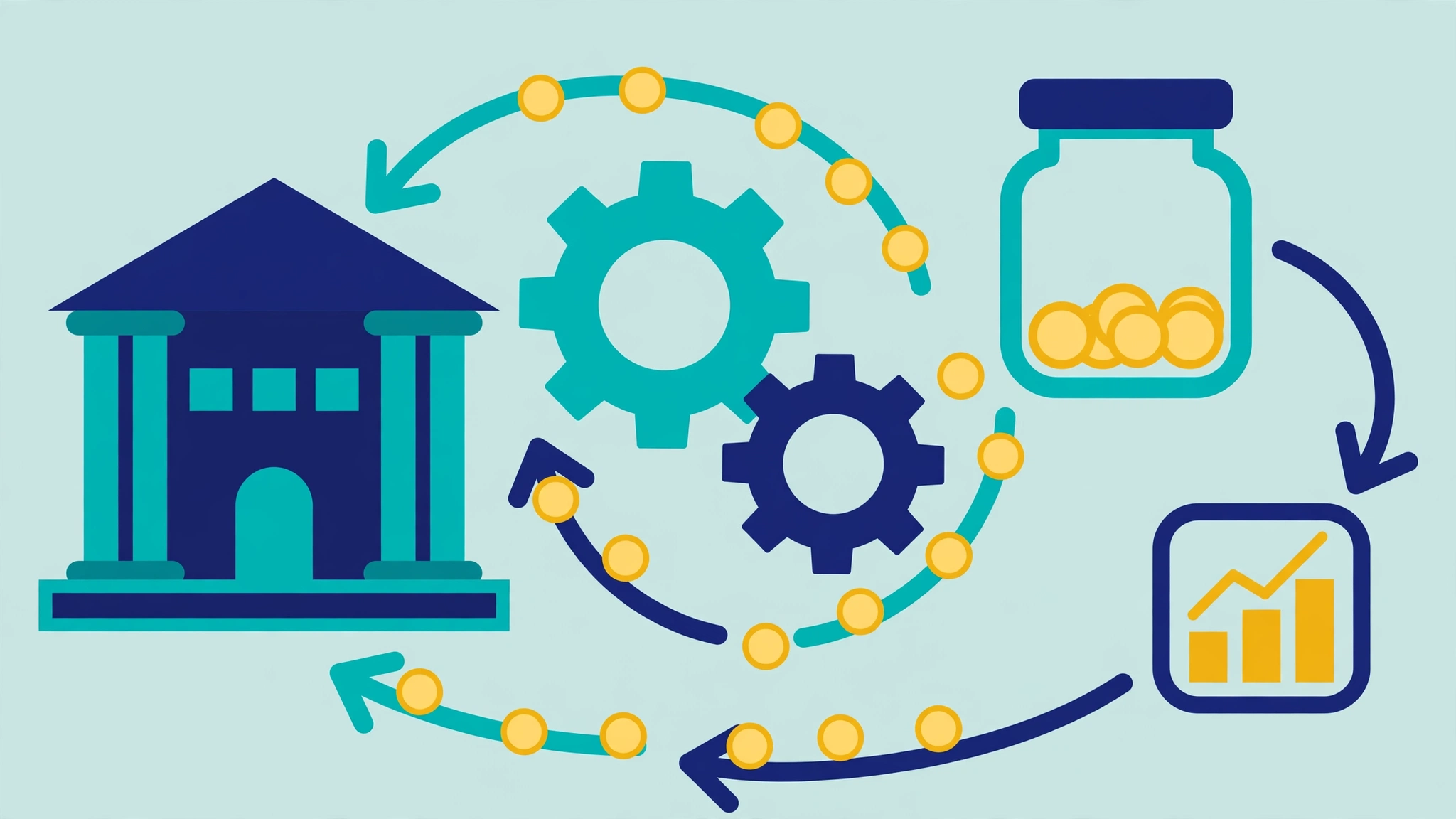
Automation inverts the dependency. Instead of relying on you to act, you set up instructions once and let them run whether or not you are paying attention. A transfer scheduled for the day after payday happens the same way in your worst week as in your best one. The system does not need to feel motivated, and it does not get distracted.
Here is what we will build across this guide:
- A payday flow — money lands, then splits by rule into bills, spending, and saving before you have a real chance to spend it.
- Guardrails — the buffers, alerts, and limits that keep an automated setup from overdrawing an account or quietly drifting off course.
- A small review habit — a short recurring check that keeps the automation pointed at what you actually want.
To make the mechanics concrete, we will use a hypothetical illustration: a $3,000 paycheck that splits into $1,200 for fixed bills, $600 for flexible spending, and $1,200 toward savings and investing goals. Those figures are invented for teaching purposes only. Your real split depends on your income, your costs, and your goals.
One caution before we begin. Automation handles the moving of money; it does not decide what the money is for, and no setup can promise a particular result from investing. Rules with numbers attached — contribution limits, account rules, tax treatment — are set by government agencies and regulators and change over time, so confirm the current figures with the relevant authority instead of relying on a number printed in an article.
None of this requires ongoing discipline once it is running. That is the entire point.
That flow needs a split to route money into, and a 50/30/20 budget that actually sticks gives the payday system its needs, wants and savings proportions.
The flow works better when the outgoings themselves shrink, and how to negotiate your bills down and keep the discount covers the calls that lower the fixed lines before payday routes what is left.
The flow runs through whichever app you watch it in, and budgeting apps compared: features, price and who each one suits scores the dashboards that make the system visible.
The Payday Flow: One Account In, Every Job Out
The idea behind the payday flow is simple: instead of deciding where every dollar goes each month, you assign each dollar a job the moment it arrives, and you let the automation carry it out. Your paycheck lands in one place — your checking account — and from there the money splits into separate buckets on the same day or the next morning. Think of it as plumbing. One pipe in, several pipes out, each one sized on purpose.
Here is the sequence in plain terms. On payday, your direct deposit arrives in checking. Shortly after, automatic transfers pull money out toward three destinations: a savings account, an investment account, and a bills buffer. Whatever remains in checking is your spendable money — and because the other jobs are already funded, that remainder is genuinely safe to spend. You are not guessing whether you can afford dinner out. The math has already happened.
Give every dollar a destination
- Savings: an automatic transfer moves a set amount into a separate savings account, ideally one that is a little inconvenient to reach.
- Investing: another transfer feeds your investment account on a schedule you choose, so contributions happen whether or not you feel like it.
- Bills buffer: a third transfer collects the money for upcoming bills in one holding spot, so the funds are there when the due dates hit.
- Spendable remainder: what is left in checking is yours to use freely, guilt-free.
Once the bills buffer is funded, put your fixed bills on autopay so they are paid from that money automatically. Rent or mortgage, insurance, phone, utilities, subscriptions — anything with a predictable amount can run on autopilot. For credit cards, the strongest habit is autopay set to the full statement balance, which avoids interest and keeps your balance from creeping up. If your cash flow is not there yet in a given month, paying the full balance is the goal to build toward rather than a rule you break.
A quick hypothetical illustration, using made-up round numbers: say a paycheck of $4,000 arrives. An automatic $500 goes to savings, $300 to investing, and $1,200 to the bills buffer. That leaves a hypothetical $2,000 in checking as spendable money. The point is not the amounts — it is that the split happens without willpower.
Automation handles the mechanics, but software can add a layer of awareness on top. Apps that categorize your spending and nudge you when a category runs hot can sit alongside your automated system, and if you want that layer to feel less manual, AI for personal finance: budgeting with a brain is a useful place to explore how these tools read your patterns. Review the flow every few months and adjust the transfer amounts as your income or goals change.
Automation is also how irregular bills stop ambushing the budget, and sinking funds: planned savings for irregular expenses gives each predictable cost its own monthly pot.
Automating contributions is the easy half; robo-advisors explained: what the software does, charges and leaves to you covers the services that automate the investing decisions themselves.
Automating Saving and Investing
If automating your bills is about keeping you out of trouble, automating your saving and investing is about making sure your money keeps moving forward without you having to think about it. This is the growth side of the system, and it works best when it runs quietly in the background.
Fill the emergency fund on a schedule
Start with a standing transfer to a separate savings account, set to repeat a day or two after your paycheck lands. The amount matters less than the repetition. Once the balance reaches the target you set for yourself (many people aim for three to six months of essential expenses, though the right number depends on your job stability, dependents, and comfort level), redirect that same transfer rather than canceling it. Point it at your next goal: a car repair fund, a down payment, or your investment account. The habit of moving money on a schedule is worth more than any single destination.
As a hypothetical illustration, setting aside $200 every two weeks adds up to $5,200 over a year, before any interest the account pays. Whether that pace makes sense for you is your call.
Buy investments on a calendar, not on a mood
Set up a recurring contribution to your brokerage account, and where possible, have it buy automatically instead of sitting in cash until you decide what to do. The schedule is the whole feature. When you invest on the same day every month, you never have to answer the question “is now a good time?” — a question nobody answers reliably anyway. Some months prices are higher and your contribution buys fewer shares; other months they are lower and it buys more. Over time those differences smooth out, but the bigger benefit is that the decision leaves your hands entirely. For the reasoning behind scheduled buying, read dollar-cost averaging explained: the calm way to invest.
Headlines will keep arriving. A scheduled contribution doesn’t read them. That is the point, not a flaw.
Check the automation you already have
If you are employed, part of this may already be running. Money withheld from your paycheck for a workplace retirement plan is automation in its purest form, because you never see the cash to begin with. What deserves a look is the percentage. Plans frequently enroll workers at a default rate, and defaults are built to be broadly reasonable, not tailored to your income, your timeline, or your goals. Log in, confirm what is actually being withheld, and choose the number deliberately. Also check whether you are contributing enough to capture any employer match your plan offers, since leaving that behind is the easiest gap to close.
The IRS sets annual contribution limits, and those figures are adjusted over time, so verify the current year’s numbers instead of trusting what you remember from last year. While you are in there, confirm your contributions are invested in an option you picked rather than the plan’s default selection.
Guardrails: Buffers, Alerts and the Quarterly Check
Automation runs smoothly until something drifts, and something always drifts eventually. The point of a safety layer is to keep a small timing problem from turning into an expensive one. Think of it as a seatbelt for your money, not a promise that nothing goes wrong.
Keep a Buffer in Checking
The simplest guardrail is a cushion of money you leave sitting in your checking account and never count as spendable. As a purely hypothetical illustration, if your bills total $2,000 a month, you might keep an extra $500 parked there so that a bill landing a day early does not push you into an overdraft. The exact amount is up to you; the idea is that the buffer absorbs timing mismatches between when money leaves and when your paycheck arrives. If your income is irregular, a slightly larger cushion gives you more room when a payday shifts.
Turn On Alerts
Most banks and card issuers let you switch on notifications, and these are worth enabling before you trust the system. Useful ones include:
- Low-balance alerts that warn you when checking drops near your buffer.
- Transaction alerts that confirm each autopay actually went through.
- Payment-due reminders that arrive a few days before anything is charged.
Alerts turn a silent system into one that tells you when to pay attention. A quick glance at your phone can catch a failed payment or an unexpected charge days before it grows into a bigger headache.
Move Due Dates When You Can
Many lenders, card companies, and utilities will shift your due date if you ask, though not all do. Where it is allowed, stagger payments so they do not all pile onto the day before payday. Spreading them out lowers the chance that several bills hit while your balance is at its lowest.
Hold a Short Quarterly Check
Set a recurring reminder every few months to spend fifteen minutes reviewing the machine. Put it on your calendar as a repeating event so it does not slip past you. Automation is a system you supervise, not a spell you cast once and forget. During that quick review:
- Cancel anything you no longer use, since subscriptions have a way of accumulating quietly.
- Raise your savings and investing transfers after a raise, so new money does not vanish into spending.
- Confirm that each autopay amount still matches the actual bill, because variable charges can quietly break a fixed transfer.
This check is also a good moment to revisit your longer-term plan. If you want a plain-language foundation for the investing side, Investor.gov, the SEC’s introduction to investing walks through the basics without pushing any product. Rules that govern retirement accounts are set by authorities and change over time, so treat any limit as something to look up rather than memorize.
Handled this way, autopilot becomes something you steer rather than something you hope for.
A Hypothetical Example: A $4,000 Month on Autopilot
Hypothetical illustration only. The numbers below are invented to show how money can move on its own. They are contributions, not returns, and no growth is modeled anywhere in this section. Nothing here is a recommended split for your own budget.
Imagine a person who brings home $4,000 in take-home pay each month. On payday, two automatic transfers fire before anything else touches the account:
- Savings: $400 moves to a savings account.
- Investing: $200 moves to an investment account.
That is $400 plus $200, or $600 per month. Against $4,000 in pay, that works out to 15 percent. Over a full year, the same $600 lands twelve times: $600 × 12 = $7,200. That $7,200 is money set aside, full stop. No interest, no market movement, and no compounding is assumed or implied.
The remaining $3,400 stays in checking to cover bills and everyday spending. Rent, utilities, groceries, insurance, and whatever else comes up all draw from that $3,400. If a bill is unusually large one month, the person adjusts spending, not the automatic transfers, since those already happened on payday. Because the transfers run automatically on payday, the decision happens once, when the automation is set up, and not again each month.
Why This Example Exists
The point is the order of operations, not the amounts. Money leaves the checking account first, on the same day pay arrives, and spending has to fit what is left. That is the flow. If your own pay is different, or your bills are higher, the dollar figures change but the sequence can stay the same.
One caution: any rule with a number set by a government body, such as a contribution limit, is set by that authority and changes over time. Check the current figure from the source itself before relying on it. The illustration exists to make the mechanics visible, not to suggest that 15 percent is right for you.
The Bottom Line
Automation converts good intentions into a system that runs on your worst week: pay lands, the transfers leave on schedule – savings first, investing on its regular date, bills paid from money set aside for them – and whatever remains in checking is genuinely yours to spend without arithmetic or guilt.
Build it with the guardrails in place: a checking buffer against mistimed bills, alerts switched on, due dates staggered where you can, and a short review every few months to cancel drift and raise the transfers when pay rises. You still supervise the machine; you just stop being the machine.
Disclaimer: This article is for educational purposes only and is not financial, tax, or legal advice. Investing involves risk, including the possible loss of principal. Examples are hypothetical and do not represent actual or future returns. Consider speaking with a qualified financial or tax professional about your own situation.