Few tech terms get thrown around with more confidence — and less clarity — than “Web3.” It appears in headlines, startup pitches, and social media bios, usually without anyone stopping to explain it. So what is Web3, really? In plain English: Web3 is an idea for a new version of the internet where users own their data, their digital items, and even pieces of the services they use, instead of everything being controlled by a handful of big platforms. This guide explains where the idea came from, how it works under the hood, where you can already see it in action, and — just as importantly — where the hype runs ahead of the reality.
First, a Short History: Web1 and Web2
To understand Web3, it helps to see what came before it. Think of the web’s history as three chapters.
Web1: read (roughly the 1990s)
The early web was mostly static pages. A person or company published a page; everyone else read it. There were no likes, no comments sections worth mentioning, and no accounts to log into. The web was like a giant library of brochures: useful, open, but one-directional.
Web2: read and write (the 2000s to today)
Then came the interactive web we live in now. Social networks, video platforms, blogs, and apps let anyone publish, comment, and create. But there was a trade: to participate, you hand your content, photos, connections, and personal data to big companies. They store it on their servers, set the rules, take a large cut of the money creators earn, and can change the terms — or delete your account — whenever they decide. In Web2, you are a tenant on someone else’s land.
Web3: read, write, and own
Web3 proposes a third chapter where users can also own things directly: money, digital items, usernames, and a portable identity that no single company controls. Instead of accounts living inside each company’s database, your identity and assets live in a digital wallet that you control, and you carry them from service to service.
What Web3 Actually Means in Practice
Strip away the buzzwords and Web3 comes down to a few simple shifts:
- You hold your own assets. Instead of a platform keeping your balance in its database (and being able to freeze it), digital assets sit in a wallet secured by keys only you control.
- Programs replace middlemen. Many Web3 services run on “smart contracts” — code on a public blockchain that executes exactly as written. A lending service, for example, can be software that matches lenders and borrowers automatically, with no bank branch involved.
- Records are public and shared. Transactions are recorded on blockchains that anyone can inspect, rather than in private company ledgers.
- One identity, many services. You connect your wallet to different apps instead of creating a new username and password for each one.
None of this requires you to understand the underlying cryptography, just as using email does not require understanding mail servers. But today, Web3 tools are still much clunkier than the polished apps of Web2 — a gap we will return to.
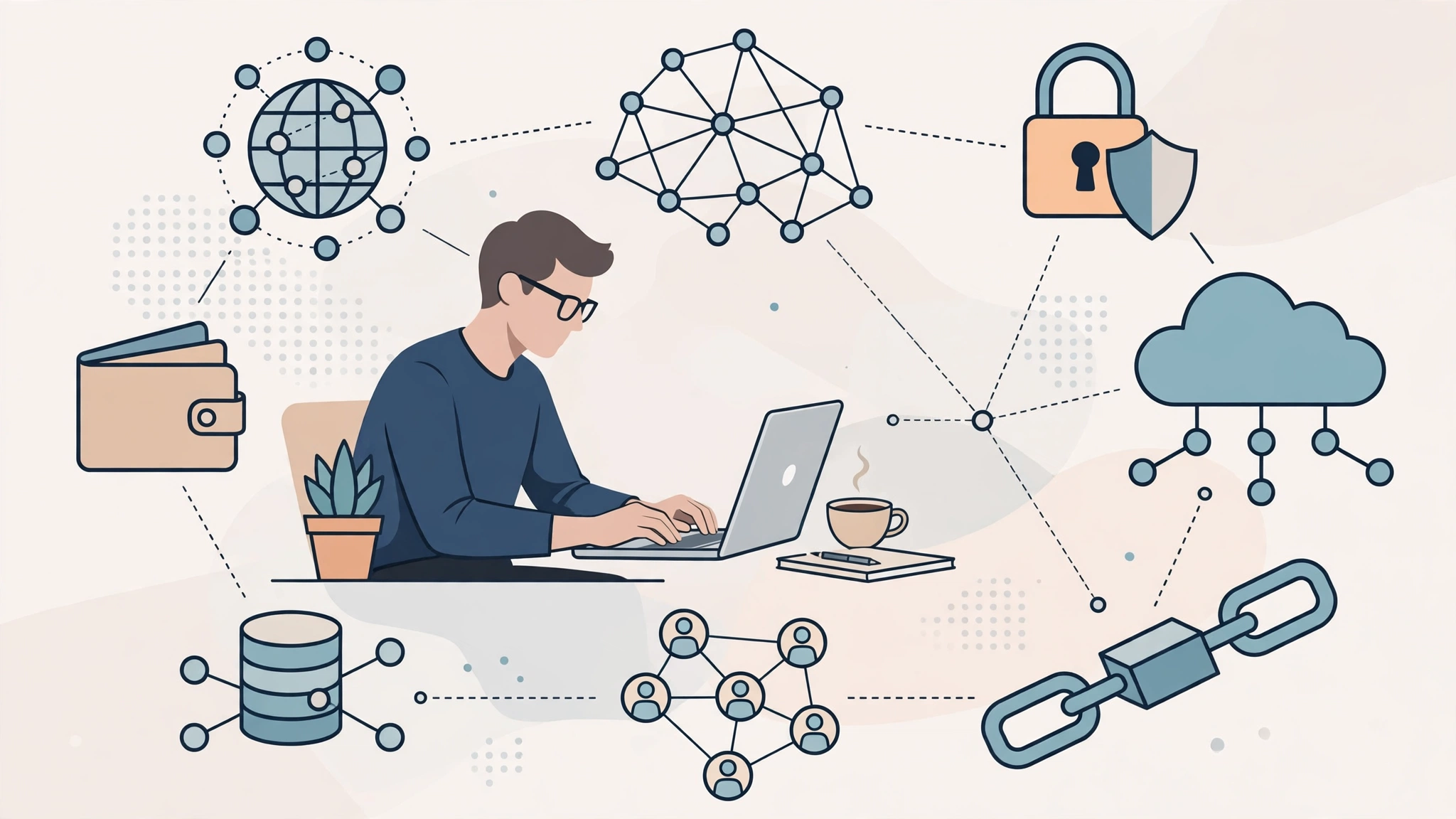
The Building Blocks of Web3
Blockchains
A blockchain is a shared, append-only record book maintained by many independent computers instead of one company. It is the foundation that makes ownership without a central referee possible: everyone can verify what belongs to whom.
Wallets and keys
A crypto wallet is your Web3 passport and safe in one. It holds your keys — secret codes that prove ownership and authorize actions. Whoever holds the keys controls the assets, which is empowering and unforgiving at the same time: there is no “forgot password” desk if you lose them.
Tokens
Tokens are digital units recorded on a blockchain. Some act like money, some represent items (a ticket, a piece of digital art, a membership), and some grant voting rights in a project’s decisions. If that is new territory, our broader introduction to investing for beginners explains the basic vocabulary of digital assets in a calmer context.
Decentralized apps (dApps)
A dApp is an application whose core logic runs on a blockchain via smart contracts rather than on one company’s servers. Exchanges, lending markets, games, and social experiments have all been built as dApps.
Real Examples of Web3 in Use Today
Web3 is not purely theoretical. People already use it to send money across borders in minutes without a bank intermediary, using stablecoins pegged to currencies like the US dollar. Creators sell digital collectibles directly to fans without a platform taking half the revenue. Some online communities organize as DAOs — groups that hold a shared treasury and vote on decisions using tokens. Video game items, event tickets, and loyalty points have all been issued as tokens that users genuinely hold and can transfer.
At the same time, honesty matters: the number of people using Web3 daily is still small compared with the billions on Web2 platforms. Most activity today involves trading and finance rather than the everyday social and entertainment uses the vision promises.
Web3 vs. the Web You Use Today
The simplest way to feel the difference is to compare everyday actions. In Web2, your photos live on a social platform; if your account is banned, they are gone. In Web3, a file or item recorded as yours stays in your wallet regardless of any single app. In Web2, paying a creator means the platform takes a cut and pays out weeks later; in Web3, payment can go wallet-to-wallet in minutes. In Web2, your follower list belongs to the platform, so moving services means starting from zero; Web3 designs aim to make your identity and connections portable.
But the trade-offs run both ways. Web2’s central control also provides customer support, fraud reversal, and password recovery. Web3’s “you are in full control” also means “you are on your own” when something goes wrong — a stolen key or a mistaken transfer usually cannot be undone.
The Problems and Criticisms — Said Plainly
A balanced guide has to include the weak points. Web3 apps are often slower, more confusing, and more expensive to use than their Web2 rivals. Scams are rampant: fake tokens, phishing sites that drain wallets, and projects that vanish with investors’ money. Much of the space is driven by speculation rather than usefulness, and “decentralized” projects sometimes turn out to be controlled by a small team behind the curtain. Environmental concerns apply to some (though not all) blockchains. Regulators are still deciding how these systems fit into law, which creates uncertainty for users and builders alike.
None of this means the core idea is empty — email and online shopping also began clunky and scam-prone. It means Web3 today is an early, rough technology, and it should be approached with curiosity rather than blind faith or blind dismissal.
Do You Need to Do Anything About Web3?
For most people: no urgent action at all. You do not need to buy tokens to “prepare” for Web3, and anyone pressuring you to invest quickly is selling something. If you are curious, the safe path is exploration: read, try a reputable wallet with a tiny amount you can afford to lose, and learn how keys and backups work before any real money is involved. If you are a creator or developer, Web3 is worth understanding because ownership-based models may become one option among many — not necessarily a replacement for everything else.
One Simple Example: A Ticket That Is Really Yours
Abstract ideas are easier to judge with a concrete example. Imagine buying a concert ticket. In today’s Web2 world, you pay a ticketing platform, and what you receive is really an entry in that company’s database. You cannot easily lend the ticket to a friend without going through the platform, reselling it may be restricted or loaded with fees, and if the company goes bankrupt or bans your account, your “ticket” can effectively vanish.
In a Web3 version, the ticket is issued as a token held in your wallet. The token itself is your proof of ownership, recorded on a public blockchain. You can transfer it directly to a friend’s wallet, resell it on any marketplace that supports it, or simply hold it — no permission needed from the original seller. The event organizer can even program rules into the ticket itself, such as a cap on resale prices or a small royalty on each resale, enforced automatically by code rather than by policy documents and support tickets.
This example shows both the promise and the catch. The promise: digital things can behave like physical things — held, given, and sold by their owner. The catch: if you lose your wallet’s keys, there is no customer service line that can restore your ticket. Web3 replaces institutional trust with personal responsibility, and different people will judge that trade very differently. Neither reaction is foolish; they simply value different things.
Who Actually Runs Web3?
Web3 is often described as “run by no one,” which is only half true. The blockchains underneath are maintained by thousands of independent computers, and changes to their rules generally require broad agreement among participants — no chief executive can unilaterally rewrite them at midnight. Many Web3 projects are also steered, at least formally, by communities of token holders who vote on proposals about fees, features, and spending.
In practice, influence concentrates. Founding teams often hold large token allocations, a handful of big holders can dominate votes, and most ordinary users interact through a small number of wallet apps and exchanges. Critics call this “decentralization theater”; supporters reply that even imperfect openness beats systems where users have no ownership and no vote at all. For a beginner, the balanced takeaway is that Web3 shifts power rather than abolishing it — and that checking who actually controls a project is one of the smartest habits you can build before trusting it with money or data. Projects that publish their governance structure, token distribution, and code openly are far easier to evaluate than those that hide behind slogans about the future.
This article is educational content, not financial advice. Cryptocurrency and Web3 projects are volatile and high-risk, and scams are common. Never invest based on hype, and never share your wallet’s recovery phrase with anyone.
Frequently Asked Questions
Is Web3 the same as cryptocurrency?
No. Cryptocurrency is one part of Web3 — the money and asset layer. Web3 is the broader idea of an internet built on blockchains, including apps, identity, ownership of digital items, and community governance.
Who invented Web3?
The term was popularized in 2014 by Gavin Wood, a co-founder of Ethereum, to describe a decentralized version of the web. The ideas built on earlier work in cryptography and peer-to-peer networks, including Bitcoin’s launch in 2009.
Will Web3 replace the current web?
Nobody knows. The likely outcome is a blend: some services adopting wallet logins, tokenized items, and transparent records where ownership matters, while most everyday apps remain as they are. Treat any claim of total replacement — in either direction — with skepticism.
The Bottom Line
Web3, in plain English, is the attempt to add ownership to the internet: your money, items, and identity held by you, in a wallet, rather than rented from platforms. Its building blocks — blockchains, wallets, tokens, and smart contracts — are real and already used for payments, collectibles, and community projects. Its weaknesses are equally real: rough user experience, scams, speculation, and unresolved regulation. The sensible stance for a beginner is informed patience — understand the idea, experiment cautiously if you wish, and let no one rush you into risking money on a vision that is still being built.