Every few minutes, somewhere in the world, a computer wins a kind of digital lottery and gets rewarded with brand-new cryptocurrency. That process is called mining, and it is the engine that keeps networks like Bitcoin running without any company or bank in charge. If you have ever wondered what crypto mining actually involves — beyond the headlines about energy use and warehouses full of machines — this guide walks through it in plain language. We will look at what miners really do, why the network needs them, what it costs to join in, and how to judge honestly whether mining is worth it for an ordinary person today.
What Is Crypto Mining, Really?
At its core, mining is a bookkeeping job. A cryptocurrency network like Bitcoin has no central office confirming payments. Instead, thousands of independent computers around the world keep identical copies of the transaction record, called the blockchain. Mining is the process that decides which new transactions get written into that record next, and in what order.
Why is it called “mining”?
The name is an analogy to gold mining. Just as gold miners spend real effort and resources to extract something scarce from the ground, crypto miners spend real computing power and electricity to unlock newly created coins. The supply of bitcoin, for example, is capped at 21 million, and new coins are released gradually as a reward for this work — much like gold becomes available slowly rather than all at once.
What miners actually do
Miners perform two essential services. First, they verify that transactions are valid — that nobody is spending coins they do not have or spending the same coin twice. Second, they bundle those verified transactions into groups called blocks and compete to add the next block to the chain. In return for this work, the winning miner receives a reward paid in the network’s own currency, plus the small fees attached to the transactions in that block.
How Mining Works, Step by Step
The process sounds mysterious, but it breaks down into a simple repeating cycle that happens roughly every ten minutes on the Bitcoin network.
Step 1: Transactions gather in a waiting room
When someone sends bitcoin, their transaction is broadcast to the network and waits in a holding area often called the mempool. Miners look into this pool and select transactions to include in their next block, usually favoring those offering higher fees, since fees become part of their earnings.
Step 2: Miners race to solve a puzzle
To earn the right to add a block, miners must find a number that, when combined with the block’s data and run through a mathematical function called a hash, produces a result meeting a strict condition — roughly, a long number beginning with a certain number of zeros. There is no shortcut: computers simply guess trillions of combinations per second until one works. This guessing game is called proof of work, because a valid result proves the miner spent real computational effort.
Step 3: The winner adds the block and gets paid
The first miner to find a valid answer broadcasts it. Other computers quickly check the answer — verification is fast, even though searching was hard — and if it is correct, the block joins the chain permanently. The winner receives the block reward, which on Bitcoin halves roughly every four years in an event called the halving, plus the transaction fees. Then the race starts again for the next block.
Proof of Work vs. Proof of Stake
Not every cryptocurrency uses mining. The main alternative is called proof of stake, where instead of competing with computing power, participants lock up (or “stake”) their own coins for a chance to be chosen to validate the next block. Ethereum, the second-largest cryptocurrency network, switched from mining to proof of stake in 2022, which reduced its energy consumption dramatically.
The practical difference for you: only proof-of-work coins can be mined with hardware. Bitcoin remains the biggest and most significant mineable coin. Many smaller proof-of-work coins exist too, but they are generally less profitable and far more volatile. When people talk about “crypto mining” today, they almost always mean Bitcoin mining or mining smaller coins with graphics cards.
What You Need to Start Mining
If you wanted to mine seriously today, you would need more than a laptop and enthusiasm. The honest list looks like this:
- Specialized hardware. Bitcoin is mined with purpose-built machines called ASICs (application-specific integrated circuits), which do nothing but mine, extremely fast. Smaller coins can still be mined with powerful graphics cards (GPUs), though profitability is usually thin.
- Cheap electricity. Mining machines run 24 hours a day and consume large amounts of power. Your electricity price is the single biggest factor in whether you profit or lose money.
- Mining software and a wallet. Free software connects your hardware to the network, and you need a crypto wallet to receive rewards.
- A mining pool. Solo miners can wait months or years between wins because the competition is enormous. Most miners join pools — groups that combine their computing power and split rewards steadily according to each member’s contribution.
- Cooling and space. Mining hardware is loud and produces serious heat. Most home miners underestimate this until the first machine arrives.
The Real Costs Nobody Puts in the Brochure
Mining advertisements love to show the reward side of the ledger. The cost side is longer. Hardware is expensive and becomes obsolete quickly, because manufacturers keep releasing faster machines and the network automatically raises the puzzle difficulty as more computing power joins. A machine that is profitable today can be a money-loser within a year or two.
Electricity bills arrive every month whether or not the coin price cooperates. And that is the other great variable: your costs are fixed in ordinary currency, but your earnings are paid in a volatile asset. If the coin’s price falls by half, your revenue falls by half while your power bill stays exactly the same. Add in pool fees, possible repair costs, taxes on mined income in many jurisdictions, and the resale value of aging hardware, and the true picture is a small business with real risk — not a money printer.
So, Is Crypto Mining Worth It?
For large operations with industrial electricity contracts, efficient modern machines, and cheap cooling, mining can be a legitimate business. For most individuals at home, the honest answer is: usually not as a pure investment, though it can be worthwhile as a hobby or learning experience with modest expectations.
Questions to ask before spending anything
- What is my true electricity cost per kilowatt-hour, including all fees and taxes? If it is above the low industrial rates big miners pay, the math is already against you.
- What is the payback period? Divide the total hardware cost by realistic monthly profit after electricity. If payback takes longer than the machine’s likely useful life, walk away.
- Am I assuming today’s coin price? Run the numbers at a price 50% lower. If that scenario is a disaster rather than a disappointment, the risk is too big.
- Would simply buying the coin be simpler? For most beginners, buying a small amount directly — the approach covered in our guide to investing for beginners — achieves exposure to the asset without hardware, noise, heat, or maintenance.
Some people mine with a spare graphics card, accept tiny earnings, and enjoy supporting a network they believe in. That is a perfectly reasonable hobby mindset. The danger is only in treating mining as guaranteed income.
Risks and Downsides to Take Seriously
Beyond profitability, mining carries practical risks. Hardware can fail or, rarely, pose fire risks when run carelessly in hot, dusty spaces. Regulations differ widely: some regions welcome miners, others restrict or ban them, and rules can change. Mining income and later sales may both be taxable events depending on where you live. Finally, beware of “cloud mining” offers that promise to rent you mining power for easy profits — this corner of the industry has a long history of scams, and legitimate returns are rarely as generous as the marketing suggests. If an offer guarantees returns, that guarantee itself is the warning sign.
A Short History: From Bedroom Laptops to Industrial Warehouses
When Bitcoin launched in 2009, mining was a hobbyist’s pastime. Ordinary home computers could mine successfully, and early participants earned blocks of 50 bitcoin with the family PC — rewards worth almost nothing at the time. The puzzle difficulty was trivially low because almost nobody was competing.
As the price rose, so did the competition. Miners moved from computer processors to graphics cards, which were far faster at the guessing game. Then came programmable chips, and finally ASICs — machines designed from scratch to do this one job many times faster than any general-purpose computer. Each leap made the previous generation of equipment nearly useless for Bitcoin mining.
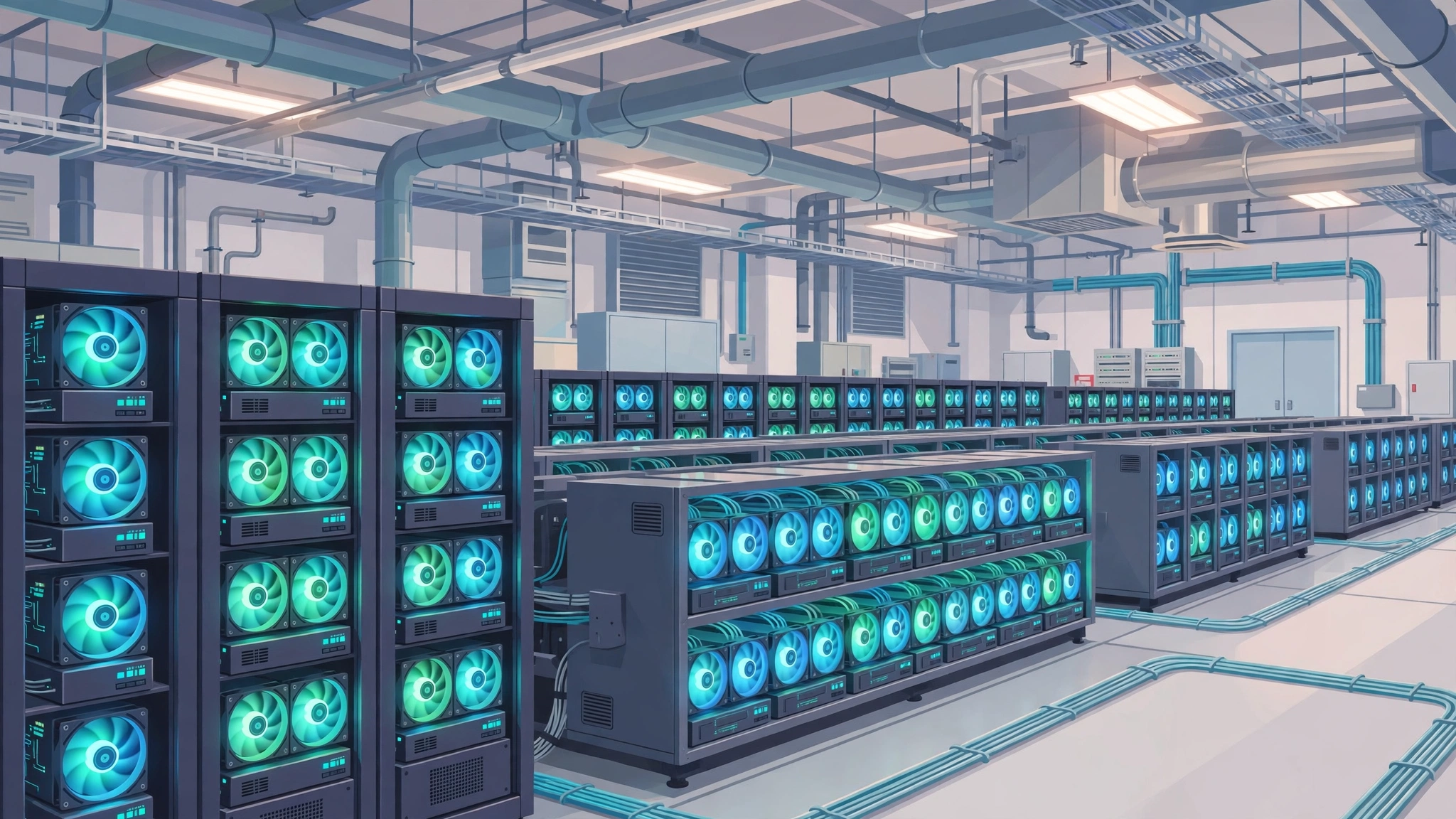
Today, most mining happens in large facilities located wherever electricity is cheapest: near hydroelectric dams, alongside natural gas fields that would otherwise flare off excess gas, or in regions with surplus wind and solar power. This industrialization is why the home-mining math has become so difficult — you are no longer competing with other hobbyists, but with warehouses running thousands of machines on negotiated industrial power contracts. Understanding that history explains both the network’s remarkable security — attacking it would mean outspending this entire global industry — and why realistic expectations matter so much for anyone thinking of joining in.
The mechanism behind all of this is the difficulty adjustment. Roughly every two weeks, the Bitcoin network automatically recalibrates the puzzle so blocks keep arriving every ten minutes on average, no matter how many miners join or leave. More competition does not create more bitcoin; it only makes each miner’s share harder to win. This is why revenue per machine trends downward over time unless the coin’s price rises to compensate — and why any honest profitability estimate must assume tomorrow will be more competitive than today.
This article is educational content, not financial advice. Cryptocurrency is volatile and high-risk; mining adds hardware and electricity costs on top of that risk. Never spend money you cannot afford to lose, and consider speaking with a qualified professional about your own situation.
Frequently Asked Questions
Can I mine crypto on my phone or laptop?
Technically some software claims to allow it, but modern laptops and phones are so much slower than specialized hardware that earnings are effectively zero, while the heat and wear can damage your device. It is not a practical way to earn cryptocurrency.
How much does a miner earn per day?
There is no fixed figure. Earnings depend on the coin, your hardware’s speed, the total competition on the network, the coin’s current price, and your electricity cost. Online mining calculators can estimate revenue for a specific machine, but always subtract electricity costs to see the real picture.
Is crypto mining legal?
It depends on your country and sometimes your region. Mining is legal in many places, restricted or banned in others, and may have tax or business-registration implications. Check your local rules before investing in equipment.
The Bottom Line
Crypto mining is the work that secures proof-of-work networks: miners verify transactions, compete to solve a computational puzzle, and earn new coins and fees for keeping the system honest without a central authority. As a business, it rewards cheap electricity, efficient hardware, and realistic expectations — and punishes wishful math. For most beginners, understanding mining matters more than doing it: it explains where new coins come from and why networks like Bitcoin are hard to attack or manipulate. If you still want to try, start small, run the numbers at pessimistic prices, and treat it as a learning project first and an income source second.