Gold is the oldest investment story in the world. Empires fell, currencies vanished, and the yellow metal kept its value through all of it — which is why, thousands of years later, people still reach for it whenever the news turns frightening. But a good story is not the same as a good investment. Treating gold investment with clear eyes means asking unfashionable questions: What return does gold actually produce? What does it cost to own? And what job, exactly, would it do in your portfolio? This guide works through gold’s real track record, the practical ways to own it, its hidden costs and risks, and the situations where it genuinely earns its keep — and where it quietly becomes a trap.
Why People Buy Gold
Gold’s appeal rests on a handful of durable arguments. It is nobody’s liability: a bar of gold is not a company’s promise or a government’s IOU, so it cannot default. It is scarce and difficult to produce, so its supply grows slowly and predictably. It is recognised everywhere on Earth, in every political system, without translation. And it has a five-thousand-year track record of holding purchasing power across the very long run — an ounce of gold bought a fine suit of clothes in ancient Rome, and it still does today.
Those qualities make gold a classic hedge: an asset people buy not to get rich, but to avoid getting poor in specific disasters — runaway inflation, currency collapse, war, or a financial system in crisis. In several modern crises, including 2008 and the inflation surge of the early 2020s, gold did indeed rise while other assets fell, which keeps its reputation alive.
What Gold Actually Returns
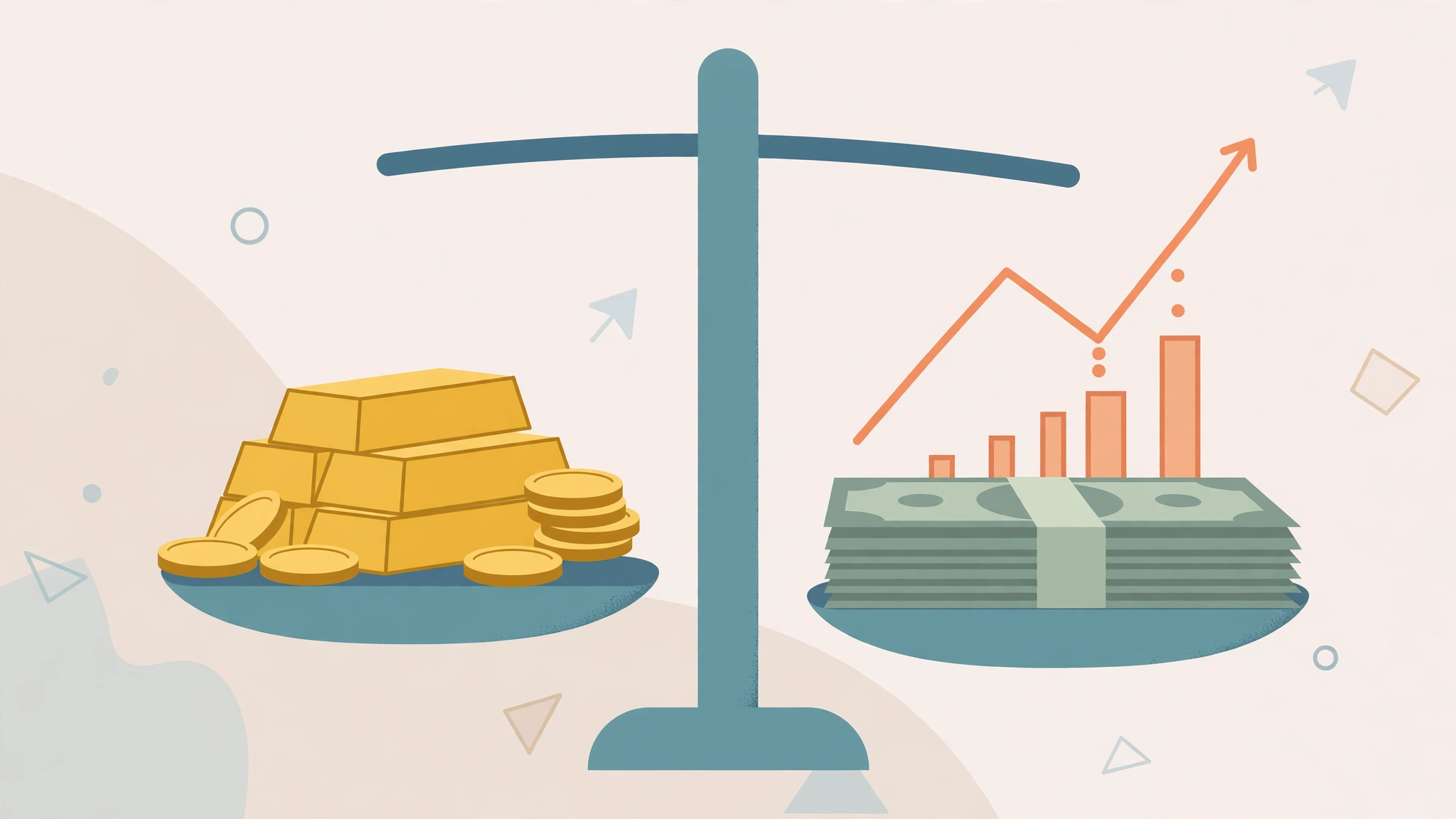
Here is the part the advertisements skip. Gold produces nothing. It pays no interest, no dividends, and no rent. A company reinvests profits and grows; a bond pays coupons; a property collects rent. Gold simply sits there, and its entire return comes from someone later paying more for it than you did. Economists call assets like this “greater fool” dependent — not because buyers are fools, but because price appreciation is the only engine.
Over very long periods, gold has roughly kept pace with inflation, preserving purchasing power with long, frustrating detours. An investor who bought at the 1980 peak waited more than a quarter of a century just to break even in nominal terms — and far longer after inflation. An investor who bought in the early 2000s enjoyed a spectacular decade instead. Timing, in other words, matters enormously with gold, and its returns arrive in bursts separated by long flat or falling stretches. Over the past century, diversified stocks have beaten gold by a wide margin, because businesses create new value while gold merely stores old value.
Gold’s Price Drivers
- Real interest rates: when safe bonds pay little after inflation, gold’s lack of income matters less and its price tends to rise; when real rates are high, gold often struggles.
- The US dollar: gold is priced globally in dollars, so a weaker dollar usually lifts its price in other currencies.
- Fear and uncertainty: crises, wars, and banking stress push investors toward gold quickly.
- Central bank buying: in recent years, central banks diversifying reserves have become major buyers, supporting demand.
- Jewellery and industry: roughly half of annual demand is jewellery, which links gold partly to consumer prosperity, especially in India and China.
The Ways to Own Gold
If you decide gold belongs in your plan, the form you choose changes your costs, risks, and convenience dramatically.
Physical Gold: Coins and Bars
Owning metal you can hold is the purest form — no counterparty, no platform, no password. It is also the most expensive way in. Dealers charge a premium over the metal’s spot price, often several percent on small coins, and buy back below spot, so you start underwater. You must store it securely, insure it, and accept that selling takes effort. Physical gold suits small, deliberate holdings bought for deep insurance, not active investing.
Gold ETFs and ETCs
Exchange-traded products backed by vaulted gold let you buy exposure with a brokerage account, in small amounts, at tight prices, for an annual fee often between 0.1% and 0.4%. You own a claim on stored metal rather than metal in your hand, which introduces a custodian you must trust — but for most investors this is the practical, low-cost route.
Gold Mining Stocks and Funds
Miners are not gold; they are businesses that dig it up. Their shares often move more sharply than gold itself — both up and down — because their profits are leveraged to the gold price, but they also carry company risks: costs, debts, accidents, and political trouble where mines operate. A mining fund diversifies the company risk but keeps the extra volatility.
Gold Futures and Spread Bets
These are leveraged trading instruments, suitable only for experienced traders. Leverage can multiply losses beyond your deposit. They are speculation tools, not investment vehicles, and beginners should leave them alone entirely.
The Hidden Costs and Risks
- The buy-sell spread: especially on physical gold, the gap between dealer buying and selling prices can consume years of price gains.
- Storage and insurance: free only if you accept the risk of keeping valuables at home.
- Opportunity cost: every pound or dollar in gold is one not compounding in productive assets. Over decades, that difference is enormous.
- Volatility: despite its safe reputation, gold can fall 20–40% over a few bad years, as it did after 2011.
- Fakes and fraud: counterfeit bars and unallocated “paper gold” schemes target exactly the fear that drives gold buying. Buy only from reputable, regulated dealers.
- Tax: treatment varies widely — some countries tax gold gains heavily, others exempt certain legal-tender coins. Check your local rules.
So: Hedge, Habit, or Trap?
Gold is a hedge when it is bought in modest size, for a defined reason — protection against inflation surprises or financial-system stress — and held with the expectation that it may do nothing for years. Like insurance, you judge it by how it performs in the disaster, not by its average year.
Gold becomes a habit when it is bought by tradition or family custom without a plan — jewellery-grade purchases at retail premiums, held indefinitely, neither sized nor reviewed. The metal is fine; the absence of thinking is the problem.
Gold becomes a trap when it dominates a portfolio, is bought in panic at peak prices after frightening headlines, or is expected to deliver stock-like growth. A portfolio that is half gold has not reduced risk; it has swapped productive risk for a single bet on fear staying fashionable.
How Much Gold, If Any?
Mainstream portfolio practice, for those who want gold at all, clusters around a small allocation — commonly 5% to 10% of the portfolio, bought through a low-cost backed ETF, rebalanced occasionally back to target. At that size, gold can soften a crisis without crippling long-term growth. Many successful investors hold none at all and rely on diversified stocks and quality bonds instead; that is also a legitimate position. The worst answers are the extremes: everything in gold, or a large holding bought emotionally in a single day. If you are still deciding where gold sits among your other options, our investing for beginners guide lays out the full menu of asset types side by side.
Gold in Crises: What History Actually Shows
Gold’s reputation rests heavily on its crisis performance, so it is worth being precise about what history does and does not show. In the financial crisis of 2008, gold fell sharply at first alongside everything else, as panicked investors sold anything saleable — then recovered strongly and reached new highs while stock markets were still healing. In the inflation shock of 2022, gold roughly held its value in dollar terms and rose in many other currencies while both stocks and bonds fell together, a year when traditional portfolios had nowhere to hide. In the long inflation of the 1970s, gold multiplied many times over.
But the same history contains the counter-examples. During the strong, stable growth of the 1980s and 1990s, gold lost value for two decades while businesses compounded. After its 2011 peak, it spent years falling and then going sideways, even through events that commentators insisted would send it soaring. The pattern is consistent: gold tends to help in crises of confidence, inflation, and falling real interest rates, and to disappoint in calm, prosperous, high-real-rate environments. An investor who buys gold is, whether they realise it or not, making a judgement about which of those worlds they most need protection against. That is a legitimate judgement — as long as it is made deliberately, in advance, and in modest size, rather than in a panic at the moment the protection is most expensive.
One more historical note matters: gold’s finest hours have usually been measured in months or a few years, while equities’ finest hours are measured in decades. A hedge that performs in the storm and a growth engine that performs across a lifetime are different tools, and confusing their timescales is how sensible hedges turn into disappointing portfolios.
Frequently Asked Questions
Is gold a good investment for beginners?
As a small satellite holding, it can be. As a first or main investment, no — beginners are usually better served by diversified funds that own productive assets. Gold teaches patience but builds wealth slowly, if at all, over many stretches.
Does gold always rise when inflation rises?
Not reliably year by year. Gold responds more to real interest rates and fear than to the inflation print itself, and it has had long periods of falling prices during inflationary times, notably the 1980s and 1990s.
What is the cheapest way to invest in gold?
For most people, a large, physically backed gold ETF or ETC bought through a low-cost broker: small spreads, modest annual fees, no storage worries, and the ability to invest small amounts regularly.
A Note on Gold Jewellery as “Investment”
In many cultures, gold jewellery is the traditional family store of value, and it deserves a fair hearing. Jewellery has genuine resale value, can be sold almost anywhere in the world, and doubles as something beautiful to wear and pass down. But as a pure investment it is the most expensive form of gold you can buy: the price includes craftsmanship, design, brand, and retail margin, which together can add 20% to well over 100% above the metal’s value — and almost none of that premium comes back when you sell. Buyers at resale pay for the gold content, minus their own margin. So enjoy jewellery as jewellery, count it as a partial store of value if you like, but do not confuse its purchase price with an investment in gold itself. If investment is the goal, low-premium coins, bars, or a backed ETF deliver far more metal per unit of money.
The Bottom Line
Gold is neither magic nor a scam. It is a scarce, durable asset that produces nothing, preserves purchasing power across very long horizons, and tends to shine precisely when other assets are in distress. Held small and deliberately, it is a reasonable hedge. Held large, bought in fear, or mistaken for a growth engine, it becomes an expensive habit — or a trap. Decide what job you are hiring gold to do, size it accordingly, and let the rest of your portfolio do the growing.
This article is educational content only and is not personalized financial advice. Consider your own circumstances, or speak with a qualified adviser, before making investment decisions.