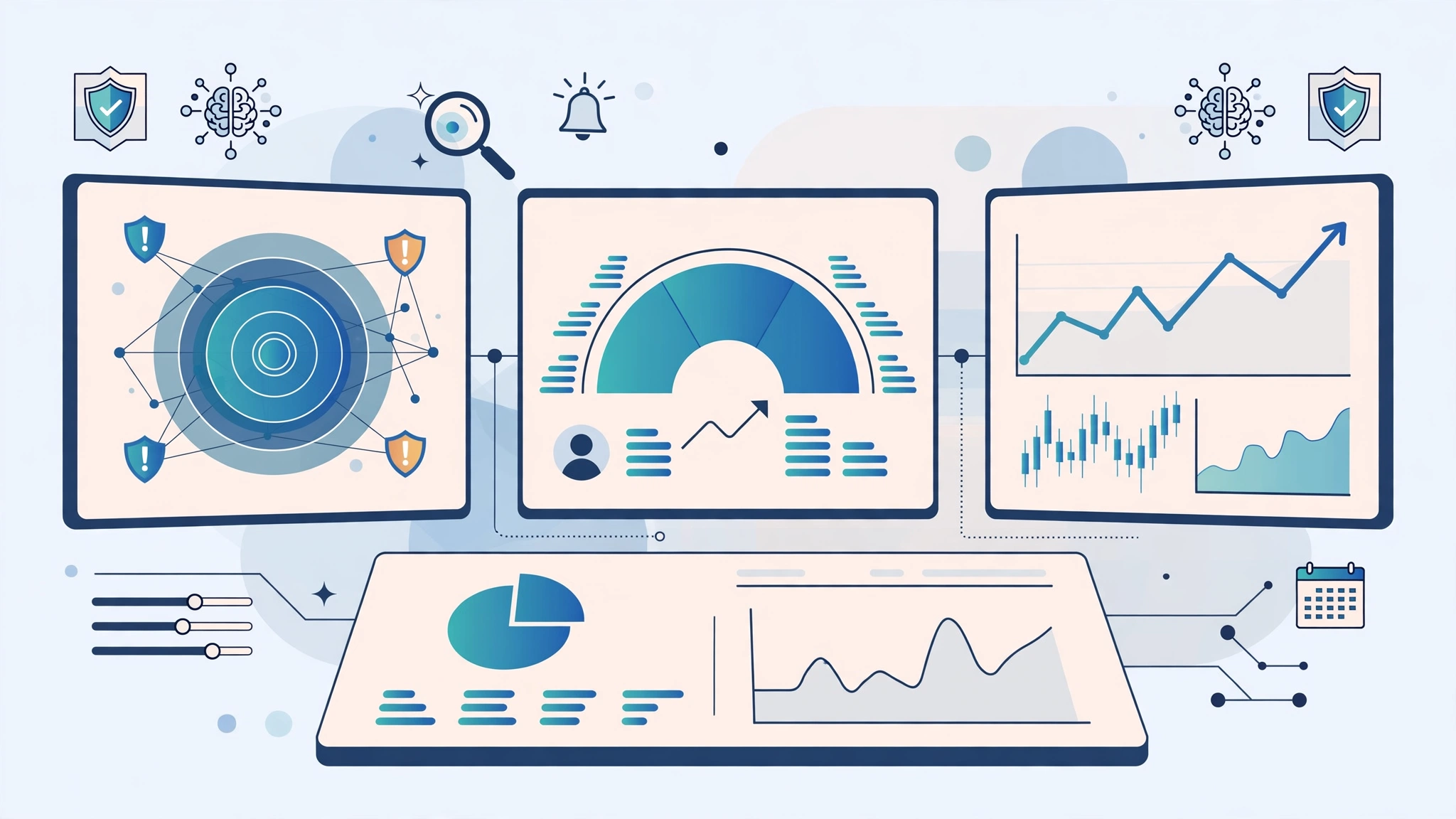
Money moves fast, and mistakes are expensive — which is exactly why ai in finance has spread so quickly. Banks use it to decide loans in minutes, payment networks use it to block fraudulent charges in milliseconds, and investment firms use it to read more market information than any human team could. None of this is science fiction, and none of it is magic. It is pattern recognition applied to some of the largest, cleanest datasets in the world.
This article walks through where AI is genuinely working in finance today, how it makes its decisions, where it falls short, and what it means for ordinary customers and investors.
Fraud Detection: The Quiet Success Story
If AI in finance has one unambiguous triumph, it is fraud detection. Every card payment you make is scored by machine learning models that compare it against your normal behavior — typical amounts, locations, merchants, and times. A charge that fits your pattern sails through. One that does not may trigger a text message, a temporary block, or a call from your bank.
Why machines beat rule books
Older systems relied on fixed rules: flag any transaction over a set amount from a foreign country. Criminals learned those rules quickly. Machine learning models instead learn what “normal” looks like for millions of accounts and spot subtle deviations humans would never catch — a slightly unusual typing rhythm on a login page, or a purchase sequence that resembles known fraud rings. These systems retrain constantly as new fraud patterns appear, which matters in an arms race where last month’s scam is already obsolete.
The results are measurable: faster detection, fewer stolen funds, and fewer embarrassing false alarms where a legitimate traveler gets their card frozen at a foreign hotel desk.
Credit Scoring and Lending Decisions
When you apply for a loan or credit card, an algorithm likely plays a major role in the answer. Traditional credit scores already used statistical models; modern AI expands the picture. Lenders can now analyze bank transaction patterns, income stability, and — with the borrower’s permission — other signals to judge creditworthiness more precisely.
The promise: fairer, faster lending
Supporters argue AI can extend credit to people the old system overlooked: freelancers with irregular but healthy income, young workers with thin credit files, small businesses whose real performance is better than their paperwork. Decisions that once took days of manual review can arrive in minutes, which is the same efficiency story driving AI automation for small businesses in other parts of the economy.
The risk: bias baked into data
A model trained on historical lending data learns historical patterns — including historical unfairness. If certain groups were denied credit in the past, the data may teach the model to repeat that behavior, even when no one intends it. Regulators in many countries therefore require lenders to explain adverse decisions, and serious institutions audit their models for disparate impact. AI lending works best when paired with human oversight and regular fairness testing, not blind trust.
Trading and Investment
Investment firms were among the earliest adopters of machine learning, and they remain among the most secretive. Their systems digest earnings reports, news stories, satellite imagery of parking lots, shipping data, and social media sentiment, looking for signals that predict price movements.
Algorithmic and high-frequency trading
Algorithms execute a large share of trading on major exchanges. Some strategies hold positions for months; others, called high-frequency trading, profit from tiny price differences in fractions of a second. Machine learning helps these systems adapt as markets change, rather than following frozen rules.
Robo-advisors for everyday investors
At the retail end, robo-advisors build diversified portfolios automatically based on your goals and risk tolerance, rebalance them over time, and harvest tax losses. They are not fortune-tellers — they mostly automate sensible, boring investing discipline at low cost. That is a feature, not a bug: for most people, steady allocation beats clever prediction.
A healthy dose of skepticism belongs here. Markets are adversarial: when many models chase the same signal, the signal disappears. AI gives firms speed and scale, not a crystal ball, and any service promising guaranteed AI-driven returns should be treated as a red flag.
Customer Service and Back-Office Work
Open your banking app and the chat assistant answering at 2 a.m. is probably AI. These systems handle balance questions, card freezes, and transaction disputes, escalating to humans when the conversation gets complicated. Behind the scenes, AI also processes documents — reading loan applications, extracting data from invoices, checking forms for errors — work that once consumed rooms of clerks.
Anti-money-laundering teams use AI too. Banks must monitor transactions for signs of criminal finance, a needle-in-a-haystack problem where machine learning ranks alerts so human investigators spend time on the cases that matter.
Risk Management and Forecasting
Banks are required to stress-test themselves against bad scenarios: recessions, market crashes, waves of defaults. AI helps model these scenarios in more detail, simulating how different portfolios behave under stress. Insurers use similar techniques to price policies and predict claims. Credit teams use machine learning to spot borrowers heading toward trouble early, sometimes reaching out with help before a missed payment becomes a default.
The Real Risks and Limits
- Opacity. Complex models can be hard to explain, yet financial decisions carry legal duties to explain. This tension is unresolved.
- Data dependence. Models trained in calm markets may behave badly in a crisis they have never seen.
- Concentration. If many institutions use similar models and data, they may all react the same way at the same time, amplifying market swings.
- Security. AI systems themselves become targets — attackers probe models, poison data, and use AI to craft better phishing.
- Accountability. When an algorithm denies a loan or freezes an account, a human institution must still own that decision.
Regulators worldwide are responding with model-risk rules, audit requirements, and in some places explicit AI legislation. The direction is clear: AI is welcome in finance, but it must be governed like any other powerful tool.
What This Means for You
As a customer, you already benefit: fewer fraudulent charges, faster loan answers, apps that categorize your spending and warn you before you overdraw. As an investor, expect AI to keep compressing fees and automating discipline — while remembering that no algorithm removes market risk. The sensible stance is neither fear nor worship. Use the tools, read the disclosures, keep a human reachable for big decisions, and be suspicious of anyone selling certainty.
Insurance: Pricing Risk with Machines
Insurance is finance’s quieter sibling, and AI is reshaping it just as deeply. Underwriters use machine learning to price policies from far more variables than traditional tables allowed — driving behavior from telematics devices, property data, even aerial imagery of roofs. Claims departments use image recognition to assess car damage from photos and natural language processing to read documents, speeding payouts from weeks to days in straightforward cases.
The same fairness questions follow: pricing that reflects genuine risk is the point of insurance, but pricing that quietly proxies for protected characteristics crosses legal and ethical lines. Insurers, like lenders, increasingly must show their models price risk rather than people.
Personal Finance Apps: AI in Your Pocket
The most visible face of AI in finance for ordinary people is the app layer. Budgeting apps categorize transactions automatically, predict upcoming bills, and nudge you before a balance runs low. Some round up purchases into savings or investments. Credit-monitoring services use machine learning to explain what changed your score and what would improve it. Tax software interviews you in plain language and fills the forms behind the scenes.
These tools share a healthy pattern: they automate awareness, not decisions. The app notices, explains, and suggests — you stay in charge of the money. When evaluating any such tool, check two things: how it makes money (if the product is free, your data or attention may be the product), and whether you can export or delete your financial data.
How Financial AI Is Regulated
Finance is one of the most regulated industries on earth, and AI has not been given a pass. Banks in the United States and Europe operate under model-risk guidance that predates modern AI: any model affecting customers must be documented, validated, and monitored. Consumer-protection law requires reasons when credit is denied, which constrains how opaque a lending model may be. Securities regulators police algorithmic trading for manipulation and instability, and new AI-specific laws — most notably in the European Union — classify many financial uses as high-risk, demanding audits, human oversight, and records.
For customers, this is quietly good news: the boring machinery of validation and audit is what stands between “the algorithm said so” and an institution that must answer for its decisions.
Payments and Central Banks: The Plumbing Layer
Beneath the apps sits the plumbing: payment networks processing billions of transactions, each scored for fraud risk in the blink between tap and approval. Machine learning is what makes instant payments safe enough to offer at all — without automated risk scoring, every tap-to-pay would need the slow manual checks of an earlier era. Central banks and regulators use similar tools in the opposite direction, scanning transaction flows for signs of systemic stress, sanctions evasion, and money-laundering networks that no team of analysts could trace by hand.
Even cash is being reimagined: several central banks are researching digital currencies, and the fraud, privacy, and monitoring questions those raise are, at their core, questions about how much algorithmic surveillance a payment system should contain. The technology is neutral; the settings are policy choices, and they are being debated right now.
A Short History: From Scorecards to Neural Networks
Finance did not discover algorithms with the recent AI boom. Credit scorecards date to the 1950s, statistical arbitrage to the 1980s, and rules-based fraud systems to the 1990s. What changed in the last decade is scale and subtlety: models moved from dozens of hand-picked variables to thousands of learned signals, and from monthly batch updates to continuous learning. Understanding this lineage helps separate durable change from marketing. The institutions succeeding with AI today are mostly those that spent years building clean data and model-governance habits — the unglamorous groundwork that makes the impressive demos possible.
What To Watch Next
The frontier is moving toward assistants that do more than answer — systems that can execute multi-step tasks, like disputing a charge, restructuring a budget, or preparing a loan application, under human-set limits. Regulators are racing to define who is liable when an agent acts. Meanwhile, expect explanation to become a selling point: the firms that can tell you, in plain language, why the machine decided what it decided will earn trust that black-box competitors cannot. Watching how your own bank handles that conversation tells you a great deal about how seriously it takes its customers.
Frequently Asked Questions
Is my bank really using AI on my account?
Almost certainly, yes — at minimum for fraud monitoring on your cards and payments. Larger banks also use it in lending decisions, customer chat, and document processing. Many now disclose this in their digital banking terms.
Can AI predict the stock market?
No system reliably predicts markets. AI can process information faster and spot statistical patterns, but markets react to surprises and to the behavior of other participants. Treat prediction claims — especially guaranteed ones — with deep skepticism.
Will AI replace human financial advisors?
It is replacing routine tasks, not the whole relationship. Algorithms handle portfolio mechanics well; humans remain better at understanding life goals, calming panic during downturns, and navigating messy personal situations. A hybrid model is where the industry is heading.
The Bottom Line
AI in finance is not coming — it is here, approving loans, stopping fraud, executing trades, and answering your banking questions at midnight. Its strengths are speed, scale, and pattern recognition; its weaknesses are opacity, bias in historical data, and brittleness in unfamiliar conditions. The institutions getting it right pair powerful models with audits, explanations, and human accountability. As a customer or investor, that combination is exactly what you should look for.