Most people delay investing because they are waiting for the right moment. Dollar cost averaging is the strategy that removes that moment from the equation entirely. Instead of trying to guess when prices are low, you invest a fixed amount of money on a regular schedule — every payday or every month — regardless of what the market is doing.
It sounds almost too simple to be a real strategy. Yet dollar-cost averaging (often shortened to DCA) is how millions of people successfully build wealth through workplace retirement plans, and it solves the two biggest problems beginners face: market timing anxiety and inconsistent habits. This guide explains how it works, when it shines, where its limits are, and how to set it up.
How Dollar-Cost Averaging Works
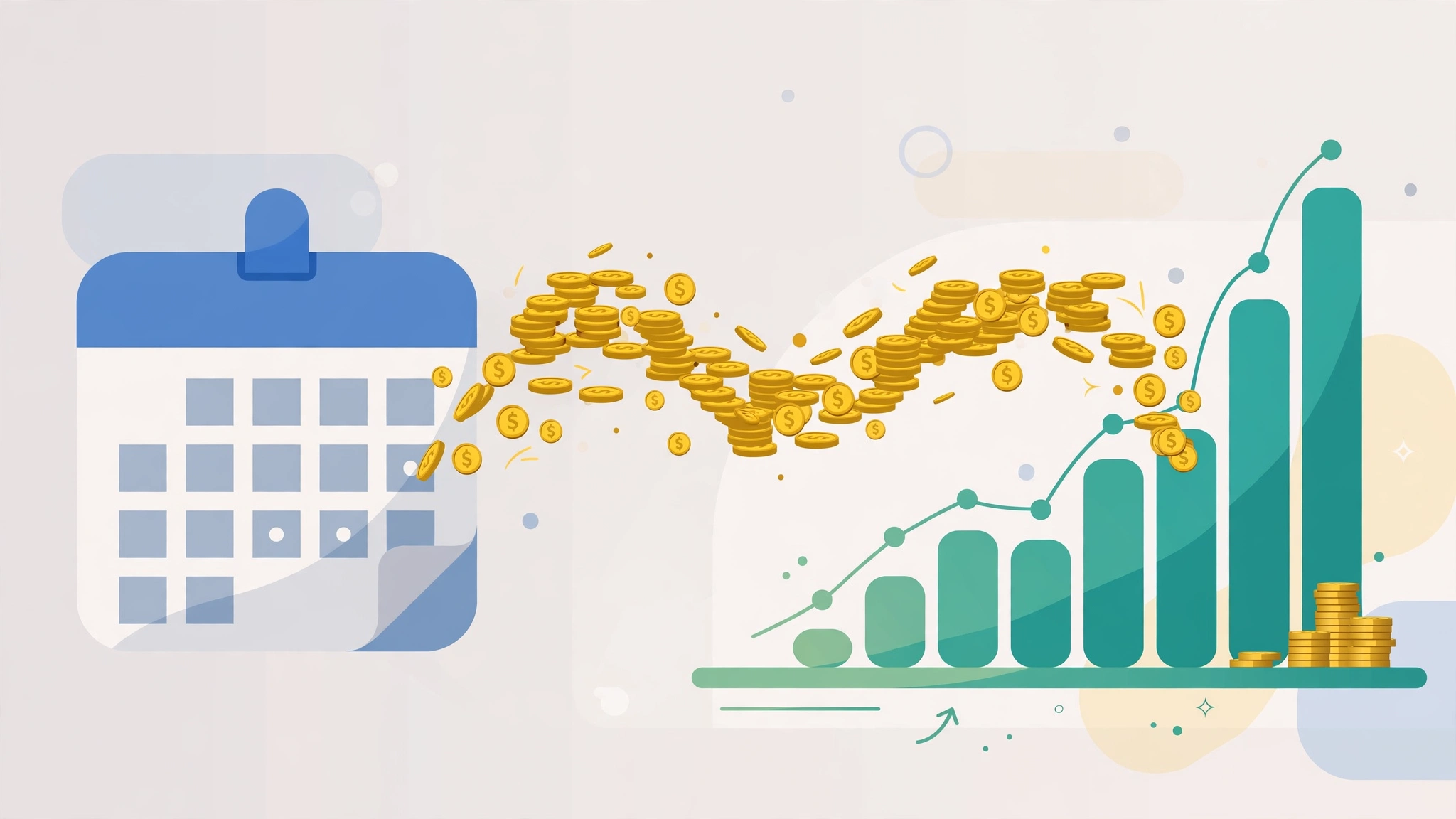
The mechanics take one minute to understand. You choose a fixed amount — say 200 per month — and a broad investment, such as a total market index fund. Every month, that same amount is invested automatically.
When prices are high, your 200 buys fewer shares. When prices are low, the same 200 buys more shares. Over time, this naturally tilts your purchases toward the cheaper periods, and your average cost per share ends up lower than the average price over the period — without you making a single prediction.
A quick illustration
Imagine investing 100 a month into a fund whose price moves around: 10, then 8, then 12, then 10 again over four months. Your purchases buy 10, 12.5, 8.3, and 10 shares — 40.8 shares for 400 total. The average price across those months was 10, but your average cost per share is about 9.80, because you automatically bought the most shares in the cheapest month. Real markets are messier, but the principle is the same.
Why It Works So Well for Beginners
It removes the timing question
Studies of market timing are unforgiving: even professionals rarely buy at the bottom and sell at the top consistently. DCA replaces the impossible question “is now a good time?” with a system that invests through all times — good, bad, and boring.
It turns investing into a habit
Wealth building depends far more on consistent contributions than on brilliant decisions. A scheduled automatic transfer behaves like a bill you pay yourself, and habits survive motivation slumps that kill one-off efforts.
It makes crashes less frightening
When your plan invests automatically, a market drop has a silver lining you can actually see: this month’s contribution bought more shares than last month’s. Many DCA investors find downturns easier to endure — some even welcome them — which protects them from the panic-selling that destroys returns. Our investing for beginners guide covers this mindset in more depth.
It matches how income arrives
Most people do not have a fortune sitting idle; they have a salary. DCA invests money as it arrives, which is simply the natural way to build a portfolio from earnings.
Dollar-Cost Averaging vs Lump-Sum Investing
The honest comparison matters. If you already have a large sum available — an inheritance, a bonus, savings accumulated over years — research on market history shows that investing it all immediately (lump-sum) has beaten spreading it out roughly two-thirds of the time. The reason is simple: markets rise more often than they fall, so money invested earlier usually has more time to grow.
So why would anyone choose DCA for a lump sum? Because the mathematically best strategy is useless if fear makes you abandon it. Spreading a large sum over six to twelve months reduces the regret and panic risk of investing everything the day before a crash. A slightly lower expected return in exchange for a plan you will actually follow is a rational trade.
The practical summary: for money arriving monthly from your income, DCA is not a compromise — it is just investing promptly. For a genuine lump sum, weigh the statistics against your temperament, and if you spread it out, commit to a fixed schedule and finish it.
How to Set Up Dollar-Cost Averaging
- Step 1 — Pick the investment: one broad, low-cost index fund or ETF is enough to start. Diversification inside the fund does the heavy lifting.
- Step 2 — Pick the amount: choose a sum you can sustain in bad months as well as good ones. Consistency beats size; you can raise it later.
- Step 3 — Pick the schedule: align it with payday, so the money moves before it can be spent.
- Step 4 — Automate it: set up the recurring transfer and purchase in your brokerage or retirement account. If your employer offers a retirement plan with matching contributions, that is DCA with a bonus — claim the full match first.
- Step 5 — Leave it alone: review once or twice a year. Do not pause contributions because of scary headlines; those are often the months that buy the cheapest shares.
Where Dollar-Cost Averaging Has Limits
DCA is a risk-management and behavior tool, not magic. It cannot make a bad investment good: averaging into a single failing company or a speculative asset just buys more of a losing position on the way down. It works best with diversified funds you intend to hold for years.
It also does not beat the market or guarantee a profit. In a market that rises steadily without dips, your later purchases cost more, and a lump sum invested at the start would have done better. DCA’s real product is discipline and reduced regret — which, for most people, is worth more than a theoretical edge.
Finally, watch the small print: if your brokerage charges a fee per purchase, frequent small buys can eat into returns. Prefer no-commission platforms and funds without transaction fees, which are widely available today.
Tips to Get the Most from DCA
- Increase contributions gradually: raise the amount by a small percentage each year or with each pay rise — you will barely notice, and the long-term effect is large.
- Keep an emergency fund separate: DCA only works if you never have to raid investments for everyday emergencies.
- Reinvest dividends: automatic reinvestment adds a second, quiet layer of regular buying.
- Write down your rules: a one-paragraph plan — amount, fund, schedule, and “I do not stop during downturns” — is surprisingly powerful when markets get loud.
- Judge it over years, not months: any short window can make a sound strategy look foolish. DCA is designed for horizons of five years and far beyond.
Dollar-Cost Averaging Is Already Running Your Retirement Plan
If you contribute to a workplace retirement plan, you are already a dollar-cost averager, whether you use the term or not. A fixed percentage of every paycheck flows into your chosen funds on a fixed schedule, in bull markets, bear markets, and every forgettable month in between. Over a career, that quiet mechanism — contributions continuing automatically through several major crashes — is the main reason ordinary workers retire with portfolios far larger than their total contributions.
This is worth remembering when financial media makes investing sound like a contest of brilliant moves. The largest, most reliable wealth-building machine available to most people is not a hot tip; it is a payroll deduction that never stops.
Spreading Out a Lump Sum: A Sensible Template
If you do receive a large sum and prefer to phase it in, give the plan structure so fear cannot renegotiate it monthly. A common template: invest one third immediately, one third after three months, and the final third after six months — or divide the sum into equal monthly parts over six to twelve months. Keep the waiting portion in a safe, interest-earning account rather than a checking account, so it is not silently losing ground.
Write the dates down and automate the transfers if your platform allows it. The entire point of phasing in is to remove future decisions; a schedule that still requires you to feel brave each month defeats its own purpose.
The Psychology That Makes DCA Win
Investors are not spreadsheets. Losses feel roughly twice as painful as equivalent gains feel good, and that asymmetry drives the two costliest behaviors in investing: refusing to start because a crash might come, and selling in panic when one does. DCA attacks both problems directly. Starting becomes easy because no single purchase feels momentous. Crashes become tolerable because your plan visibly benefits from lower prices.
There is a third, quieter benefit: regret management. A lump-sum investor who buys the day before a drop feels foolish; a lump-sum investor who waits and watches prices rise feels equally foolish. The DCA investor splits the difference in every scenario, which makes the strategy psychologically sustainable for decades — and sustainability, in the end, is what produces results.
Dollar-Cost Averaging Around the World and Across Assets
Although the term comes from stock market investing, the pattern appears everywhere ordinary people build assets. Mortgage payments steadily buy down a loan and build home equity month after month. Employees in many countries contribute to pension schemes from every salary. Even education savings plans work this way: small, regular deposits accumulating into a meaningful fund by the time a child reaches university. The amounts differ, but the engine is identical — consistency applied over years.
Some investors apply DCA to volatile assets like cryptocurrencies, reasoning that fixed purchases tame extreme price swings. The mechanic works the same, but the warning from earlier applies with extra force: averaging only helps if the asset itself is sound enough to recover. With a diversified stock index, recovery has historically been a matter of time. With a single speculative token, it may never come. DCA smooths the ride; it does not choose the destination.
Reviewing Your DCA Plan Once a Year
A yearly fifteen-minute review keeps the system healthy. Check four things: whether your contribution still fits your budget and goals, whether you can raise it slightly, whether the fund you buy still has low fees and broad diversification, and whether dividends are set to reinvest automatically. That is all. Resist the urge to optimize further — changing funds or schedules in response to news almost always subtracts more than it adds. The plan’s power comes precisely from how little attention it demands.
Frequently Asked Questions
How much should I invest each month with dollar-cost averaging?
Any amount you can sustain consistently. Many people start with 5 to 15 percent of their income after essentials and expensive debt. The exact figure matters less than starting now and increasing gradually.
Should I stop dollar-cost averaging when the market falls?
Stopping during falls removes the strategy’s main benefit, because falling prices are when your fixed amount buys the most shares. If your goal and emergency fund are intact, continuing is usually the right move.
Does dollar-cost averaging work for individual stocks?
It can be used, but it is much safer with diversified funds. A single company can fall and never recover; a broad index has historically recovered from every downturn given enough time.
The Bottom Line
Dollar-cost averaging trades the fantasy of perfect timing for the reality of steady progress. You invest a fixed amount on a fixed schedule into diversified funds, automatically buying more when prices are low and less when they are high. It will not make headlines, and it will not make you rich this year — but as a calm, durable system for turning income into wealth, it is very hard to beat.
This article is educational content, not personalized financial advice. Consider your own goals and circumstances, and consult a qualified financial professional before making investment decisions.