How to Invest in Crypto Safely as a Beginner
Introduction: The Asset Class Where Safety Is a Skill
Cryptocurrency is the only mainstream investment where a beginner can lose everything in four different ways: the price collapses, the exchange holding the coins fails, a scammer takes the coins directly, or the investor loses their own access and no one on Earth can restore it. Stocks can fall; bank deposits are insured; a forgotten brokerage password is a phone call. Crypto removes most of those cushions, and in exchange offers an asset class that has produced both extraordinary gains and total losses, sometimes in the same year.
That is not an argument to avoid crypto entirely, and it is not an argument to rush in. It is an argument that in crypto, safety is not a feature of the product – it is a set of skills and habits the investor has to supply personally. This article teaches those habits in the order they protect you.
First, the groundwork: what you are actually buying, why “safely” has to start before any purchase, and the rules that come before all others – position size, money you can afford to lose, and security habits treated as non-negotiable. Second, the purchase itself: how buying actually works, what custody means, and the difference between an exchange account and a wallet. Third, the threat catalog – the scams and failure modes that account for most beginner losses, most of which have nothing to do with price.
As the pillar guide on this topic, the article ends with a pre-flight checklist: the complete sequence, from first dollar to stored recovery phrase, that a cautious beginner should be able to tick off before owning a single coin. If any item on it is missing, the safe move is to stop and fix it – in crypto, patience is not just a virtue, it is most of the security model.
Before You Buy: The Rules That Come First
Rule one: only money you can afford to lose entirely. This phrase appears in every crypto guide, so let it mean something specific here: if the amount you are considering became zero tomorrow, your rent, debts, emergency fund and plans would be untouched, and your reaction would be disappointment rather than disaster. If that is not true of the amount, the amount is too big. Crypto prices have repeatedly fallen by half or more and stayed down for years; plan on the assumption that it will happen to you, because for most holders, at some point, it has.
Rule two: size it as a small slice. Beginners who hold crypto as part of a wider portfolio commonly keep it to a small percentage of their total investments – small enough that its total loss would be a bad year, not a ruined plan. The worked example at the end of this article shows why the percentage matters more than the dollar amount: at a small enough size, even crypto’s worst behavior becomes survivable arithmetic instead of a life event.
Rule three: the foundation comes first. An emergency fund in an insured bank account and any high-interest debt handled are worth more than any coin’s upside, because they protect you in every scenario rather than one. Crypto bought on a credit card, or instead of an emergency fund, is not an investment strategy – it is leverage against your own stability. If the broader foundations are new to you, Investor.gov, the SEC’s introduction to investing, is the official place to build them before any of this.
Rule four: understand what you are buying. A cryptocurrency is a digital asset whose ownership is recorded on a blockchain – a shared ledger maintained by a network rather than a bank. It is not a share: it represents no claim on a company’s earnings, pays no dividend, and its price is set purely by what buyers and sellers agree on, around the clock, with no closing bell and no regulator standing behind its value. Thousands of coins exist; a small number account for most of the market’s value and trading, and the long tail is a graveyard of abandoned projects and deliberate frauds. A beginner’s research burden is real, and it starts with being able to explain, in one sentence, why the specific coin being bought might be worth more to someone else later.
With those four rules in place, the purchase itself can be boring – which is exactly what you want it to be.
Custody decisions are really sizing decisions, and choosing a wallet setup that matches how much you hold walks through hot, cold and custodial options for a first portfolio.
Buying and Holding: Exchanges, Wallets and Custody
Most beginners buy crypto on an exchange – a platform that matches buyers and sellers, rather like a stockbroker for digital assets. The mechanics are covered step by step in how to buy your first cryptocurrency safely; what matters for safety is what happens underneath the friendly interface.
When your coins sit on an exchange, what you actually hold is the exchange’s promise – an entry in its database saying it owes you coins. If the exchange is hacked, mismanaged or fails, that promise can become worth little, and crypto exchange failures have repeatedly left customers queuing as creditors. This is the fact behind the community’s blunt slogan: not your keys, not your coins. It overstates the case for small, short-term balances – reputable exchanges are how everyone starts – but it correctly identifies that an exchange balance is a claim on a company, not possession of an asset.
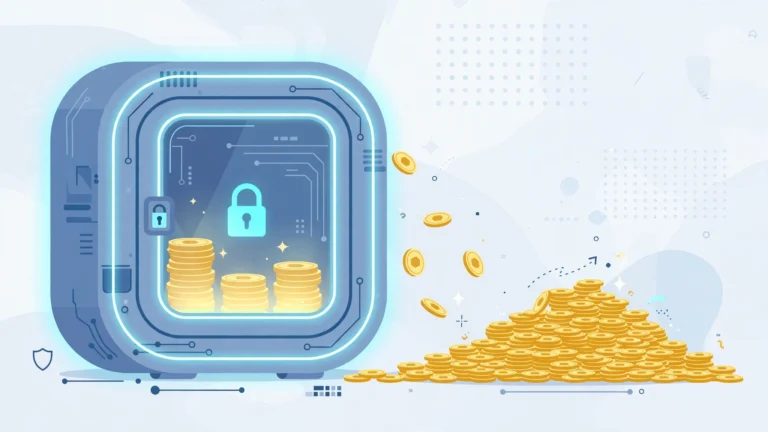
A wallet is the alternative: software or a hardware device that holds the cryptographic keys controlling your coins. Whoever holds the keys holds the coins, in the most literal sense in all of finance. A hot wallet lives on an internet-connected device – convenient, and exposed to whatever compromises that device. A cold wallet, typically a hardware device kept offline, removes the internet from the equation and is the standard for sums that matter. Every wallet comes with a recovery phrase – a list of words that can regenerate the keys. That phrase is the master key to everything: store it offline, never type it into a website, never photograph it into a cloud account, and never share it with anyone, because no legitimate company will ever ask for it.
Choose an exchange the way you would choose a bank, minus the insurance: established, transparent about its business, and operating openly under the regulations of its jurisdiction – while remembering that crypto platforms do not carry the deposit-insurance protections of a bank account, a difference that has mattered enormously every time one has failed. Enable two-factor authentication with an authenticator app rather than text messages, use a unique password, and treat every security setting as part of the investment itself. In crypto, your operational security is not admin. It is the vault.
A few account settings deserve the same seriousness as the wallet decision. Many platforms let you maintain a withdrawal allowlist – a fixed set of wallet addresses, set in advance, to which withdrawals can be sent; turning it on means a hijacked account still cannot send your coins to a stranger’s address without a waiting period and fresh alerts. A dedicated email address used only for crypto accounts shrinks the value of the address leaks that pile up from ordinary websites, and a password manager makes the unique-password rule effortless instead of aspirational. None of these settings is exciting, and together they close off the most common ways accounts are actually emptied – which is the entire job.
Most entries in that threat catalog share the same tells, and a practical checklist for catching crypto scams early turns them into checks you can run in minutes.
The Threat Catalog: How Beginners Actually Lose Crypto
Price falls make the headlines, but the losses that empty beginners’ accounts are mostly thefts and traps. Learn the catalog:
- The guaranteed-return pitch. Anyone promising steady, high, guaranteed crypto returns is describing a fraud, because no such product exists. The pitch arrives by message, social media or a new online “friend,” and the returns shown are fabricated until withdrawal day, when the money is simply gone.
- Phishing and fake support. A message warns your account is at risk and links to a pixel-perfect copy of your exchange, harvesting your password and codes. Variants pose as wallet “support” and ask for your recovery phrase – the one thing no legitimate service ever needs.
- The fake coin and the pump. A new token is promoted with celebrity names and urgency; insiders sell into the buying they created, and late buyers hold something unsellable. Any coin whose pitch is mostly about its price going up is telling you what it is.
- The wrong address. Crypto transfers are irreversible. A mistyped address, the wrong network, or malware that swaps a copied address sends funds into the void with no bank to call. The defence is ritual: send a small test amount first, every time, and verify the address character by character.
- Your own security. A reused password, text-message two-factor codes intercepted through a hijacked phone number, a recovery phrase stored in email – the unglamorous failures account for a large share of all losses.
Our dedicated guide to how to spot crypto scams before they cost you walks through these schemes with their scripts exposed; read it before your first purchase, not after your first scare. The pattern underneath every item in the catalog is the same: urgency, secrecy, and a request to bypass a safety step “just this once.” Legitimate investments can wait a day for verification. Fraud cannot survive one.
Finally, the risk no security habit removes: the asset itself. Prices can fall by half in weeks and stay down for years; regulators can change the rules around platforms; a coin’s technology can fail or be abandoned. That is why the rules in the first section – size, affordability, foundations – are the real safety system, and everything in this section is just its reinforcement. Crypto safety, in the end, is mostly decided before the buy button is ever pressed.
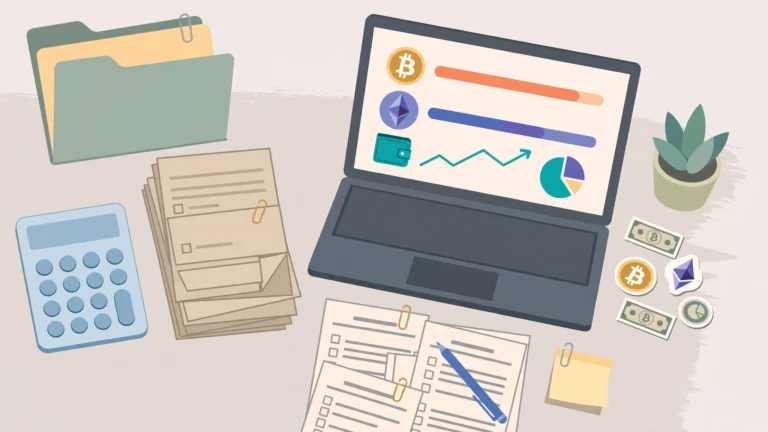
One unglamorous duty rides along with all of it: records. Every purchase, sale, swap and transfer is an event you may need to account for later, including to the tax authorities, whose rules for digital assets are theirs to set and do change over time. Keep the exchange’s statements, note what you paid for each coin and when, and store those records with the same care as the recovery phrase. The investor who cannot reconstruct their own history owns a second, slower problem on top of the market risk – and it is entirely self-inflicted.
A Hypothetical Example: Why the Percentage Is the Protection
The portfolio below is invented, and the price moves are chosen to be harsh on purpose. No returns are being modeled – the example shows what position sizing does to a bad outcome.
Imagine an investor with a total portfolio of $20,000 who decides crypto will be 5% of it: $1,000. The rest sits in diversified funds and cash, following the investor’s ordinary plan.
Now give crypto its bad year. The coins fall by half – a move crypto has made before and will make again. The $1,000 becomes $500. Measured against the whole portfolio, the damage is $500 out of $20,000: 2.5%. Painful, memorable, and entirely survivable; the plan continues, the contributions continue, and the investor can even rebalance calmly.
Now the true worst case: the coins go to zero – the exchange, the project or the market takes everything. The loss is the full $1,000, which is 5% of the portfolio. A bad outcome by any standard, and one that leaves 95% of the plan standing. Run the same disaster at a 50% position instead, and the identical market event costs the investor $10,000 and half their financial life. The coins did not change. The percentage did.
That is the whole mathematics of investing in crypto safely: you cannot control the price, the hackers or the headlines, but the size of the position is decided by you, in advance, in a calm moment. Decide it there – and the worst day in crypto becomes a story you tell, not a hole you climb out of.
The Bottom Line
Crypto cannot be made safe, but a beginner can be kept safe inside it: money whose total loss would not hurt, sized as a small deliberate slice of a portfolio; bought through established, regulated venues; held with the custody rules understood and the seed phrase treated like the money itself; and defended by one simple habit – never moving funds at someone else’s direction.
Do those four things and the remaining risk is the honest one: the price. It will swing harder than anything else you own, and no guide can repeal that. Keep records for taxes from the first purchase, ignore guaranteed returns wherever they appear, and let the size of the position – chosen calmly, in advance – be the thing that lets you watch the swings without becoming one of their casualties.
Disclaimer: This article is for educational purposes only and is not financial, tax, or legal advice. Investing involves risk, including the possible loss of principal. Examples are hypothetical and do not represent actual or future returns. Consider speaking with a qualified financial or tax professional about your own situation.