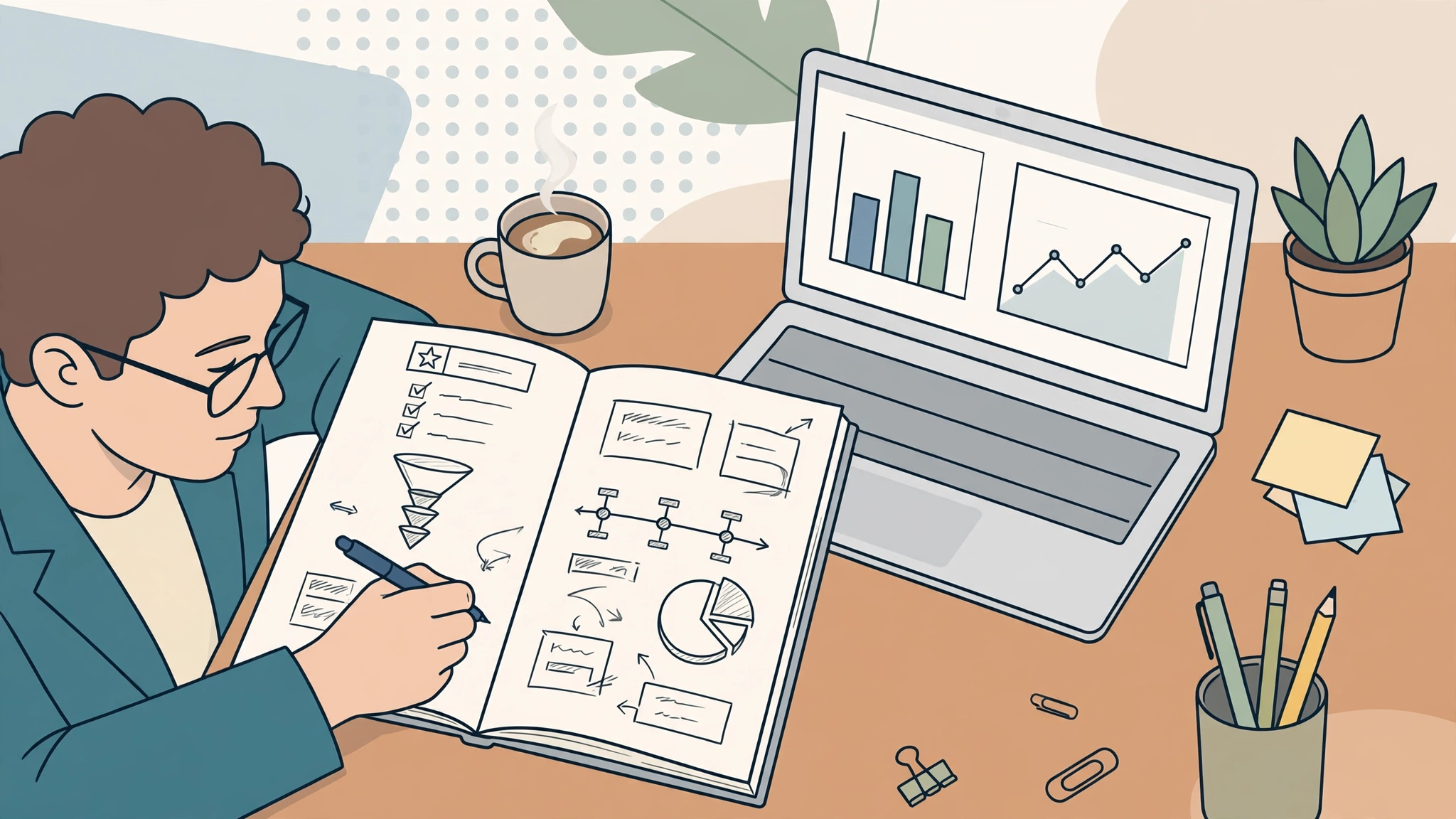
A business plan sounds like homework for bankers, but at its heart it is simply a written answer to a few honest questions: What are you selling? Who will buy it? How will you reach them? And will the numbers work? Knowing how to write a business plan matters whether you are seeking a loan, bringing in a partner, or just trying to keep your own thinking straight. The good news is that a useful plan does not need to be fifty pages long. This guide gives you a simple template that covers everything that matters, section by section.
Why You Need a Business Plan (Even a Short One)
Many founders skip the plan and rely on enthusiasm. Enthusiasm fades; a written plan keeps working. Writing forces you to confront the weak spots in your idea while fixing them is still free. It also gives you a reference point: three months in, you can compare reality with your assumptions and adjust deliberately instead of drifting.
If you ever apply for funding, rent a commercial space, or pitch a partner, a plan is the document they will ask for first. Even a lean five-page plan puts you ahead of most applicants because it shows you have thought about the whole business, not just the product.
How Long Should It Be?
For your own use, one to ten pages is plenty. Lenders and investors may expect more detail, especially in the financial section, but clarity beats length every time. A short plan that is actually used beats a long one gathering dust.
Section 1: Executive Summary
Write this section last, but place it first. In half a page, summarize your entire business: what you sell, who buys it, why it will win, and what you need (if anything) to get started. Think of it as the trailer for a film — it should make the reader want to see the rest.
Example: “BrightNest Cleaning will offer eco-friendly home cleaning in the Austin suburbs. Busy dual-income families already pay premium rates for reliable cleaners; BrightNest wins on vetted staff, easy online booking, and green products. The business launches with two cleaners and reaches profitability in month five.”
Section 2: Business Description
Here you explain the business itself in plain terms:
- What you do — your products or services, described as a customer would understand them.
- The problem you solve — the frustration, cost, or gap that makes people reach for their wallets.
- Your legal structure — sole proprietorship, LLC, or another form, and why you chose it.
- Stage and goals — are you an idea, a side project with sales, or an operating business? What do you want to achieve this year?
Keep the tone factual. This section is not advertising; it is orientation for anyone reading the plan, including future you.
Section 3: Market Analysis
Investors and lenders care about this section because a great product in a shrinking market still struggles. You do not need expensive research — you need honest answers to three questions.
Who Is Your Customer?
Describe your target customer as a specific person, not “everyone.” Where do they live, what do they earn, what do they already buy, and what triggers them to look for a solution like yours? The narrower and clearer this picture, the cheaper your marketing becomes.
How Big Is the Opportunity?
Estimate realistically. If there are 20,000 households in your service area and 10 percent might buy once a year at your price, that is your real ceiling today. Simple math with stated assumptions is more credible than a giant industry figure copied from the internet.
Who Else Is Competing?
List your main competitors, their prices, and their weaknesses. Then state your edge in one sentence: faster, friendlier, more specialized, more convenient — something a customer would actually notice. “Better quality” is not an edge unless you can prove it.
Section 4: Products and Services
Describe each offer, its price, and what it costs you to deliver. If you plan to expand later — new services, a product line, a second location — note the sequence and rough timing. Many growing companies later add AI automation for small businesses at this stage to deliver more without hiring, so it is worth a line in your roadmap if it fits your model.
Be specific about suppliers or tools your delivery depends on, and what you would do if a key one disappeared. A short note here shows maturity and costs you nothing.
Section 5: Marketing and Sales Plan
A brilliant offer that nobody hears about fails quietly. This section explains how customers will find you and how a curious visitor becomes a paying customer.
- Channels — search, social media, referrals, partnerships, local advertising, marketplaces. Pick two or three you can sustain, not ten you will abandon.
- Message — the one result you promise, in the customer’s words, not industry jargon.
- Sales process — inquiry, quote, booking, delivery, follow-up. Note where you will ask for reviews and referrals, because happy customers are your cheapest channel.
- Budget and rhythm — what you will spend monthly, and what you will do weekly. Consistency matters more than intensity.
Section 6: Operations and Team
Explain how the business runs day to day. Who does what? If you are solo, say so, and note which tasks you will outsource (bookkeeping, design, deliveries) and when you expect to hire. Include your location, opening hours, key equipment, and any licenses or insurance you hold. This section reassures readers that the plan survives contact with a normal Tuesday.
Section 7: Financial Plan
Numbers frighten many founders, but a basic financial plan needs only three simple tables, built from honest estimates.
Startup Costs
List everything you must buy or pay for before the first sale: registration, equipment, initial stock, website, deposits. Total it. This is the smallest honest number you need to begin.
Monthly Costs and Break-Even
List fixed monthly costs (rent, software, insurance, phone) and your per-sale costs (materials, fees, delivery). Then calculate break-even: fixed costs divided by the profit you keep from each sale. If your fixed costs are 1,200 a month and you keep 30 per sale, you need 40 sales a month to break even. That single number tells you whether your marketing plan is ambitious enough.
Twelve-Month Forecast
Project sales month by month, starting conservatively. Most new businesses grow gradually, not in a straight line to riches. A forecast that shows a slow first quarter and steady growth looks far more trustworthy than instant success — and it prepares you mentally for the real shape of year one.
A One-Page Version for Busy Founders
If a full plan feels heavy, start with one page containing: your offer in one sentence, your customer in one sentence, your three competitors and your edge, your prices, your monthly costs, your break-even sales number, and your top three actions for the next 90 days. Expand it into the full template when you need funding or a partner. A one-page plan you review monthly is a genuine business tool, not a shortcut.
Common Mistakes to Avoid
Writing it once and never reopening it. Review your plan quarterly and update the numbers; a living document guides decisions. Inventing market numbers. Stated assumptions beat fake precision. Skipping the competition. Claiming you have none signals you have not looked. Forgetting cash timing. Profit on paper is not money in the bank — note when customers actually pay and when bills actually land.
A Worked Mini-Example: The Plan in Action
To see how the pieces fit together, here is a compressed example. Maya wants to open a mobile dog-grooming service. Her executive summary states the offer (grooming at the customer’s home), the customer (busy dog owners in two suburbs), and the goal (profitable within six months, working solo).
Her market section notes roughly 9,000 dog-owning households nearby, two competing salons with three-week waiting lists, and her edge: no travel or waiting for the dog, booked by text message. Her marketing plan leans on a free Google Business Profile, partnerships with two veterinary clinics, and a referral discount. Her financial section lists startup costs of about 2,800 (used grooming equipment, insurance, licenses, basic branding), monthly costs of about 650, and a per-appointment profit of 28 after fuel and supplies. Break-even: roughly 24 appointments a month — six a week — which her marketing plan can plausibly deliver by month three. Her twelve-month forecast grows from 20 appointments a month to 90, at which point she plans to hire a second groomer. Notice what the plan did for Maya: it turned a vague dream into six appointments a week. That is the real purpose of the document.
How to Actually Use Your Plan After Writing It
A plan earns its keep in the months after you write it. Schedule a short monthly review — thirty minutes with your plan and your bank statements. Compare three things: what you expected to sell, what you actually sold, and what you actually spent. Where reality differs, ask why before changing anything; a slow month may reflect seasonality, a weak channel, or a price problem, and each has a different fix.
Update the plan in pencil, not in stone. Change the numbers as you learn, adjust the marketing section when a channel proves itself, and add milestones as you hit them. When you approach a bank or a partner later, this trail of honest updates is more persuasive than any polished first draft, because it proves you run your business with your eyes open.
Finally, share the plan selectively. A mentor, an accountant, or a trusted fellow founder can spot blind spots you cannot see. You do not need to show it to everyone — but one outside reader who asks hard questions will improve it more than another week of solitary polishing.
Where to Find Free Help and Feedback
You do not have to write your plan alone in a vacuum. Small business development centers, chambers of commerce, and public libraries in many regions offer free plan reviews and workshops. Online, founder communities will happily critique a plan if you offer the same in return. Even a friend who runs any kind of business can serve as a first reader — ask them one question: “Where does this stop making sense?” Their answer will point straight at the section that needs another draft. Use these free resources before you ever consider paying a consultant; outside eyes are the cheapest upgrade a plan can get.
Frequently Asked Questions
Do I need a business plan to start a business?
Legally, usually not — but practically, yes. Even a one-page plan clarifies your offer, your costs, and your break-even point, and it becomes essential the moment you want a loan, a lease, or a partner.
How detailed should the financial section be?
Detailed enough to show startup costs, monthly costs, prices, and a twelve-month forecast with stated assumptions. Lenders mainly want to see that the math works and that you understand your break-even point.
Should I pay someone to write my business plan?
Usually not at the start. Consultants can polish a plan, but the thinking is the valuable part, and only you can do it. Write your own first draft with this template, then seek free feedback from a mentor or small business advisor.
The Bottom Line
A business plan is not paperwork for its own sake — it is your idea, tested on paper while testing is cheap. Cover the seven sections honestly: summary, description, market, products, marketing, operations, and financials. Keep it short enough to reread, update it as reality teaches you, and let it steer your next decisions. Founders who plan this way do not avoid surprises, but they meet them prepared.